
Humidity & Condensation Explained
Understanding how moisture moves through industrial buildings — and why controlling air movement matters
Humidity and condensation are often misunderstood within industrial environments. When water appears on ceilings, walls, doors or products, many people assume the problem is temperature. In reality, the underlying cause is frequently the movement of moisture-laden air through the building.
Every industrial building contains moisture. People, products, processes, weather conditions and ventilation systems all influence humidity levels. The challenge is not simply controlling temperature, but controlling where moisture travels and where it eventually condenses.
Understanding how moisture behaves can help explain why some facilities remain stable and dry while others experience dripping ceilings, wet floors, corrosion, mould growth and unnecessary energy costs.

What Is Humidity?
Humidity describes the amount of water vapour suspended within the air. Although invisible, this moisture is constantly moving throughout the building.
Warm air can carry significantly more moisture than cold air. This means two areas of a building can contain very different amounts of water vapour, even if they appear similar at first glance.
As temperatures change, the air's ability to hold moisture changes too. Understanding this simple principle provides the foundation for understanding condensation.

Relative Humidity Explained
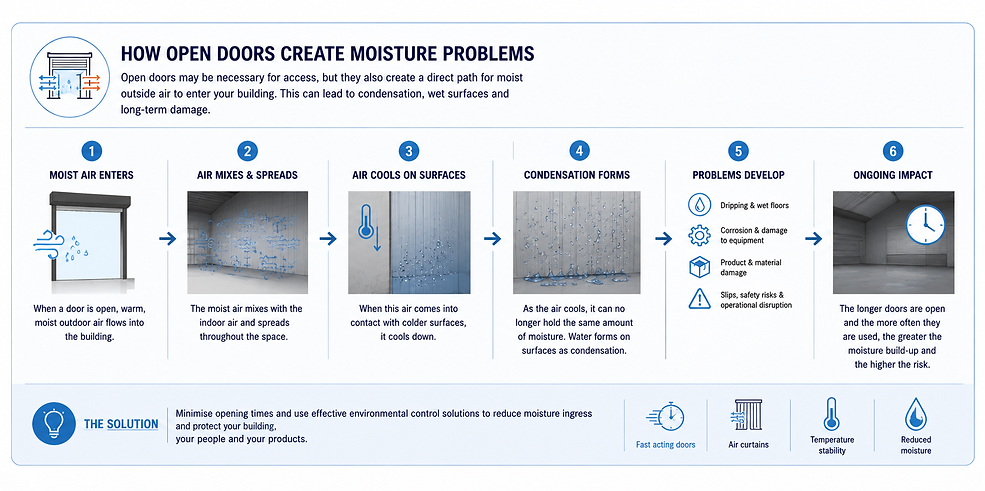
Relative humidity measures how much moisture the air is holding compared with the maximum amount it could hold at that temperature.
This is why humidity readings can change even when no additional water has been introduced. As air warms, its moisture-holding capacity increases. As air cools, that capacity falls.
A relative humidity reading of 70% does not necessarily mean the air contains more water than air at 50%. Temperature plays a major role in determining the result.
Why Condensation Happens
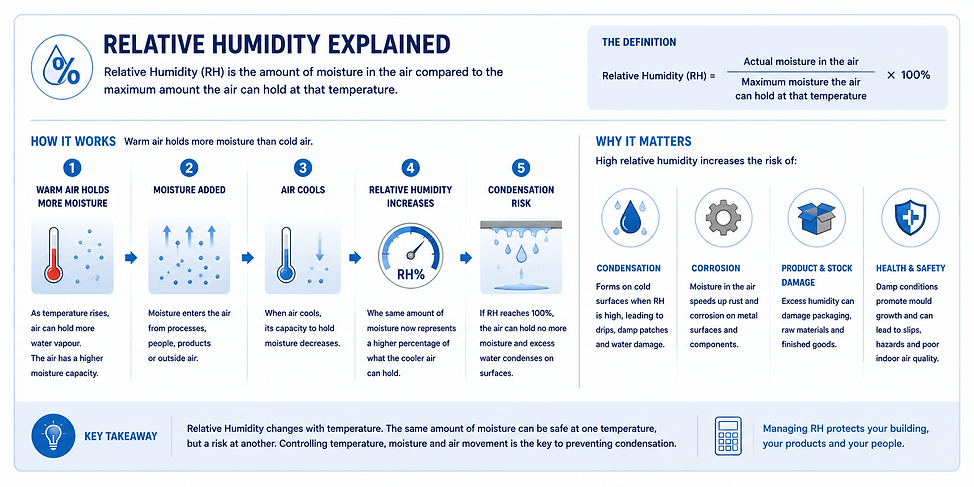
Condensation occurs when warm moisture-laden air encounters a surface that is colder than the surrounding environment.
As the air cools, it loses its ability to retain the same amount of water vapour. The excess moisture is released as liquid water, forming droplets on surfaces.
This can occur on doors, lintels, roof sheets, walls, machinery, products and loading areas. In many cases, the visible water is only the symptom. The root cause is often uncontrolled moisture movement elsewhere in the building.
Related Reading: High Speed Doors
The Dew Point Explained
The dew point is the temperature at which condensation begins to form.
As air temperature falls, the amount of moisture it can hold gradually reduces. Once the dew point is reached, moisture starts to leave the air and collect on nearby surfaces.
Understanding dew point is important because it allows condensation risk to be predicted before visible water appears. This is particularly useful in temperature-controlled environments and facilities with varying internal and external conditions.

How Open Doors Create Moisture Problems
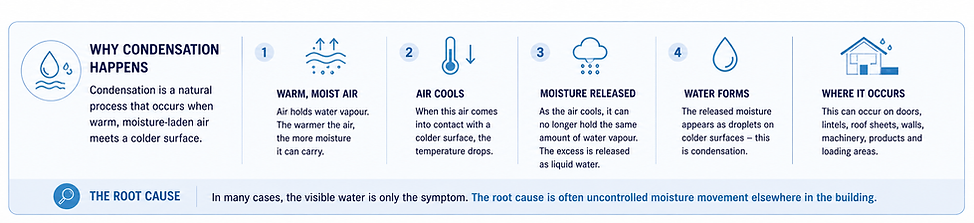
Open doorways do far more than allow temperature transfer. They also allow moisture transfer.
When warm humid air enters a cooler environment, significant quantities of moisture can be introduced into the building. This moisture may remain invisible initially before eventually condensing on colder surfaces.
In many industrial environments, humidity problems originate at openings rather than within the conditioned area itself. Reducing exposure time and controlling air movement can therefore play a major role in reducing condensation.
Related Reading: Heat Loss Through Open Doors
Condensation Risk Zones
Condensation rarely forms uniformly throughout a building. Certain areas are naturally more vulnerable than others.
Common risk zones include door openings, loading bays, corners, roof structures, cold surfaces, external walls and areas with restricted airflow.
Understanding where condensation is most likely to occur can help identify opportunities to improve environmental control and reduce maintenance issues.

Signs You May Have a Humidity Problem
Humidity issues are often recognised long before measurements are taken.
Dripping ceilings, wet floors, corrosion, mould growth, damaged packaging, fogging, condensation on doors and inconsistent environmental conditions can all indicate excessive moisture movement.
Because these symptoms develop gradually, they are frequently accepted as normal operating conditions when, in reality, opportunities for improvement may exist.
Related Reading: Air Curtains

Moisture Has Energy
One of the most overlooked aspects of humidity is that moisture carries energy.
When warm humid air enters a conditioned environment, it does not simply introduce water vapour. It also introduces latent heat energy. Before environmental conditions can return to normal, this energy often needs to be removed by heating, cooling or refrigeration systems.
This means humidity control is not only about comfort, condensation or product protection. It can also have a direct influence on energy consumption and operating costs.
Related Reading: Request Your ROI

Managing Humidity & Condensation
Humidity and condensation are often treated as isolated problems, but they are usually symptoms of a wider environmental issue. Moisture enters buildings through open doorways, air leakage, ventilation systems and everyday operational activities. Once inside, that moisture can condense on colder surfaces, creating wet floors, corrosion, product damage and poor working conditions.
Effective humidity control is rarely achieved through a single solution. It typically requires a combination of reducing moisture ingress, managing air movement, maintaining appropriate pressure balance and minimising the amount of time openings remain exposed. By understanding how moisture moves through a building, it becomes possible to tackle the root cause rather than simply dealing with the visible effects.
The process illustrated below provides a practical framework for identifying, controlling and monitoring moisture-related risks. Whilst every facility is different, the underlying principles remain the same: reduce uncontrolled air exchange, maintain stable environmental conditions and monitor performance over time.
Moisture problems rarely develop overnight. They often begin as minor signs such as occasional condensation, damp patches or fluctuating humidity levels before gradually affecting products, equipment and building fabric.
Regular monitoring of humidity, temperature, dew point and door exposure times can help identify issues before they become costly. In many industrial environments, improving environmental control not only reduces condensation risk but can also contribute towards lower energy consumption, improved product protection and a more comfortable working environment.
Understanding the relationship between moisture, air movement and energy use is often the first step towards creating a more efficient and reliable facility.

Final Thoughts
Condensation is rarely the problem itself. More often, it is evidence of moisture movement occurring elsewhere within the building.
By understanding humidity, dew point, air movement and exposure time, it becomes easier to identify the root causes of environmental instability and implement practical solutions.
Whether the objective is reducing condensation, improving product quality, enhancing environmental control or lowering energy costs, managing moisture movement is often a critical part of the solution.
Related Reading: Energy Saving Knowledge Hub