
How Much Energy Do Open Industrial Doors Waste?
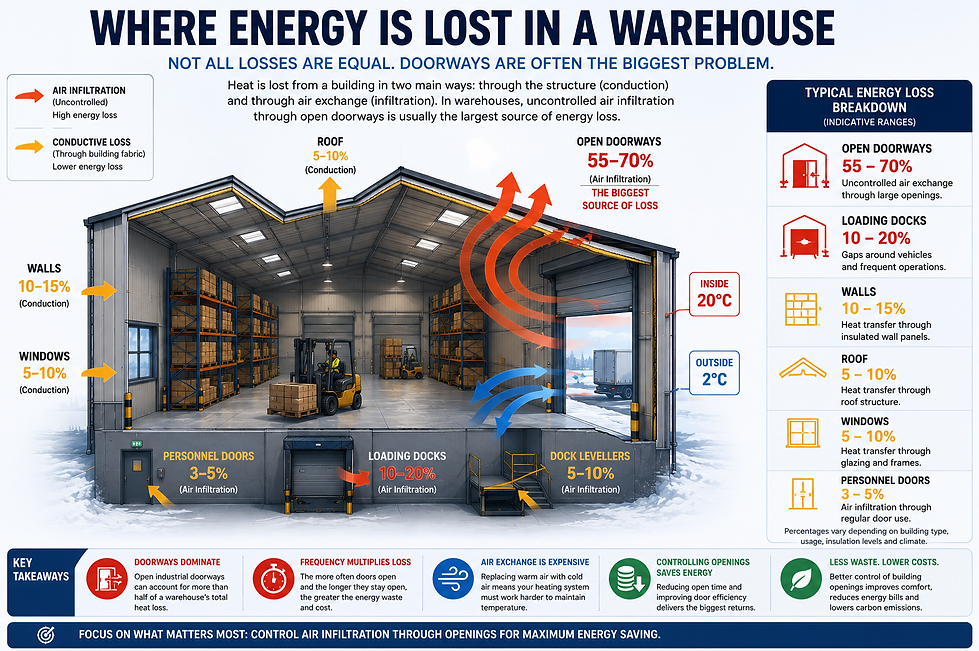
In many industrial and warehouse environments, one of the largest causes of uncontrolled heat loss is not the walls, roof or windows — it is the doorway.
Every time an industrial door opens, heated or cooled air begins to escape almost immediately. In busy warehouses, manufacturing facilities and temperature-controlled buildings, this process can happen hundreds of times every day.
The result is often significant:
🟢 Increased heating costs
🟢 Unstable temperatures
🟢 Uncomfortable working conditions
🟢 Condensation problems
🟢 Increased energy consumption
🟢 Greater strain on HVAC systems
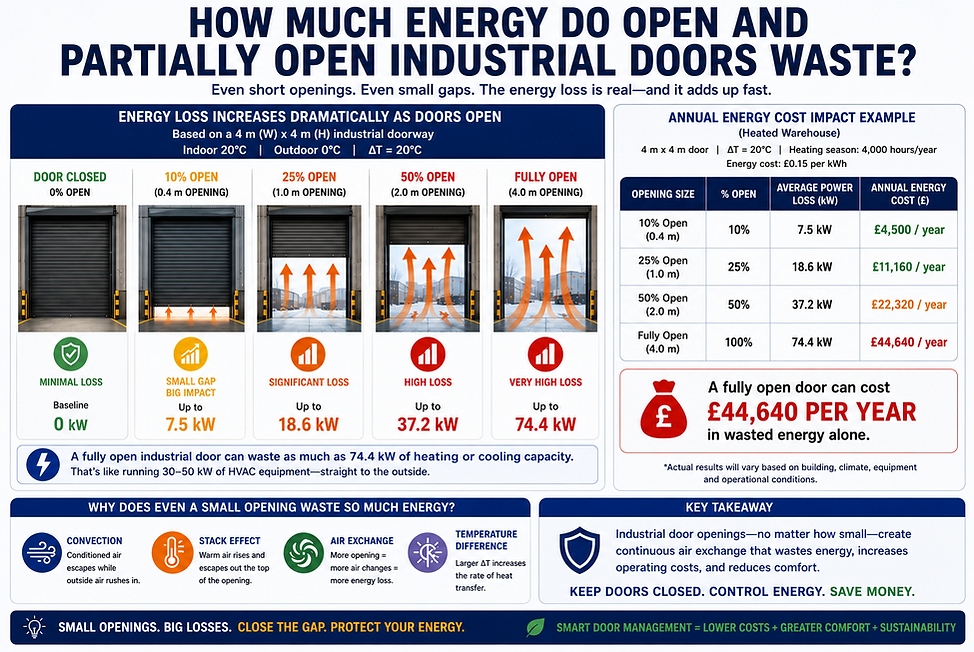
What many businesses underestimate is just how much energy can be lost through open and partially open industrial doors over time. Even openings that are only partially open can allow large volumes of conditioned air to escape.
This guide explains:
🟢 How industrial doorway heat loss occurs
🟢 Why open doors waste so much energy
🟢 The difference between open and partially open openings
🟢 How heat loss is calculated
🟢 The effect of forklift traffic and repeated door cycles
🟢 Why opening speed matters
🟢 How businesses reduce energy waste in high-traffic openings
The aim is to provide a practical understanding of industrial doorway energy loss and the operational factors that influence it. In many industrial and warehouse environments, relatively small reductions in opening exposure time can contribute towards worthwhile long-term energy reductions. You can read more about potential operational and financial benefits on our ROI Savings page.
Why Open Industrial Doors Cause Significant Heat Loss
Heat naturally moves from warm areas to colder areas.In industrial buildings, this becomes particularly important because door openings are often large, frequently used and exposed to external conditions.
When a warehouse or production facility is heated during colder months, warm internal air continually tries to escape through any available opening. At the same time, colder external air enters the building to replace it. This process is known as air infiltration. Unlike heat transfer through insulated walls or roofs, open doorways allow unrestricted air movement. As a result, the rate of energy loss can increase dramatically whenever a door is opened.
Large industrial openings accelerate this process because:
🟢 Warm air rises naturally
🟢 Pressure differences draw air through the opening
🟢 Forklift movement creates additional air turbulence
🟢 Repeated door cycling prevents temperature stabilisation
🟢 Larger openings allow greater volumes of air to be exchanged
In many warehouses, loading bays and production facilities, doorway heat loss can exceed losses through the building fabric itself.
The Difference Between Closed, Partially Open and Fully Open Doors
One common misconception is that a partially open industrial door only loses a small amount of energy.
In reality, partially open doorways can still allow substantial heat transfer and air movement.
This is particularly true in:
🟢 Forklift access routes
🟢 Loading bay openings
🟢 Temperature-controlled production areas
🟢 Cold storage facilities
🟢 Chilled distribution environments
A fully closed insulated industrial door acts as a barrier between internal and external environments. However, once the opening is exposed, air movement begins immediately.
Even a relatively small opening can create:
🟢 Rapid heat escape
🟢 Cold air infiltration
🟢 Draughts
🟢 Pressure imbalance
🟢 Moisture ingress
🟢 Airborne contamination transfer
The larger the opening and the longer it remains open, the greater the energy loss becomes.
Partially open industrial doors often remain open for extended periods during loading operations or forklift movement. Over the course of a working day, these periods can accumulate into hours of uncontrolled energy loss.

Why Warehouses Experience High Levels of Doorway Energy Loss
Warehouses and logistics facilities are particularly vulnerable to heat loss through industrial doors because they typically combine:
🟢 Large openings
🟢 High traffic levels
🟢 Frequent vehicle movement
🟢 Long opening durations
🟢 Significant internal volume
🟢 Repeated shift patterns
Many distribution centres operate continuously throughout the day, with industrial doors opening repeatedly for:
🟢 Forklifts
🟢 Pallet movement
🟢 Deliveries
🟢 Dispatch operations
🟢 Internal traffic routes
🟢 Pedestrian access
In some facilities, doors may cycle hundreds of times per shift.
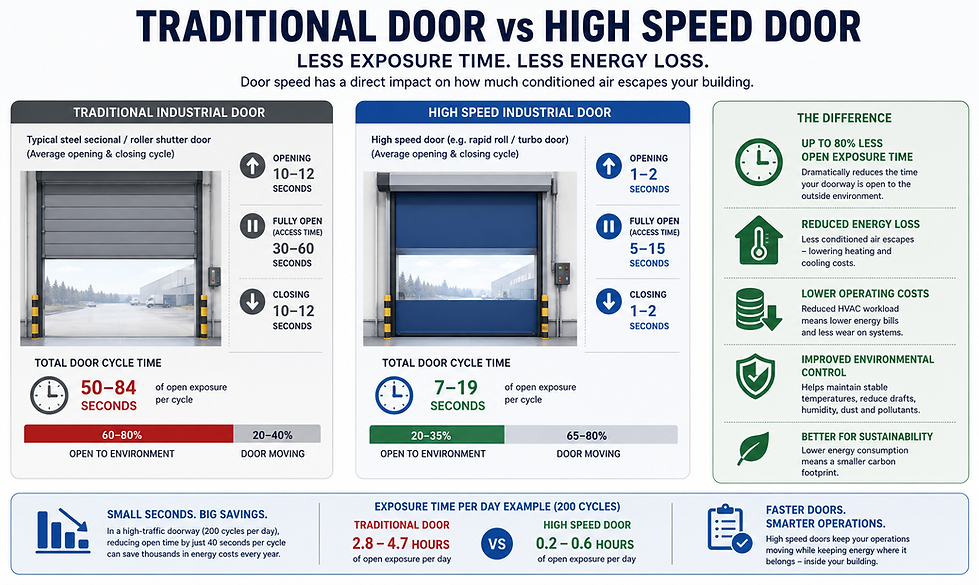
Traditional industrial shutters and sectional doors can sometimes remain open for long periods simply because opening and closing speeds are relatively slow. This encourages operators to leave openings exposed for convenience. Unfortunately, prolonged open times can create major energy losses, particularly during winter months or within temperature-controlled environments.

The Effect of Temperature Difference (ΔT)
The greater the temperature difference between internal and external environments, the greater the rate of heat transfer.
This temperature difference is commonly referred to as ΔT (delta T).
For example:
🟢 A warehouse maintained at 18°C
🟢 An external temperature of 2°C
This creates a temperature difference of 16°C.
As this temperature difference increases, warm air escapes more rapidly through open doorways.
This becomes especially important in:
🟢 Heated warehouses
🟢 Food production facilities
🟢 Pharmaceutical environments
🟢 Cold storage areas
🟢 Chilled processing rooms
In cold room applications, temperature differences may exceed 25°C, dramatically increasing the rate of energy transfer whenever a doorway opens.

How Heat Transfer Through Industrial Doors Is Calculated
Heat transfer through building elements is often expressed using a simplified formula:
Q=A×U×ΔTQ = A \times U \times \Delta TQ=A×U×ΔT
Where:
🟢 Q = Heat transfer
🟢 A = Area of the opening
🟢 U = Thermal transmittance (U-value)
🟢 ΔT = Temperature difference
This equation is useful for understanding conductive heat transfer through closed building materials.
However, open industrial doors introduce a much larger factor: air exchange. When a doorway is open, heated or cooled air physically leaves the building and is replaced by external air. This form of heat loss can rapidly exceed conductive losses through insulated walls and doors. For this reason, opening time is often one of the most important factors affecting industrial building energy efficiency.
For example, a frequently used 6m x 6m warehouse opening experiencing a temperature differential of 15°C and moderate airflow conditions could potentially lose many thousands of kWh of energy each year if left exposed for extended periods. If operational improvements or faster acting doors reduced average open time from 60 minutes per day to 15 minutes per day, annual heat loss could theoretically reduce from approximately 81,250 kWh to around 20,313 kWh — a potential reduction of over 60,000 kWh per year.
In many cases, the cumulative reduction in heat loss can become commercially significant over time, particularly on frequently used openings. Our Payback Period page explains how reduced opening times and improved environmental control can influence long-term return on investment.

Why Door Opening Times Matter
The amount of energy lost through an industrial doorway is heavily influenced by:
🟢 How often the door opens
🟢 How long the opening remains exposed
🟢 The size of the opening
🟢 Traffic frequency
🟢 External conditions
A large industrial opening left open for several minutes can exchange enormous volumes of internal air.
In high-traffic environments, this process repeats continuously throughout the day.
For example:
🟢 A 6m × 6m warehouse opening
🟢 Opened repeatedly during loading operations
🟢 During winter conditions
may lose significant quantities of heated air every hour.
Even reducing average opening time by a few seconds per cycle can substantially reduce overall energy consumption across a year.
This is one reason why opening speed and automatic closing behaviour are increasingly important in modern industrial facilities.

Fork Lift Traffic and Air Movement
Forklift traffic can significantly increase air movement through industrial openings. As forklifts travel through a doorway, they physically displace air and create turbulence around the opening.
This increases:
🟢 Heat escape
🟢 Cold air infiltration
🟢 Dust movement
🟢 Airborne contamination transfer
🟢 Humidity movement
In temperature-controlled environments, forklift traffic can rapidly destabilise internal conditions. Busy warehouse openings may experience almost continuous air exchange during operational periods.
This is particularly problematic where:
🟢 Chilled storage connects to ambient warehouse areas
🟢 Production areas require temperature consistency
🟢 Clean manufacturing environments require environmental separation
🟢 External openings are exposed to wind pressure

Wind Pressure and External Openings
External industrial doors are also affected by wind pressure.
Wind striking the outside of a building can force external air into the opening while simultaneously drawing internal air outward.
This effect increases significantly with:
🟢 Larger openings
🟢 Exposed building elevations
🟢 Coastal locations
🟢 Elevated sites
🟢 Distribution centres with large loading areas
Even when external temperatures are relatively mild, wind-driven air movement can increase overall energy consumption.
This is one reason why environmental control is often more difficult around loading bays and high-traffic warehouse entrances.

Cold Storage and Chilled Environments
In cold storage applications, open doorway energy loss becomes even more critical.
Whenever a cold room door opens:
🟢 Warm external air enters
🟢 Moisture enters the environment
🟢 Condensation risk increases
🟢 Ice formation may occur
🟢 Refrigeration systems work harder
The larger the temperature difference, the faster this process occurs.
Repeated doorway exposure in cold storage facilities can lead to:
🟢 Unstable temperatures
🟢 Increased running costs
🟢 Reduced refrigeration efficiency
🟢 Product quality concerns
🟢 Hygiene complications
For this reason, cold storage environments often place strong emphasis on:
🟢 Rapid opening and closing speeds
🟢 Controlled opening durations
🟢 Reliable environmental separation
🟢 Reduced air infiltration

Why Partially Open Doors Still Waste Energy
Partially open industrial doors are often assumed to be an acceptable compromise between access and energy control.
However, even partially exposed openings can create significant airflow. Warm air does not require a fully open doorway to escape.
In many cases:
🟢 Upper opening gaps allow warm air to escape
🟢 Lower gaps allow cold air to enter
🟢 Pressure differences continue driving airflow
🟢 Turbulence continues around moving traffic
This means that a partially open industrial door may still generate considerable energy loss over time.
In busy environments, maintaining partial openings throughout the day can produce surprisingly high cumulative heat loss.

The Importance of Environmental Separation
Modern industrial buildings increasingly focus on environmental separation.
This means controlling:
🟢 Temperature
🟢 Airflow
🟢 Humidity
🟢 Dust movement
🟢 Insects
🟢 Airborne contamination
Doorways are one of the most vulnerable parts of any industrial environment because they temporarily break the separation between spaces.
Reducing uncontrolled open time helps maintain:
🟢 More stable internal conditions
🟢 Improved working comfort
🟢 Reduced HVAC demand
🟢 Lower heating and cooling costs
🟢 Improved operational efficiency
This is particularly important in:
🟢 Food production
🟢 Pharmaceuticals
🟢 Logistics
🟢 Manufacturing
🟢 Clean production areas
🟢 Temperature-sensitive environments

Why Door Speed Can Influence Energy Efficiency
Industrial door opening speed can have a major influence on cumulative heat loss. Traditional industrial doors may take considerable time to fully open and close. During this period, the opening remains exposed.
In high-frequency environments, reducing opening duration can help reduce:
🟢 Heat escape
🟢 Air infiltration
🟢 Environmental instability
🟢 Unnecessary HVAC load
This is one reason why many modern warehouse environments use high speed industrial doors in high-traffic locations.
By reducing the amount of time an opening remains exposed, businesses can improve environmental control and reduce unnecessary energy loss.

Understanding The Long Term Impact
Doorway energy loss is often underestimated because the losses occur gradually throughout the working day.
However, when repeated over:
🟢 Hundreds of door cycles
🟢 Multiple shifts
🟢 Changing seasons
🟢 Large industrial openings
the cumulative effect can become substantial.
Reducing unnecessary open time may contribute towards:
🟢 Lower heating costs
🟢 Reduced refrigeration demand
🟢 Improved environmental control
🟢 Greater workplace comfort
🟢 Improved operational efficiency
🟢 Reduced energy consumption
For many facilities, industrial door performance forms an important part of wider energy management strategies.
Conclusion
Open and partially open industrial doors can contribute significantly to heat loss, air infiltration and environmental instability within industrial buildings. In warehouses, production facilities and temperature-controlled environments, repeated doorway exposure can increase heating and cooling demand far more than many operators realise.
The amount of energy lost depends on several factors, including:
🟢 Opening size
🟢 Opening duration
🟢 Traffic frequency
🟢 Temperature difference
🟢 Air movement
🟢 External conditions
Even relatively small reductions in open door time can help improve energy efficiency over the long term. As industrial buildings place greater emphasis on sustainability, environmental control and operational efficiency, understanding doorway heat loss is becoming increasingly important.
Businesses reviewing industrial door performance often consider:
🟢 Opening speed
🟢 Insulation
🟢 Traffic flow
🟢 Environmental separation
🟢 Automation
🟢 Operational frequency
as part of wider efforts to reduce unnecessary energy consumption and improve building efficiency.
Every building operates differently, and actual savings will depend upon factors such as opening size, traffic intensity, operating hours and temperature differential. If you would like to assess the potential savings for your own operation, please visit our Request Your ROI page.

Practical Advice and Guidance
Understanding heat loss within an industrial building is often the first step towards improving overall energy efficiency and operational performance.
In many cases, significant energy loss occurs through frequently used openings, uncontrolled airflow and poor environmental separation — particularly within warehouses, factories and loading areas.
The good news is that meaningful improvements do not always require major structural changes. Practical measures such as high speed doors, improved airflow control, better sealing and environmental separation can often deliver measurable long-term benefits.
Every building operates differently, and the most effective solution will depend upon factors such as traffic levels, operating temperatures, workflow and the overall use of the space.
We are always happy to offer practical advice and guidance, whether you are reviewing a specific opening, trying to reduce energy loss or simply looking to better understand how heat is escaping from your building.
If you would like to discuss your application, arrange a site visit or request further information, please contact us.

Energy Saving Doors
25 Britannia Square
Worcester
Worcestershire
WR1 3DH
United Kingdom
+44 1905 317878