
High Speed Doors for Industrial & Commercial Applications
High speed doors are fast-acting industrial doors designed to improve efficiency, reduce heat loss and support high-traffic environments. Widely used in warehouses, manufacturing facilities and distribution centres, they provide a reliable solution for maintaining internal conditions while ensuring smooth workflow.
By opening and closing rapidly, high speed doors minimise air exchange, helping to reduce energy costs and improve overall building performance. Whether installed internally or externally, they are a practical upgrade for any high-traffic opening.
High speed doors are now widely used across warehouses, logistics facilities, production areas, temperature-controlled environments and manufacturing buildings where operational efficiency, environmental control and energy reduction are important considerations. Different high speed door types are suited to different applications, ranging from internal warehouse divisions through to heavily exposed external openings.

What Are High Speed Doors?
High speed doors are fast-acting industrial doors specifically designed for environments where openings are used frequently throughout the day. Unlike traditional roller shutters, they operate at significantly higher speeds, reducing the amount of time a doorway remains open.
This rapid operation helps to maintain internal temperatures, improve efficiency, and reduce unnecessary energy loss. Also referred to as rapid roll doors, high speed doors are typically used in areas where traffic flow, environmental control, and reliability are critical particularly in warehouse environments and industrial applications.
High speed doors are typically constructed using durable fabric or insulated curtain systems, combined with robust guide tracks and high-performance drive units. This enables the doors to open up to 1,000mm/s. They are designed for high-frequency operation, making them suitable for environments where doors may open and close hundreds of times per day.
Unlike conventional doors, they are engineered to balance speed with reliability, ensuring consistent performance even in demanding industrial conditions. This makes them particularly effective in maintaining controlled environments while supporting continuous operational flow.

Different types of high-speed doors are designed to suit specific environments, depending on factors such as traffic levels, exposure to weather and temperature-control requirements.
🟢 External High-Speed Doors
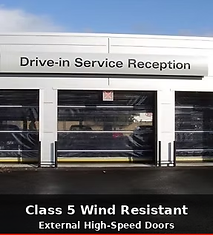
Designed for exposed openings, these doors are built to withstand wind and weather while maintaining speed and reliability.
🟢 Internal High-Speed Doors
Ideal for separating different zones within a building, helping to control temperature, airflow and cleanliness.
🟢 Cold Room High-Speed Doors
Specialist solutions designed for chilled and freezer environments where temperature stability is critical.
🟢 High-Speed Insulated Steel Doors
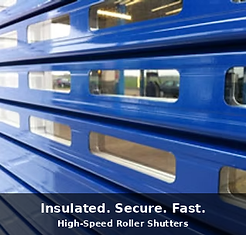
Designed for applications requiring both speed and insulation, these doors combine high operating speeds with excellent thermal performance.
🟢 Rapid Roll / Fabric Doors
Lightweight, flexible doors designed for high-cycle use, often featuring self-repairing curtains for durability in busy areas.
Selecting the right type depends on your specific operational requirements, traffic levels and environmental conditions.
Each type of high-speed door is designed with specific performance characteristics in mind. External doors typically offer enhanced wind resistance and durability, while internal doors focus on speed and smooth operation. Insulated doors provide improved thermal performance, making them suitable for temperature-sensitive environments.
By selecting the correct type for each opening, businesses can maximise both efficiency and longevity of the installation.
Not sure if a high-speed door is right for your application? For lower-usage or security-focused openings, a roller shutter door may be a more suitable option.
Types of High Speed Doors


Choosing the Right Type of High Speed Door
No single high speed door is suitable for every industrial environment.
Some applications prioritise speed and traffic flow, whilst others require improved thermal separation, resistance to wind loading, hygiene control or higher levels of physical security.
For example, internal openings within busy warehouses may benefit from lightweight rapid-roll solutions designed for fast cycling and environmental separation, whereas exposed external openings may require a more robust high speed door system with greater wind resistance.
Similarly, temperature-controlled environments such as cold stores and chilled production areas often require specialist insulated door systems designed to reduce heat transfer and minimise air leakage.
Different styles of high speed door can therefore be selected depending upon the operational priorities of the building.

Where Are High Speed Doors Used?
High-speed doors are typically constructed using durable fabric or insulated curtain systems, combined with high-performance motors designed for frequent operation. They are widely used across a range of industries where efficiency and environmental control are important:
🟢 Warehouses and distribution centres
🟢 Manufacturing and production facilities
🟢 Food processing and hygiene-sensitive environments
🟢 Cold storage and temperature-controlled areas
🟢 Logistics and high-traffic loading bays
See how our doors perform in real-world environments. In each of these settings, high-speed doors help to reduce delays, improve working conditions and maintain consistent internal environments.
In many of these environments, doors are in constant use throughout the day, making speed and reliability essential to maintaining efficient operations. High-speed doors are widely used in warehouses where speed, energy efficiency and workflow are critical. Learn more about our warehouse high-speed doors.
In addition to these core applications, high-speed doors are also used in pharmaceutical facilities, automotive plants and retail distribution centres where environmental control and operational efficiency are critical.
Their flexibility allows them to be installed in both new-build and retrofit projects, making them a practical solution for businesses looking to upgrade existing door systems without major structural changes.
For more specific applications, explore our solutions for warehouse environments, cold storage and food production facilities.


Key Benefits of Industrial High Speed Doors
High-speed doors offer a range of practical benefits for industrial and commercial buildings:
🟢 Reduce Heat Loss and Energy Costs: By limiting air exchange between different environments.
🟢 Improve Workflow Efficiency: Particularly in busy, high-traffic areas.
🟢 Maintain Internal Temperatures: Helping to provide better environmental control.
🟢 Enhance Safety: With built-in safety features and soft curtain designs.
🟢 Reduce Draughts and Airborne Contamination: Helping to maintain cleaner and more controlled environments.
🟢 Minimise Downtime: Through fast operation and self-repairing options.
These benefits make high-speed doors particularly effective in busy industrial environments where efficiency and environmental control are critical. In busy environments, even small improvements in door performance can lead to significant long-term savings and operational gains.
For environments where airflow control is critical, high-speed ZIP doors provide one of the most effective solutions.
In many industrial environments, door performance is often overlooked as a factor in overall efficiency. However, where openings are used frequently, the speed and reliability of the door can have a direct impact on both energy consumption and productivity.
Reduce heat loss and improve thermal efficiency with our high-speed insulated roller shutters, ideal for temperature-controlled environments.
High-speed doors help to reduce delays, minimise temperature fluctuations and support smoother movement of goods and personnel. Over time, these improvements contribute to lower operating costs and a more efficient working environment.

Environmental Control & Airflow Reduction
High-speed doors are frequently used as part of a wider environmental control strategy within industrial buildings.
By reducing the amount of time an opening remains exposed, they can help to:
🟢 Reduce uncontrolled airflow
🟢 Minimise draughts
🟢 Improve temperature stability
🟢 Reduce airborne dust and pollution transfer
🟢 Support cleaner internal working environments
In some applications, high-speed doors may also be combined with additional environmental control measures such as air curtains, insulated door systems or improved building envelope performance.
When assessing energy performance, factors such as air leakage, door speed, usage frequency and overall thermal separation are often just as important as insulation values alone.

Why High Speed Doors Improve Energy Efficiency
One of the biggest sources of energy loss in industrial buildings is uncontrolled air movement through frequently used door openings.
Every time a door is opened, warm air escapes and cold air enters, forcing heating systems to work harder to maintain internal temperatures. This can result in significant energy waste.
Energy saving high speed doors address this problem by reducing the time an opening is exposed. Their rapid operation and effective sealing help to maintain stable internal conditions, reducing the load on heating and cooling systems. Over time, this leads to lower energy costs, improved efficiency, and better overall control of the internal environment.
In high-traffic environments, even small reductions in door open time can lead to noticeable energy savings. By limiting the exchange of air between internal and external environments, high speed doors help maintain more stable temperatures and reduce the demand placed on heating and cooling systems.
This not only improves energy efficiency but also contributes to a more comfortable working environment and better protection for temperature-sensitive goods.

Understanding Potential Energy Savings
In many applications, reducing open-door exposure time can contribute towards measurable reductions in heat loss and energy consumption.
For this reason, many businesses now assess high speed doors not simply as an operational upgrade, but as part of a wider energy efficiency strategy with a potentially measurable return on investment.
Where required, energy saving calculations and ROI assessments can also be undertaken based upon individual site conditions.
Every industrial building operates differently, and the potential savings achieved from a high-speed door installation will vary depending upon:
🟢 Operating hours
🟢 Traffic frequency
🟢 Internal and external temperatures
🟢 Existing door performance
🟢 Airflow conditions
🟢 Opening size
In many applications, reducing open-door exposure time can contribute towards measurable reductions in heat loss and energy consumption.
For this reason, many businesses now assess high-speed doors not simply as an operational upgrade, but as part of a wider energy-efficiency strategy with a potentially measurable return on investment.
Where required, energy-saving calculations and ROI assessments can also be undertaken based upon individual site conditions.

High Speed Door Servicing & Legal Requirements
High-speed doors are designed for performance, but like any mechanical system they require regular servicing to remain safe, efficient and compliant with current legislation.
Under UK health and safety regulations, industrial doors must be maintained in a safe working condition. This places a clear responsibility on the building owner or operator to ensure that high-speed doors are regularly inspected, serviced and documented.
Regular servicing not only helps you meet your legal obligations, it also ensures that your doors continue to operate at peak efficiency—reducing downtime, preventing costly breakdowns and maintaining energy performance.
What Are Your Legal Obligations?
All industrial doors, including high-speed doors, fall under workplace safety legislation such as the Provision and Use of Work Equipment Regulations (PUWER). This requires that:
🟢 Doors are maintained in a safe condition
🟢 Regular inspections are carried out by a competent person
🟢 Any faults are identified and rectified promptly
🟢 A documented maintenance record is kept
Failure to comply can result in enforcement action in the event of an accident.
For a full explanation of your obligations, please refer to our High-Speed Door Legal Requirements Guide..
What Happens During A Service Visit?
A typical high-speed door service is a comprehensive inspection of all key components to ensure safe and reliable operation.
This will generally include:
🟢 Full check of door operation and cycle performance
🟢 Inspection of curtain, guides and structural components
🟢 Testing of safety devices (photocells, safety edges and sensors)
🟢 Checking motor, drive system and control panel
🟢 Inspection of fixings and mounting points
🟢 Adjustment and lubrication of moving parts
🟢 Identification of wear or potential faults
For a breakdown of what is undertaken during maintenance, please see our High-Speed Door Servicing page.
Following the visit, you will receive a clear report outlining the condition of the door and any recommended actions.
Why Regular Servicing Matters
🟢 Maintain compliance with health and safety legislation
🟢 Reduce downtime and unexpected failures
🟢 Extend the lifespan of your doors
🟢 Protect staff and site safety
🟢 Preserve energy-efficiency performance

High Speed Doors Supply & Installation
We specialise in the supply and installation of high speed doors across the UK, supporting industrial and commercial environments where efficiency, durability and reliability are critical.
With extensive experience in warehousing, manufacturing and logistics, we understand the practical challenges of high-traffic openings and temperature control. Our approach is based on real-world performance — not theory. We provide clear, practical advice and recommend solutions that deliver long-term operational benefits.
Why Work With Us?
🟢 In-House UK Manufacturing: With all key suppliers based locally in the West Midlands.
🟢 Proven at Scale: With hundreds of high-speed doors installed across a wide range of industries.
🟢 Trusted by the Trade: With a significant proportion of our production supplied to industrial door professionals.
🟢 Designed for Real-World Performance: Refined through continuous use in demanding environments.
🟢 Tailored Solutions: Designed to meet your exact operational and environmental requirements.
🟢 UK-Wide Supply & Installation: High-speed door solutions supplied and installed throughout the UK.
🟢 Extensive Industry Experience: Across warehouse, manufacturing and logistics environments.
🟢 Clear, Straightforward Technical Advice: Helping you select the right solution for your application.
🟢 Focus on Energy & Efficiency: Helping to reduce heat loss and improve operational efficiency.
🟢 Complete Project Support: From initial survey through to installation and aftercare.
With a large installed base of high-speed doors across the UK, we have delivered solutions across a wide range of demanding environments. You can explore our recent installations in the High-Speed Door Gallery to see how these systems perform in real-world applications.

Understanding Potential Operational Benefits
Every industrial building operates differently, and the most suitable high speed door solution will depend upon the operational requirements of the site.
For some businesses, the priority may be improving workflow and traffic flow. For others, the focus may be reducing uncontrolled airflow, improving environmental separation or lowering energy loss through frequently used openings.
In many applications, a properly specified high speed door can contribute towards measurable operational and energy-saving improvements.
If you would like to see how these principles apply in real-world environments, you may wish to review our case study examples or learn more about potential ROI savings and payback periods associated with high speed door installations.
We are also happy to assess your application and provide guidance on the most suitable solution for your building, traffic levels and environmental requirements.
Energy Saving Doors
25 Britannia Square
Worcester
Worcestershire
WR1 3DH
United Kingdom
+44 1905 317878