
A Case Study & Typical Timelines
Evaluating Cost Savings with High‑Speed Doors
The first step for a manufacturing company considering upgrading to high‑speed doors is recognising where the biggest losses and savings lie. In many UK industrial buildings, large doorways—such as loading bays, warehouse entrances and internal segregation points—are major sources of energy waste. Each time a conventional industrial door remains open or moves slowly, conditioned air (heated or cooled) escapes and external air enters, forcing HVAC systems to work harder.
The facility’s energy manager will begin by gathering baseline data: monthly energy bills, heating/cooling usage during peak and off‐peak periods, frequency of door openings, traffic flows in and out of key entrances, indoor vs outdoor temperature differentials, and any complaints about thermal comfort or drafts. Simultaneously, a walk‑through audit of door zones is conducted: how many times the doors open per hour, how long they remain open, how well seals perform, any visible damage or draft paths, and the age/condition of existing doors.
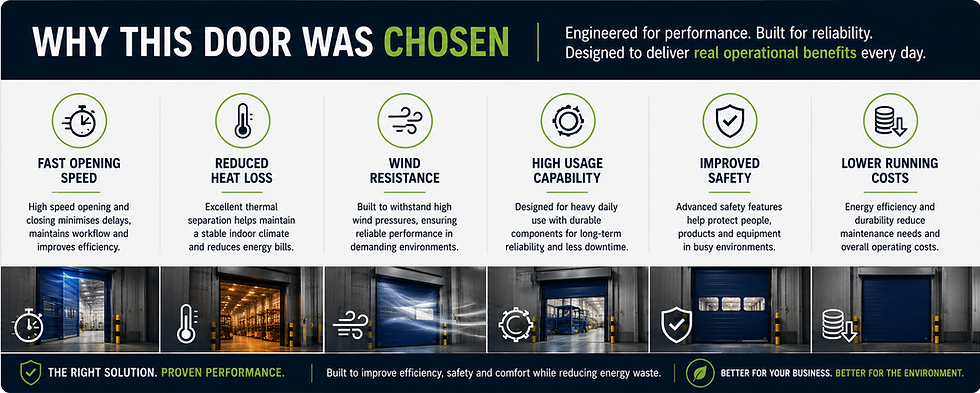
With this data, the company can estimate potential savings from replacing conventional doors with rapid‐action, high-speed doors such as a Zip Door. These doors open and close faster, reducing open time, they typically have better sealing and insulation, and they can be automated or sensor‐operated to reduce human error in leaving doors open. The cost savings might be estimated by modelling the reduction in air-exchange rates, improved thermal control, lower heating/cooling demand, and improved production/throughput from faster door cycles.
For example, if the audit reveals that a loading bay door remains open for an average of 30 seconds per cycle and cycles 200 times per day, switching to a high-speed Zip Door that reduces open time to 10 seconds could cut 20 seconds * 200 = 4,000 seconds (≈ 66 minutes) of open time each day. With known airflow and temperature differential data, that can equate to a significant kWh saving over a year. Combined with better insulation and environmental sealing, the potential reduction in energy costs can become significant. Businesses wishing to explore these potential savings further can use our Request Your ROI page to estimate possible operational and energy-saving benefits.
In parallel, non-energy benefits are quantified: improved throughput (vehicles don’t wait as long), reduced drafts and staff discomfort, fewer cold spots, lower maintenance (less wear/tear on slower conventional doors) and improved safety/compliance. All these factors help strengthen the overall business case for installing modern rapid operating door systems.

Timeline Stage: Weeks 1-2
🟢 Week 1: Kick-off meeting, baseline data collection (utility bills, door usage logs, condition inspection)
🟢 Week 2: Energy audit and door-zone survey, estimate of potential savings and payback period.
Exploring Grant Funding Options & Preparing Application
Once the business case is drafted, the next phase is exploring funding/grant opportunities to help offset the capital cost of installing high-speed doors. In the UK, there are schemes aimed at industrial energy efficiency and decarbonisation. For example, the Industrial Energy Transformation Fund (IETF) supports manufacturing businesses investing in energy-efficient technologies.
Regional or local business growth hubs may also offer grants for energy efficiency (e.g., small-business efficiency grants).
In this phase, the project team will:
🟢 Review eligibility criteria of relevant grant schemes (e.g., minimum energy savings required, project size, business size).
🟢 Map the high-speed door upgrade against those criteria: Does it deliver measurable energy savings? Will documentation be available? Does the business size and sector match?
🟢 Initiate pre-application work: gather required documents (rated energy audit, baseline energy use, project specification for doors, cost estimates from suppliers, anticipated savings and ROI).
🟢 Select preferred high-speed door supplier and get budget quote including installation, commissioning, training and maintenance.
🟢 Draft a grant application, which often includes project plan, timeline, cost-benefit calculation, implementation risk management and monitoring plan.

Timeline Stage: Weeks 3-6
🟢 Week 3: Identify relevant grant schemes and review eligibility.
🟢 Week 4: Gather required baseline data and supplier quotes.
🟢 Week 5: Draft application documents and internal approvals.
🟢 Week 6: Submit grant application.
Grant Evaluation & Approval
After submission, the business aw
aits the grant decision. Most schemes will review applications for completeness, eligibility, value for money, and carbon/energy-saving impact. There may be a scoring system, and sometimes a site visit or additional questions from the grant administrator.
During this period, the business should avoid committing to purchase or installation until grant approval is secured (unless the funder allows advance procurement). The supplier may hold budget quotes for 30–60 days; extend if necessary.
If approved, the grant letter will specify:
🟢 Funding amount (often a percentage of eligible costs)
🟢 Payment terms (e.g., part up-front, part on completion)
🟢 Documentation requirements (invoices, installation photographs, energy-savings verification)
🟢 Reporting obligations

Timeline Stage: Weeks 7-10
🟢 Weeks 7–8: Grant administrator reviews application and may request clarifications.
🟢 Weeks 9–10: Grant approval received (typically within 6–10 weeks), and funding agreement signed.
Procurement & Installation of High-Speed Doors
With grant approval in hand, the project moves into procurement and installation. Activities here include:
🟢 Purchase Order: Issue the purchase order to the supplier of the high-speed doors.
🟢 Final Technical Specification: Confirm door size, opening speed, insulation, sensors, control systems, safety features and integration with building management or logistics systems.
🟢 Installation Scheduling: Schedule installation to minimise disruption—often during a planned plant shutdown or low-throughput period.
🟢 Site Preparation: Remove old doors, verify structural supports, ensure suitable electrical/network connections for sensors and controls, and confirm safety compliance.
🟢 Installation: The supplier’s engineers fit the new high-speed door systems and test cycle speeds, seals, safety systems, automation and integration.
🟢 Commissioning: Confirm that doors operate at the specified speed, minimise leakage of conditioned air, sensors operate correctly and safety interlocks are in place.
🟢 Staff Training: Brief facility operators on correct door usage, the benefits of minimising open time and appropriate maintenance routines (seal checks, sensor calibration).
🟢 Warranty & Maintenance Plan: Establish a schedule for service visits, monitoring of door cycles and recording of any overrides or faults.

Timeline Stage: Weeks 11-14
🟢 Week 11: Order placed and site preparation begins.
🟢 Week 12: Removal of old doors and completion of site works.
🟢 Week 13: Main installation of high-speed doors.
🟢 Week 14: Commissioning, staff training and handover.
Monitoring, Validation & Energy Savings Realisation
After installation, the business begins monitoring actual performance and energy savings. This is vital both for internal benefits and for satisfying grant reporting requirements.
Key tasks include:
🟢 Collect Post-Installation Data: Record energy consumption data, including HVAC loads, door-zone heat-loss metrics and door cycle counts.
🟢 Compare Against the Baseline: Calculate actual savings, including reductions in kWh consumption, energy costs and CO₂ emissions.
🟢 Monitor Door Performance: Review cycle-count data from the control system, average open time per cycle, non-routine opening events and maintenance or fault logs.
🟢 Gather Staff Feedback: Assess whether draughts have been reduced, throughput times have improved and HVAC loads have become more stable.
🟢 Report to the Grant Funder: Submit invoices, installation certificates, monitoring results, savings calculations and any required case-study summary.
Internally, the business should also update its ROI model. If actual savings exceed the original predictions, the anticipated payback period will reduce accordingly.

Timeline Stage: Months 1 - 12 Post Installation
🟢 Month 1: Data gathering begins.
🟢 Month 3: Preliminary energy savings reviewed.
🟢 Month 6: Interim report produced and adjustments made (e.g., staff behaviour around doors).
🟢 Month 12: Full year-on-year comparison of energy usage, cost savings, door performance and payback calculation.
Realistic Timeline Summary
Putting it all together, a typical timeline for a high-speed door upgrade with grant funding might look like this:
🟢 Weeks 1–2: Audit, baseline data collection and savings estimate.
🟢 Weeks 3–6: Grant research, supplier quotes gathered, application drafted and submitted.
🟢 Weeks 7–10: Grant evaluation and approval.
🟢 Weeks 11–14: Procurement, installation and commissioning.
🟢 Month 1 onwards: Monitoring begins.
🟢 Month 3: Interim review.
🟢 Month 6: Adjustments based on usage and performance.
🟢 Month 12: Full annual review and validation of savings and payback.
From start to full annual review of savings, you’re looking at roughly 12–14 months. However, the major installation and savings realisation occur within the first 3–6 months post-installation.
Best Practices & Tip For Maximising Success
🟢 Early Engagement with a Specialist High-Speed Door Supplier: Ensure the solution is correctly sized, specified and integrated, and help build an accurate savings model.
🟢 Robust Baseline Data: The more accurate your baseline data (door cycles, open times and HVAC loads), the stronger your business case and grant submission.
🟢 Avoid Committing Prematurely: Until grant approval is secured, avoid making significant capital commitments.
🟢 Change Management with Staff: Even the fastest door will not deliver the expected savings if staff leave it open or override sensors—training is key.
🟢 Monitor Door Use: Most high-speed doors have cycle counters or control-system logs—use these to track performance.
🟢 Behavioural Reinforcement: Encourage employees to minimise open time, report issues promptly and keep seals clean and functioning correctly.
🟢 Report Early and Clearly: Many grant funders require timely reporting—plan for this from the outset.
🟢 Plan for Maintenance: Scheduled maintenance helps ensure performance remains high and energy savings are sustained over the long term
Conclusion
Upgrading to high‑speed doors is a strategic investment for manufacturing facilities seeking to reduce energy consumption, improve operational efficiency and qualify for grant funding. The process—from identifying savings potential through the audit, securing grant support, installing the doors and realising energy and cost reductions—can typically be completed within a 12‑month period from start to full savings validation.
With careful planning, strong baseline data, grant readiness and supplier collaboration, businesses can deliver substantial returns, enhanced workflow and improved environmental performance.
For any facility considering such a project, this timeline and process serve as a blueprint: an audit, grant application, installation, monitoring and savings realisation. Taking advantage of UK grant schemes for energy efficiency and combining them with high‑speed door technology offers a clear path to both operational and sustainability gains.
Energy Saving Doors
25 Britannia Square
Worcester
Worcestershire
WR1 3DH
United Kingdom
+44 1905 317878