
Air Leakage and Draught Control in Industrial Buildings
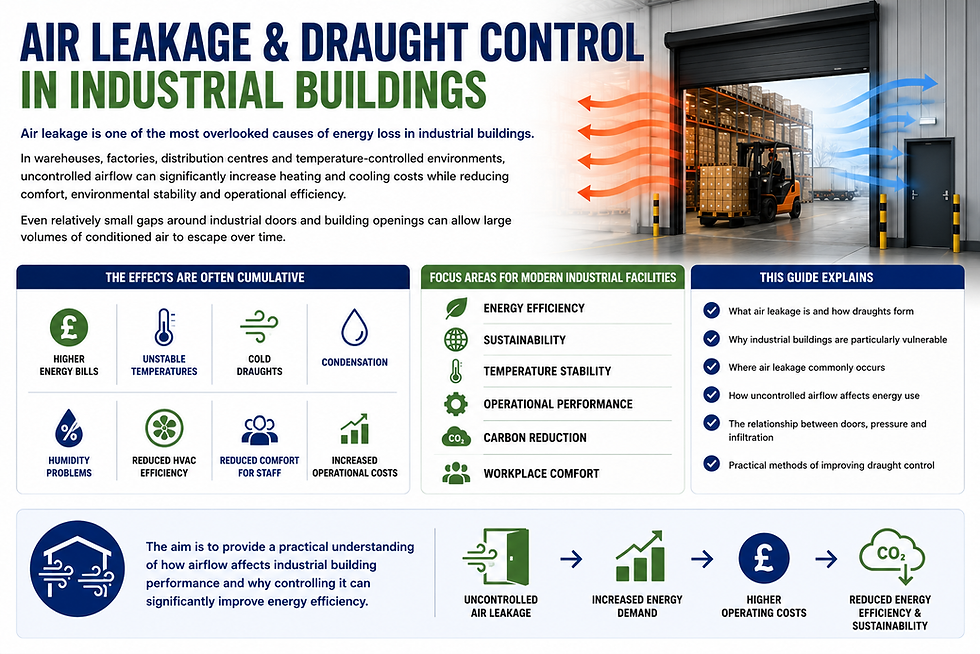
Air leakage is one of the most overlooked causes of energy loss in industrial buildings.
In warehouses, factories, distribution centres and temperature-controlled environments, uncontrolled airflow can significantly increase heating and cooling costs while reducing comfort, environmental stability and operational efficiency.
Even relatively small gaps around industrial doors, loading bays and building openings can allow large volumes of conditioned air to escape over time.
The effects are often cumulative:
🟢 Higher energy bills
🟢 Unstable temperatures
🟢 Cold draughts
🟢 Condensation
🟢 Humidity problems
🟢 Reduced HVAC efficiency
🟢 Reduced comfort for staff
🟢 Increased operational costs
In high-traffic industrial environments, controlling air movement is becoming increasingly important as businesses focus on:
🟢 Energy efficiency
🟢 Sustainability
🟢 Temperature stability
🟢 Operational performance
🟢 Carbon reduction
🟢 Workplace comfort
This guide explains:
🟢 What air leakage is
🟢 How draughts form
🟢 Why industrial buildings are particularly vulnerable
🟢 Where air leakage commonly occurs
🟢 How uncontrolled airflow affects energy use
🟢 The relationship between doors, pressure and infiltration
🟢 Practical methods of improving draught control
The aim is to provide a practical understanding of how airflow affects industrial building performance and why controlling it can significantly improve energy efficiency.
What Is Air Leakage?
Air leakage is the uncontrolled movement of air into and out of a building through gaps, openings and unsealed areas.
In industrial buildings, this commonly occurs around:
🟢 Industrial doors
🟢 Loading bays
🟢 Dock levellers
🟢 Roof junctions
🟢 Wall interfaces
🟢 Personnel doors
🟢 Ventilation openings
🟢 Damaged seals
🟢 Partially open doorways
Whenever internal and external air pressures differ, air naturally moves through available gaps.
This process is known as air infiltration and exfiltration.
🟢 Infiltration: Outside air entering the building
🟢 Exfiltration: Conditioned internal air escaping
Both contribute to energy loss.
In heated buildings, warm internal air escapes and is replaced by colder external air. In cooled environments, cooled air escapes while warmer air enters. In many industrial buildings, reducing uncontrolled air movement forms part of a wider strategy focused on improving Environmental Control, stabilising temperatures and improving operational efficiency across warehouse and production environments.
The larger the leakage path and the greater the pressure difference, the greater the airflow becomes.

What Is Air Leakage?
Why Industrial Buildings Experience High Air Leakage
Industrial buildings are particularly vulnerable to air leakage because they often combine:
🟢 Large openings
🟢 High traffic levels
🟢 Repeated door operation
🟢 Loading activities
🟢 High internal volumes
🟢 Changing pressure conditions
Unlike domestic buildings, industrial environments frequently rely on large operational openings that are opened repeatedly throughout the day.
Examples include:
🟢 Warehouse loading doors
🟢 Forklift access routes
🟢 Dispatch bays
🟢 Chilled storage openings
🟢 Manufacturing transfer points
Every opening temporarily breaks the environmental separation between internal and external conditions.
In busy facilities, this can result in almost continuous air exchange. Even modern insulated buildings can perform poorly if uncontrolled air leakage is not managed effectively.
In larger industrial and logistics facilities, uncontrolled air leakage is often most noticeable around frequently used external openings where wind pressure, vehicle movement and continual traffic can increase unwanted air movement. This is one of the reasons why many facilities now use External High Speed Doors to help reduce opening exposure time and improve environmental separation.
Air leakage is not only an issue between the inside and outside of a building. In many factories and warehouse operations, uncontrolled airflow can also occur between production, storage and dispatch areas. In these environments, Internal High Speed Doors are commonly used to help improve environmental separation and reduce unnecessary air movement between operational zones.

Common Sources of Air Leakage
Air leakage can occur in many different areas throughout an industrial building.
In many cases, the issue is not a single large opening, but multiple smaller areas of uncontrolled airflow working together.
Typical sources include:
🟢 Open Doorways: Frequently used entrances, loading bays and operational openings can allow substantial volumes of warm or cooled air to escape. Even short periods where doors remain open can significantly increase energy loss over time.
🟢 Gaps Around Doors & Frames: Poorly fitted doors, worn seals and damaged frames can create continuous low-level air leakage throughout the day. These smaller leaks are often overlooked but can collectively have a significant impact on building efficiency.
🟢 Roof & Cladding Junctions: Air leakage commonly occurs around roof penetrations, wall joints, cladding interfaces and service entries. As warm air naturally rises, poorly sealed roof areas can become a major source of heat loss.
🟢 Windows & Personnel Doors: Older glazing systems, damaged seals and poorly insulated personnel doors can contribute towards unnecessary heat transfer and draughts.
🟢 Ventilation Imbalance: Uncontrolled or poorly managed ventilation systems can create pressure imbalances that increase unwanted airflow through openings and gaps.
Within taller industrial buildings, warm air naturally rises towards roof level. As this warmer air escapes through high-level leakage points, colder external air is drawn into the building at lower levels to replace it. This process is commonly known as the “stack effect”.
Air leakage can become particularly important within temperature-controlled and refrigerated environments where warmer surrounding air continually attempts to move towards colder conditioned areas. This is one of the reasons why airflow control plays such an important role within Cold Room applications.
The larger the building and the greater the internal temperature difference, the more significant this airflow movement can become. In warehouses with high ceilings and large openings, stack effect can dramatically increase heating demand during colder months. Understanding this behaviour is important when considering environmental separation and airflow control strategies.

The Impact On Energy Costs
Air leakage directly increases the workload placed on heating and cooling systems.
When conditioned air continually escapes, HVAC systems must operate for longer periods in order to maintain target temperatures.
This can result in:
🟢 Increased energy consumption
🟢 Higher fuel and electricity costs
🟢 Greater maintenance requirements
🟢 Reduced equipment lifespan
🟢 Poorer overall building efficiency
In high-traffic environments, the cumulative cost of uncontrolled air movement over a full year can be substantial.
Improving Air Leakage & Draught Control
Reducing air leakage does not always require major structural changes.
In many cases, targeted improvements can significantly improve environmental control and reduce unnecessary energy waste.
Common improvement measures include:
🟢 High-Speed Doors: High-speed doors help minimise the amount of time openings remain exposed, reducing uncontrolled airflow between areas. Where improved sealing and reduced draughts are important, businesses may consider systems such as ZIP high-speed doors, which combine fast operation with a close-fitting side retention system to help improve environmental control around busy openings.
🟢 Improved Door Seals: Replacing worn or damaged seals around industrial doors can help reduce continuous low-level air leakage.
🟢 Environmental Separation: Separating operational areas with suitable door systems or barriers can help maintain more stable internal conditions.
🟢 Air Curtains: Air curtains can help reduce airflow through frequently used openings by creating a controlled air barrier.
🟢 Improved Building Fabric: Addressing gaps within cladding, roofing and wall interfaces can improve overall building tightness and reduce unwanted infiltration.

The Next Step To Save Energy
If you are reviewing energy loss within your building, we are always happy to offer practical advice and guidance.
Whether you are considering high speed doors, improving environmental separation, reducing draughts or simply understanding where energy is being lost, we can help you assess the options available.
Every building operates differently, and in many cases relatively small improvements can deliver worthwhile operational and energy-saving benefits.
If you would like to discuss your application, arrange a site visit or request further information, please contact us.

Energy Saving Doors
25 Britannia Square
Worcester
Worcestershire
WR1 3DH
United Kingdom
+44 1905 317878