
Air Curtains & Energy Saving
In many industrial and commercial buildings, significant energy can be lost through frequently used openings.
Every time a doorway is exposed:
🟢 Warm air can escape
🟢 Colder air can enter
🟢 HVAC systems may need to work harder
🟢 Internal temperatures can become less stable
🟢 Draughts and discomfort can increase
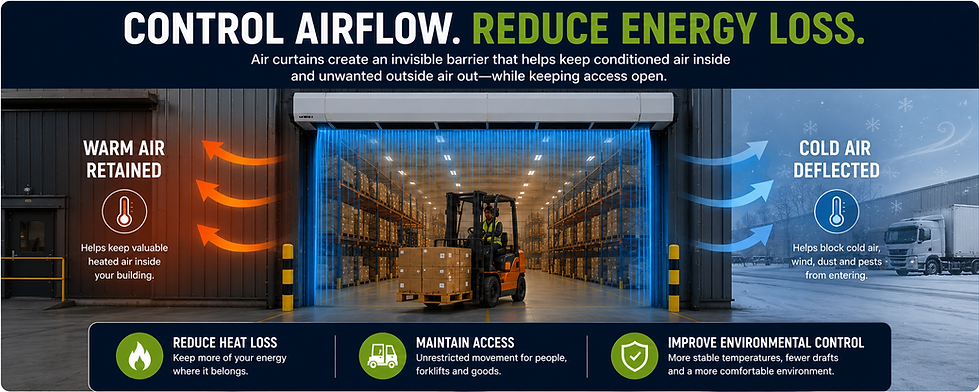
Air curtains are designed to help reduce this uncontrolled air movement by creating a controlled air barrier across an opening.
When correctly specified and installed, air curtains can help:
🟢 Reduce heat loss
🟢 Improve environmental control
🟢 Reduce draughts
🟢 Stabilise temperatures
🟢 Improve staff comfort
🟢 Support operational efficiency
They can be particularly useful in buildings where access needs to remain frequent or unrestricted, but where uncontrolled airflow is causing energy loss or environmental instability.
What Is An Air Curtain?
An air curtain is a system designed to project a controlled stream of air across an opening.
This airflow helps create a separation between two different environments, while still allowing people, forklifts, vehicles and goods to pass through.
Air curtains are commonly installed above doorways, loading openings, warehouse entrances and other frequently used access points.
Unlike a physical door, an air curtain does not close the opening. Instead, it helps reduce the transfer of air through the opening when access is required.
This makes air curtains particularly useful where:
🟢 Doors are frequently open
🟢 Traffic movement is constant
🟢 Fast access is required
🟢 Draughts are an issue
🟢 Temperature stability is difficult to maintain

Why Open Doorways Create Energy Loss
An open doorway creates a direct path for air to move between two areas.
In heated buildings, warm internal air can escape through the opening while colder external air enters to replace it.
In cooled or temperature-controlled environments such as a Cold Room, the reverse can also occur, with conditioned air escaping and warmer external air entering the controlled area.
This uncontrolled air exchange can result in:
🟢 Increased heating demand
🟢 Increased cooling demand
🟢 Draughts
🟢 Unstable temperatures
🟢 Reduced staff comfort
🟢 Higher running costs
🟢 Increased pressure on HVAC and refrigeration systems
The longer the opening remains exposed, the greater the potential energy loss.
This is why frequently used openings — particularly within warehouse, production and cold storage environments — can have a much greater impact on energy performance than many businesses initially realise.

How Air Curtains Help Reduce Energy Loss
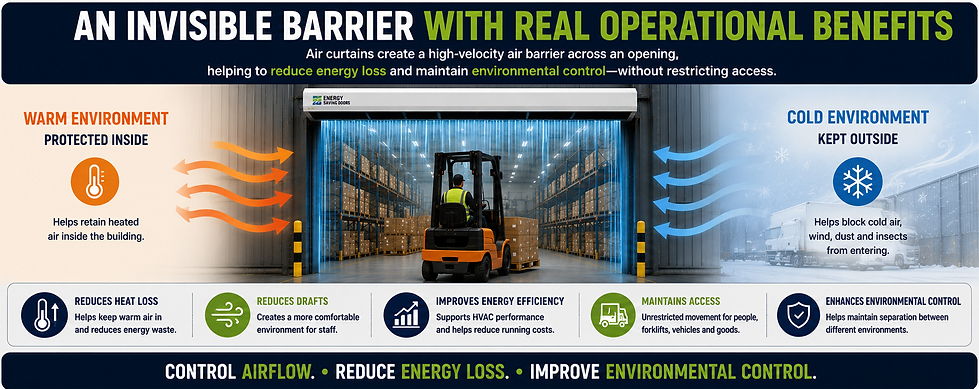
Air curtains help by creating a controlled air stream across the doorway.
This air stream acts as a barrier, helping to reduce the amount of air that can freely pass through the opening.
When correctly specified, an air curtain can help:
🟢 Retain warmer air inside heated spaces
🟢 Reduce cold air ingress
🟢 Reduce draughts near doorways
🟢 Improve temperature stability
🟢 Support HVAC performance
🟢 Improve comfort for people working nearby
Air curtains are not a complete substitute for a closed insulated door, but they can be very effective during periods when the opening needs to remain in use.
Their main benefit is that they help reduce uncontrolled air exchange without restricting access.
Air Curtains vs Physical Doors
A physical door provides the strongest separation when it is closed.
However, in busy operational environments, doors may need to open frequently for:
🟢 Forklifts
🟢 Deliveries
🟢 Staff movement
🟢 Vehicle access
🟢 Goods transfer
During these periods, the opening is exposed and air movement can become uncontrolled.
An air curtain helps reduce this exposure by creating an air barrier while the opening is in use.
In many applications, the best solution is not necessarily one or the other.
The most effective environmental control strategy may involve a combination of:
🟢 Fast-acting doors
🟢 Air curtains
🟢 Improved sealing
🟢 Environmental separation
🟢 Traffic management
For example, a high-speed door can minimise open time, while an air curtain can help reduce air movement during the period when the doorway is exposed.
Used together, they can provide a stronger overall approach to energy saving and environmental control.

Where Air Curtains Are Most Effective
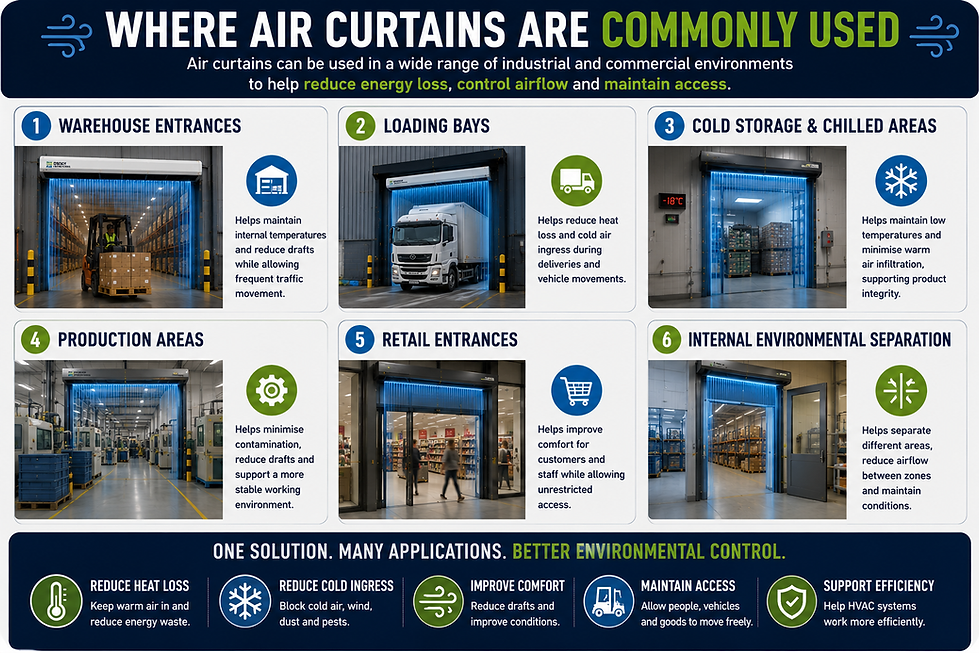
Air curtains can be particularly useful where an opening is used frequently and closing the doorway every time is not practical.
Common applications include:
🟢 Warehouse entrances
🟢 Loading bays
🟢 Dispatch areas
🟢 Goods-in areas
🟢 Retail entrances
🟢 Production areas
🟢 Internal environmental separation
🟢 Chilled or temperature-sensitive areas
They are often most effective where there is regular movement through the opening but a need to reduce draughts, temperature fluctuation or energy loss.
The suitability of an air curtain depends on the specific conditions of the opening, including height, width, exposure, traffic frequency and temperature difference.
Air Curtains & HVAC Efficiency
Heating, ventilation and air conditioning systems work most efficiently when internal conditions remain stable.
When large volumes of air are continually lost through an opening, heating, ventilation and air conditioning (HVAC) systems may need to run for longer or work harder to maintain the desired temperature.
By helping to reduce uncontrolled air exchange, air curtains can support HVAC efficiency.
This can help:
🟢 Reduce heating demand
🟢 Reduce cooling demand
🟢 Maintain more stable internal temperatures
🟢 Reduce strain on HVAC equipment
🟢 Improve comfort near entrances and doorways
🟢 Reduce avoidable energy waste
In many buildings, improved airflow control can contribute towards a more consistent and efficient internal environment.

Operational Benefits Beyond Energy Saving
Although energy saving is a major benefit, air curtains can also support wider operational performance.
A correctly specified air curtain can help:
🟢 Reduce draughts around frequently used openings
🟢 Improve staff comfort
🟢 Reduce airborne dust and contamination transfer
🟢 Help limit insect ingress
🟢 Support environmental separation
🟢 Maintain access without physical obstruction
🟢 Improve working conditions near entrances and loading areas
For busy industrial and commercial buildings, this can be just as important as the direct energy saving.
Better environmental control can help create a more comfortable, efficient and stable working environment.

Air Curtains & Return On Investment
The return on investment from an air curtain will depend on how the building is used.
Factors that influence potential savings include:
🟢 Opening size
🟢 Frequency of use
🟢 Internal temperature
🟢 External exposure
🟢 Operating hours
🟢 HVAC demand
🟢 Traffic flow
🟢 Existing door arrangements
Where an opening is used frequently and creates significant heat loss or cold air ingress, an air curtain can often contribute towards reduced running costs and improved environmental stability.
In some applications, the benefit may come from direct energy saving.
In others, the value may come from improved comfort, reduced draughts, better workflow, or improved separation between operational areas.

Choosing The Correct Air Curtain
Correct specification is essential.
An air curtain must be selected to suit the opening and the operating environment.
Important factors include:
🟢 Doorway height
🟢 Doorway width
🟢 Mounting position
🟢 Airflow velocity
🟢 Building pressure
🟢 Wind exposure
🟢 Traffic movement
🟢 Internal and external temperature difference
🟢 Whether heating is required within the air curtain
A poorly specified or incorrectly installed air curtain may not provide the desired level of environmental control.
For best results, the air curtain should be considered as part of the wider building environment, rather than as a standalone item.

Air Curtains as Part of a Wider Energy-Saving Strategy
Air curtains can be a valuable part of an energy-saving strategy, but they should be considered alongside other measures.
These may include:
🟢 High-speed doors
🟢 Improved door seals
🟢 Environmental separation
🟢 Better traffic flow
🟢 Reduced open time
🟢 Improved building fabric
🟢 HVAC optimisation
In many cases, the strongest results come from combining several practical improvements.
The aim is to reduce uncontrolled airflow, stabilise internal conditions and reduce unnecessary energy demand.
Practical Advice & Guidance
Every building operates differently, and the effectiveness of an air curtain depends heavily upon the demands of the opening.
Traffic flow, opening size, pressure differences, heating systems and surrounding environmental conditions can all influence performance.
We are always happy to offer practical advice and guidance when reviewing heat loss, airflow management, environmental control and energy-saving opportunities.

Energy Saving Doors
25 Britannia Square
Worcester
Worcestershire
WR1 3DH
United Kingdom
+44 1905 317878