
Return on Investment & Energy Savings
Reducing heat loss within industrial buildings is not simply about lowering energy bills.
In many cases, improving environmental control can also help stabilise temperatures, reduce drafts, improve workflow efficiency and support more consistent operating conditions across warehouses, factories and logistics facilities. Modern rapid operating systems such as a Zip High Speed Door can help minimise opening exposure time and improve environmental separation within busy operational environments.
For applications where both speed and security are important, many businesses also consider High Speed Roller Shutter Doors as part of a wider energy reduction strategy. You can also view our Case Study page for further examples of how modern high speed door systems can contribute towards long-term operational and energy-saving benefits.

Understanding Return on Investment (ROI)
Return on investment is simply a way of assessing how long it may take for an improvement to repay its original cost through operational savings.
For industrial door systems, these savings may come from:
🟢 Reduced heating demand
🟢 Reduced cooling demand
🟢 Reduced air leakage
🟢 Lower HVAC runtime
🟢 Improved operational efficiency
🟢 Reduced environmental instability
🟢 Reduced maintenance and downtime
In many cases, the financial saving is gradual but continuous — delivering benefits year after year.
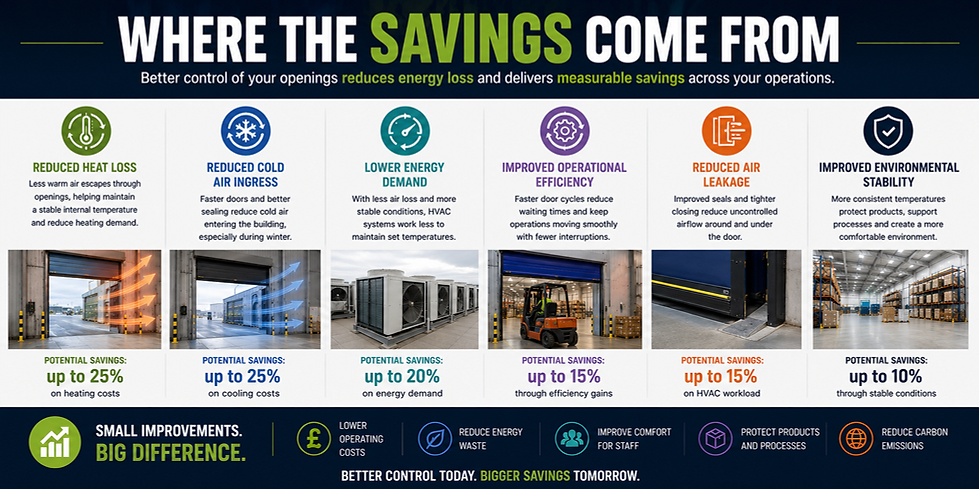
Where Energy Loss Typically Occurs
One of the biggest causes of energy loss within industrial buildings is uncontrolled airflow through frequently used openings.
This commonly occurs where:
🟢 Doors remain open for extended periods
🟢 Openings experience heavy traffic
🟢 Environmental separation is poor
🟢 Air leakage exists around openings
🟢 Slower doors allow prolonged exposure
🟢 Warm air escapes continuously
In busy operational environments, even small reductions in open time can significantly reduce the amount of conditioned air lost from the building.
Why Open Time Matters
A common misconception is that insulation alone determines energy efficiency.
In reality, the amount of time the opening remains exposed often has a much greater influence on overall heat loss.
Even a well-insulated door can allow substantial heat loss if it remains open for long periods.
This is one reason why high speed doors can often produce meaningful operational savings:
🟢 Faster opening and closing
🟢 Reduced airflow exchange
🟢 Shorter exposure times
🟢 Improved environmental stability
🟢 Lower heating and cooling demand
The goal is not simply to insulate the opening — it is to reduce uncontrolled air movement through it.

How High Speed Doors Can Help Reduce Energy Costs
Doors that can reduce energy costs are designed to minimise the amount of time an opening remains exposed.
By reducing open time and improving environmental separation, they can help:
🟢 Reduce heat loss
🟢 Reduce cold air ingress
🟢 Improve HVAC efficiency
🟢 Reduce draughts
🟢 Improve temperature stability
🟢 Reduce energy consumption
Research and industry guidance consistently highlight the importance of reducing air exchange through frequently used openings when improving industrial energy efficiency.
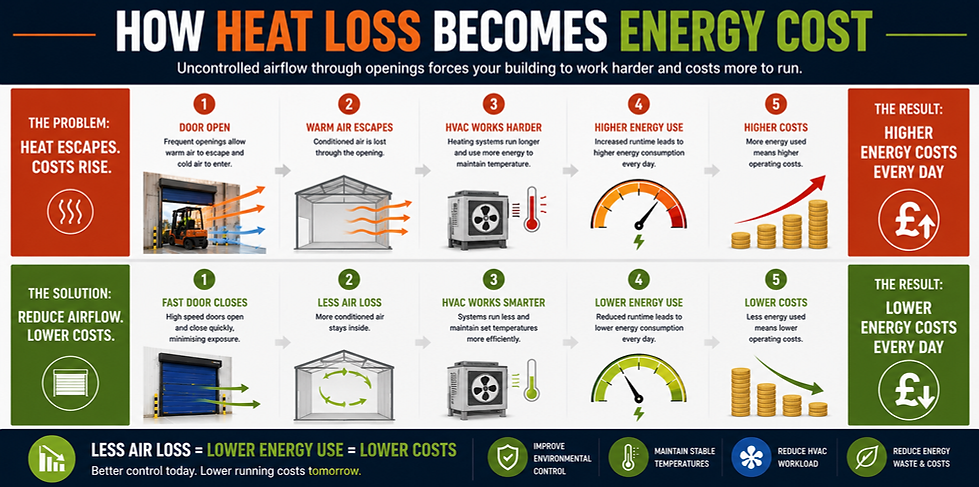
Return on Investment is about more than Heating Bills
The financial return from improved environmental control is not always limited to direct energy savings.
Additional operational benefits may include:
🟢 Improved workflow efficiency
🟢 Reduced waiting times
🟢 More stable internal environments
🟢 Reduced condensation
🟢 Improved product protection
🟢 Improved staff comfort
🟢 Reduced strain on HVAC systems
🟢 Reduced maintenance and repair demand
In temperature-sensitive operations, improved environmental stability can often be just as valuable as the direct energy reduction itself.

Every Building Operates Differently
The level of potential saving will vary considerably depending upon:
🟢 Building size
🟢 Opening size
🟢 Traffic frequency
🟢 Internal temperature
🟢 External conditions
🟢 Operating hours
🟢 HVAC usage
🟢 Existing door performance
🟢 Environmental requirements
A busy warehouse opening operating hundreds of cycles per day will typically experience far greater energy loss than a low-use opening.
This is why Return On Investment calculations should always consider real operational conditions rather than relying on generic assumptions alone.
Factors That Influence Potential Savings
Traffic Frequency
The more frequently an opening is used, the greater the potential for uncontrolled airflow and heat loss.
High cycle openings often present the greatest opportunity for improvement.
Temperature Difference
The greater the temperature difference between the two areas, the greater the potential energy loss through the opening.
For example:
🟢 Heated warehouse to external environment
🟢 Chilled area to ambient warehouse
🟢 Clean room to production area
Open Time
Longer open times allow larger volumes of conditioned air to escape.
Reducing exposure time is often one of the most effective ways to improve environmental control.
Air Leakage
Poor sealing around:
🟢 Guides
🟢 Thresholds
🟢 Head details
🟢 Surrounding structure
can create continual low-level heat loss, even when the door is closed.
HVAC Demand
Where heating or cooling systems must constantly compensate for unstable conditions, energy demand increases significantly. Improving environmental stability can help reduce HVAC workload and operational costs.
Measuring Real Savings
Many businesses now monitor:
🟢 Energy consumption
🟢 HVAC runtime
🟢 Opening cycle counts
🟢 Door open time
🟢 Environmental temperatures
🟢 Operational throughput
to better understand the relationship between environmental control and operational performance.
In many cases, the greatest long-term savings come from combining:
🟢 Improved insulation
🟢 Reduced airflow
🟢 Faster operation
🟢 Better environmental separation
🟢 Improved building sealing
rather than relying on a single improvement alone.

A Practical Investment
For many industrial buildings, improving environmental control can become a practical long-term investment rather than simply an operational expense.
Relatively small improvements can often contribute towards:
🟢 Lower operating costs
🟢 Reduced energy waste
🟢 Improved efficiency
🟢 Improved environmental stability
🟢 Improved working conditions
🟢 Reduced carbon emissions
The exact payback period will vary depending upon the application, but in many cases the operational benefits continue long after the original investment has been recovered.
We can provide a practical ROI and energy-saving assessment based upon your building, operating temperatures, traffic levels and door usage.

Energy Saving Doors
25 Britannia Square
Worcester
Worcestershire
WR1 3DH
United Kingdom
+44 1905 317878