
Cold Room Energy Loss & Environmental Control
Cold rooms operate by maintaining a stable temperature difference between the conditioned internal environment and the surrounding building.
Every time a cold room opening is exposed:
🟢 Warmer external air can enter
🟢 Conditioned air can escape
🟢 Refrigeration systems have to work harder
🟢 Humidity levels can increase
🟢 Environmental stability can be affected
In many applications, significant energy losses may occur not through the insulated walls of the cold room itself, but through:
🟢 Door openings
🟢 Uncontrolled airflow
🟢 Traffic movement
🟢 Extended door open times
🟢 Continual air exchange
I
Improving airflow control and reducing unnecessary air movement can significantly improve cold room efficiency, temperature stability and operational performance.
This is one of the reasons why many facilities use Internal High Speed Doors within temperature-controlled environments to help minimise opening exposure time and improve environmental separation.

Why Cold Rooms Lose Energy
Cold rooms lose energy because heat naturally moves towards colder environments. Whenever a temperature difference exists between two areas, energy transfer will occur.
In cold room applications, warmer surrounding air continually attempts to move towards the colder conditioned space. This becomes particularly significant when an opening is exposed.
Every time a cold room door opens:
🟢 Warmer external air can enter
🟢 Cooled air can escape
🟢 Refrigeration systems must remove the additional heat
🟢 Moisture can enter the controlled environment
In many cold room applications, the largest source of energy loss is not the insulated structure itself, but the continual exchange of air through operational openings.
The more frequently the opening is used, the greater the potential environmental instability and energy demand. For this reason, many businesses now consider Zip High Speed Doors within cold storage and temperature-controlled applications where fast opening speeds and improved environmental control are important operational considerations.

Air Exchange Is Often The Real Problem
Cold rooms lose energy because heat naturally moves towards colder environments. Whenever a temperature difference exists between two areas, energy transfer will occur.
In cold room applications, warmer surrounding air continually attempts to move towards the colder conditioned space. This becomes particularly significant when an opening is exposed.
Every time a cold room door opens:
🟢 Warmer external air can enter
🟢 Cooled air can escape
🟢 Refrigeration systems must remove the additional heat
🟢 Moisture can enter the controlled environment
In many cold room applications, the largest source of energy loss is not the insulated structure itself, but the continual exchange of air through operational openings.
The more frequently the opening is used, the greater the potential environmental instability and energy demand. In larger industrial facilities, this can also affect wider Warehouse Temperature Control strategies, particularly where refrigerated areas connect directly with warehouse, dispatch or production environments.

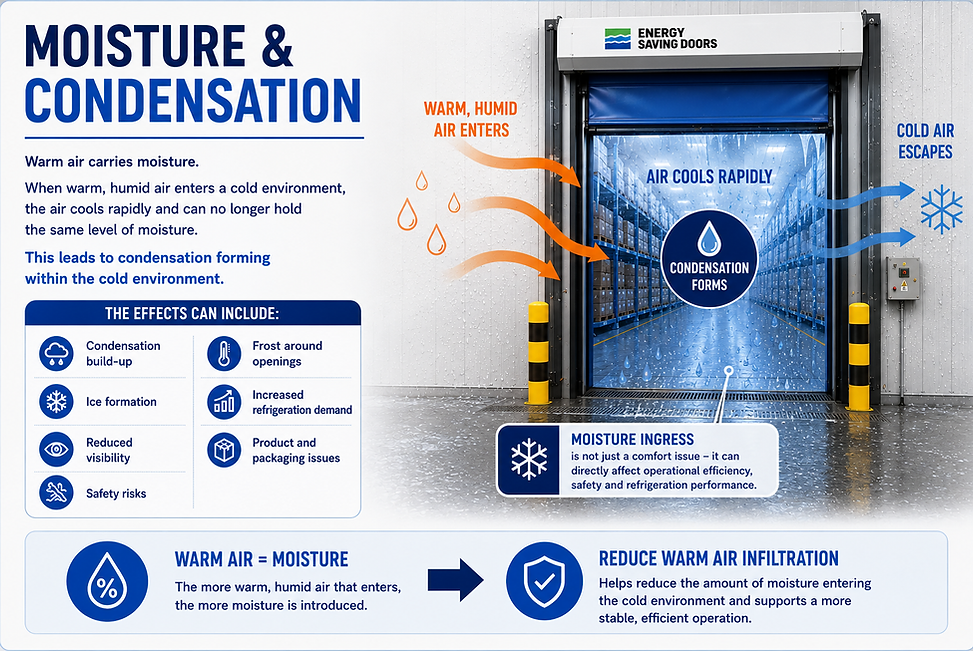
Warm air carries moisture.
When warmer humid air enters a cold room environment, the air cools rapidly and can no longer retain the same level of moisture.
This leads to condensation forming within the cold environment.
Over time, this can contribute towards:
🟢 Condensation build-up
🟢 Ice formation
🟢 Slippery floors
🟢 Reduced visibility
🟢 Frost around openings
🟢 Increased refrigeration demand
🟢 Product and packaging issues
Moisture ingress is therefore not simply a comfort issue — it can directly affect operational efficiency, safety and refrigeration performance.
Reducing warm air infiltration helps reduce the amount of moisture entering the cold environment and, in many cases, can contribute towards worthwhile long-term ROI Savings through reduced refrigeration demand and improved environmental stability.
Moisture & Condensation
Why Door Speed Matters
Door speed can have a major influence on cold room performance.
The longer an opening remains exposed, the greater the potential for:
🟢 Air exchange
🟢 Heat transfer
🟢 Humidity ingress
🟢 Increased refrigeration demand
High-speed doors help reduce the amount of time an opening remains exposed during traffic movement.
This can help:
🟢 Reduce warm air infiltration
🟢 Improve temperature stability
🟢 Reduce frost and condensation
🟢 Reduce refrigeration demand
🟢 Improve operational efficiency
However, the important factor is not simply the maximum quoted opening speed.
What matters most is the total exposure time of the opening during real operation.
Factors that can influence this include:
🟢 Activation positioning
🟢 Traffic flow
🟢 Closing speed
🟢 Door reaction time
🟢 Vehicle movement
Together, these factors determine how effectively the opening is controlled during everyday operation.

Environmental Separation
Environmental separation is often an important part of improving cold room efficiency.
Rather than exposing the cold room directly to warmer operational areas, many facilities use:
🟢 Buffer zones
🟢 Staging areas
🟢 Airlocks
🟢 Internal separation
🟢 Controlled transfer areas
These measures can help reduce the environmental impact of regular traffic movement.
Separating areas with different temperature requirements can help reduce:
🟢 Sudden temperature changes
🟢 Direct warm air ingress
🟢 Moisture transfer
🟢 Refrigeration demand
Smaller, more controlled temperature transitions often help create a more stable and efficient cold storage operation.

Refrigeration Load & Operating Costs
Every time warm air enters a cold room, refrigeration systems must remove the additional heat energy introduced into the environment.
This increases refrigeration load and energy consumption.
Refrigeration systems may need to:
🟢 Run for longer periods
🟢 Cycle more frequently
🟢 Remove additional moisture
🟢 Compensate for unstable temperatures
Over time, this can contribute towards:
🟢 Higher operating costs
🟢 Increased energy demand
🟢 Increased equipment wear
🟢 Reduced system efficiency
🟢 Higher maintenance requirements
Reducing unnecessary air exchange can therefore help improve overall refrigeration efficiency and reduce avoidable energy waste.

High speed doors are commonly used in cold room and temperature-controlled environments because they help minimise opening exposure time.
By opening and closing rapidly, high-speed doors can help:
🟢 Reduce air exchange
🟢 Improve environmental separation
🟢 Reduce warm air ingress
🟢 Reduce frost and condensation
🟢 Improve temperature stability
🟢 Support efficient workflow
In busy operational environments, reducing doorway exposure time by even a few seconds per cycle can contribute towards significant long-term energy and environmental benefits.
This can be particularly important where:
🟢 Traffic frequency is high
🟢 Temperature differences are significant
🟢 Refrigeration demand is continuous
🟢 Operational efficiency is critical
High Speed Doors & Cold Room Efficiency

The Hidden Cost Of Environmental Instability
Poor environmental control within cold room environments can create wider operational issues beyond direct energy loss.
Environmental instability can contribute towards:
🟢 Frost build-up
🟢 Condensation
🟢 Refrigeration inefficiency
🟢 Unstable product temperatures
🟢 Packaging damage
🟢 Visibility issues
🟢 Safety concerns
🟢 Increased maintenance requirements
🟢 Increased downtime
In many cases, the operational impact can exceed the direct cost of the additional energy consumed.
Improving airflow control and reducing unnecessary air exchange can therefore help support:
🟢 Product protection
🟢 Operational reliability
🟢 Refrigeration efficiency
🟢 Staff safety
🟢 Environmental consistency

Practical Cold Room Energy Saving Matters
Improving cold room efficiency does not always require major structural changes.
In many applications, relatively small improvements can significantly improve environmental control and reduce unnecessary energy loss.
Common measures include:
🟢 High-speed doors
🟢 Improved sealing
🟢 Reduced door open time
🟢 Traffic management
🟢 Regular door maintenance
🟢 Improved operational control
The most effective approach will depend upon the specific application, traffic levels and operational demands of the environment.

Practical Advice & Guidance
Every cold room application operates differently, and the most effective energy-saving strategy will depend upon:
🟢 Operating temperature
🟢 Traffic frequency
🟢 Opening size
🟢 Refrigeration demand
🟢 Workflow
🟢 Environmental conditions
In many cases, relatively small improvements to airflow control and environmental separation can significantly improve cold room efficiency and reduce unnecessary energy loss.
We are always happy to offer practical advice and guidance
when reviewing:
🟢 Cold room energy loss
🟢 Airflow management
🟢 Environmental control
🟢 High-speed doors
🟢 Environmental separation
🟢 Operational efficiency
If you would like to discuss your application, arrange a site visit or request further information, please contact us.

Energy Saving Doors
25 Britannia Square
Worcester
Worcestershire
WR1 3DH
United Kingdom
+44 1905 317878