
To recieve your own High Speed Door Return on Investment (R.O.I.) Assessment, please provide the following information where possible.

What Your Personalised ROI Report Includes
Every facility is different. Door sizes, operating patterns, internal temperatures and traffic volumes can vary significantly between sites. That is why we produce a personalised assessment rather than relying on generic assumptions.
Your report is designed to help quantify the operational and financial impact of your existing doorways and identify opportunities for improvement.
Open-Door Exposure Analysis
Many industrial buildings focus on insulation, heating systems and building fabric when considering energy efficiency.
However, every time a door opens, conditioned air can escape and external air can enter the building. Our assessment calculates how many hours per year your doorway is effectively exposed to the outside environment.
This often provides a useful starting point for understanding the scale of potential energy loss.
Annual Energy Saving Estimate
Using information about your doorway, operating pattern and building conditions, we estimate the potential reduction in energy loss that may be achieved through improved environmental separation.
This provides an indication of the annual energy savings that could be available.
Carbon Reduction Assessment
Reducing unnecessary energy consumption can also reduce associated carbon emissions.
Your report includes an estimate of potential annual CO₂ reduction, helping support sustainability initiatives, environmental reporting and Net Zero objectives.
Annual Cost Saving Estimate
Energy efficiency improvements ultimately need to make commercial sense. Your report converts potential energy savings into an estimated annual financial benefit, helping quantify the value of reducing unnecessary open-door exposure.
Payback Period Calculation
Many businesses need to justify investment decisions before proceeding. Your report includes an estimated payback period, showing how long it may take for operational savings to offset the cost of the proposed solution. This can help support internal discussions with management, finance teams and operational stakeholders.
High-Speed Door Recommendation
Where appropriate, we provide guidance on the most suitable door technology for your application. Recommendations take into account opening size, operating frequency, environmental requirements and operational objectives.
Personalised Report
The findings are presented in a clear, easy-to-understand report that can be shared internally with colleagues, managers or decision makers. The objective is simple: to provide a practical assessment of how doorway performance may be affecting energy consumption, operating costs and environmental control within your facility.
How We Calculate Your Return on Investment
A Structured Engineering Assessment
Industrial doorways are operational openings rather than static building elements. Their performance is influenced not only by insulation values, but also by opening frequency, operating speed, traffic patterns and environmental conditions.
For this reason, assessing the true impact of a doorway requires a wider analysis than simply reviewing product specifications.
Our ROI Assessment follows a structured seven-stage methodology designed to quantify operational exposure, estimate energy impact and calculate potential financial and environmental benefits.
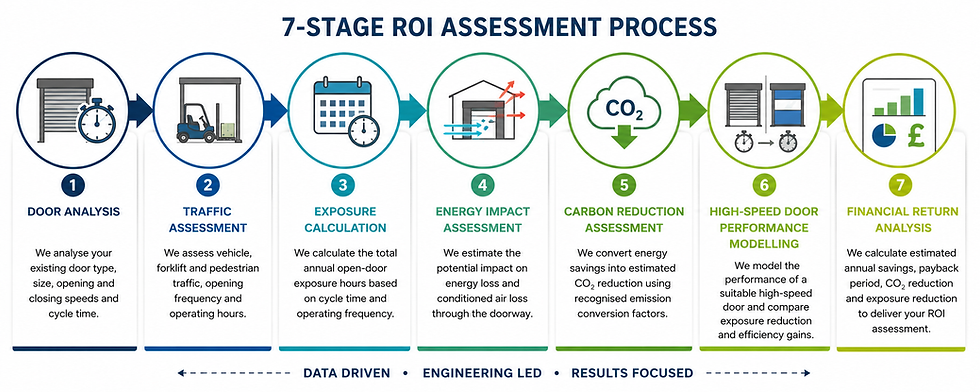
Stage 1 – Existing Door Cycle Analysis
The assessment begins by evaluating the performance characteristics of the existing doorway.
Factors considered include:
• Door type
• Opening dimensions
• Opening speed
• Closing speed
• Total open-close cycle time
• Daily operating hours
The objective is to establish how long the opening remains exposed during normal operation.

Stage 2 – Traffic Frequency Assessment
The operational demand placed upon the doorway is then evaluated.
This includes:
• Vehicle movements
• Forklift activity
• Pedestrian traffic
• Opening frequency per hour
• Operating days per year
Even relatively small differences in traffic frequency can have a significant effect on annual exposure.

Stage 3 – Annual Open-Door Exposure Calculation
Using the cycle time and operating frequency, we calculate the total annual period during which the doorway is exposed to the external environment.
This figure is expressed as annual exposure hours and provides a useful indicator of potential environmental separation performance.
Many organisations are surprised to discover that a frequently used doorway can accumulate hundreds of hours of open-door exposure each year.

Stage 4 – Energy Impact Assessment
Once annual exposure has been established, we estimate the potential impact on building energy performance.
The assessment considers factors such as:
• Door dimensions
• Internal design temperature
• External ambient conditions
• Building usage patterns
• Exposure duration
The purpose of this stage is to estimate the potential reduction in uncontrolled heat transfer and conditioned air loss that may be achieved through improved environmental separation.

Stage 5 – Carbon Reduction Assessment
Energy consumption and carbon emissions are intrinsically linked.
Using recognised conversion factors, the assessment estimates the potential reduction in carbon emissions associated with the projected energy savings.
This provides an indication of how improved doorway performance may contribute towards sustainability objectives, environmental reporting and carbon reduction initiatives.

Stage 6 – High-Speed Door Performance Modelling
The assessment then models the impact of replacing the existing doorway with an appropriate high-speed door solution.
Factors considered include:
• Faster opening speeds
• Faster closing speeds
• Reduced exposure periods
• Improved environmental separation
• Operational suitability
This stage enables a direct comparison between the existing and proposed solutions.

Stage 7 – Financial Return Analysis
The final stage converts the estimated operational improvements into a commercial assessment.
This includes:
• Estimated annual energy savings
• Estimated annual cost savings
• Estimated carbon reduction
• Exposure reduction percentage
• Indicative payback period
The result is a practical business case that can be used to support investment decisions and evaluate the potential return on a high-speed door installation.

Engineering Assessment Disclaimer
The ROI Assessment is intended to provide an indicative engineering appraisal based upon the information supplied and a range of reasonable operating assumptions. Actual energy consumption, environmental conditions and financial outcomes will vary between buildings and applications.
The assessment is designed to assist decision making by providing a structured comparison between existing doorway performance and the potential benefits of improved environmental separation.

The Science Behind The Assessment
Every ROI assessment is based upon a number of engineering and operational factors. The articles below explain the principles used within our methodology and provide additional information on heat loss, air movement, carbon reduction and industrial door performance.