
Payback Period for Energy Saving High Speed Doors
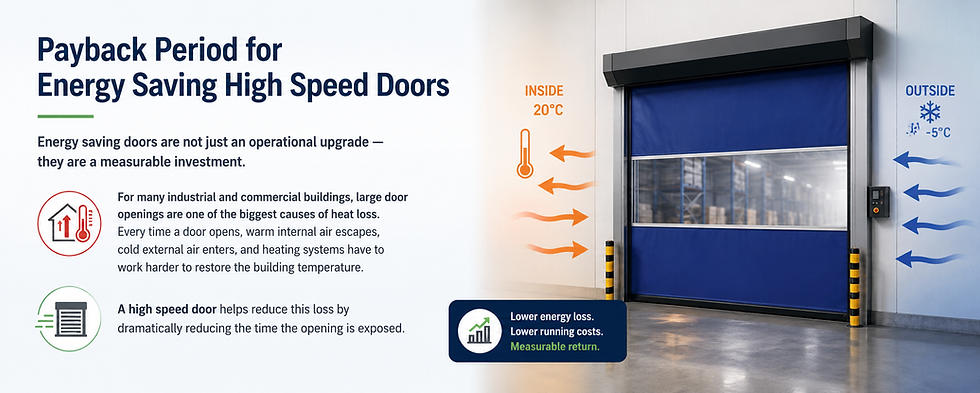
Energy saving doors are not just an operational upgrade — they are a measurable investment.
For many industrial and commercial buildings, large door openings are one of the biggest causes of heat loss. Every time a door opens, warm internal air escapes, cold external air enters, and heating systems have to work harder to restore the building temperature.
A high speed door helps reduce this loss by dramatically reducing the time the opening is exposed.
What is the Payback Period?
The payback period is the time it takes for the energy savings generated by the door to recover the cost of the investment.
In simple terms:
Payback Period = Cost of Door ÷ Annual Energy Savings
Once the door has paid for itself, the energy savings continue year after year.

Why Door Open Time Matters
With a conventional industrial door, the opening may remain exposed for far longer than necessary. In busy warehouses, loading bays, factories and production areas, this can add up to many hours of heat loss every week.
A high speed door can open and close quickly, helping to reduce:
🟢 Heat loss
🟢 Cold air ingress
🟢 Draughts
🟢 Temperature fluctuation
🟢 Energy waste
🟢 Unnecessary strain on heating systems
This is particularly important where doors are used frequently throughout the working day.

Worked Example: Heat Loss Through a 6m x 6m Opening
A 6m x 6m doorway has an open area of 36m².
Using a moderate air movement assumption of 0.5m/s and a temperature difference of 15°C, the heat loss through the open doorway can be over 325 kW while the door is open.
If the door is open for just 1 hour per day, this can equate to approximately:
325 kWh of energy loss per day
81,250 kWh per year based on 250 working days
£9,750 per year at £0.12 per kWh
This demonstrates why reducing door open time can have such a significant impact on energy costs.
If you would like a worked example for your own project then please consult us.

How High Speed Doors Improve Payback
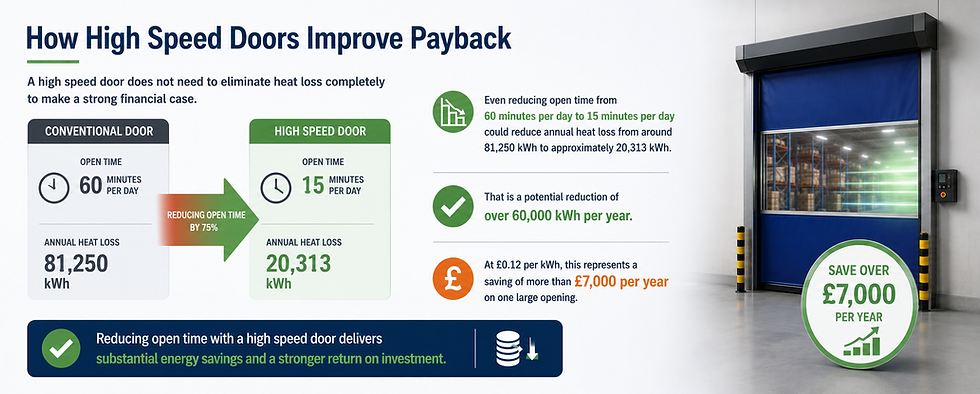
A high speed door does not need to eliminate heat loss completely to make a strong financial case.
Even reducing open time from 60 minutes per day to 15 minutes per day could reduce annual heat loss from around 81,250 kWh to approximately 20,313 kWh.
That is a potential reduction of over 60,000 kWh per year.
At £0.12 per kWh, this represents a saving of more than £7,000 per year on one large opening.
These types of potential ROI Savings are one of the reasons why many warehouses, factories and distribution centres now review opening exposure time as part of their wider energy reduction strategy.
If you would like to assess the possible savings for your own operation, you can also visit our Request Your ROI page to explore the potential payback period and operational benefits associated with modern high speed door systems.
Factors That Affect Payback
The main factors include:
-
door size
-
number of opening cycles per day
-
time the door remains open
-
internal and external temperature difference
-
wind and air movement
-
energy cost per kWh
-
quality of the door seal
-
type of activation system used
For example, automatic activation, radar sensors, remote controls or induction loops can help the door operate efficiently and reduce unnecessary open time.

More Than Energy Savings
The financial saving is important, but it is not the only benefit.
Energy saving high speed doors can also help to improve:
🟢 Working conditions
🟢 Staff comfort
🟢 Temperature control
🟢 Warehouse efficiency
🟢 Traffic flow
🟢 Environmental separation
🟢 Noise reduction
🟢 Pest control
🟢 Overall building performance
This means the true value of the door is often greater than the energy saving calculation alone.

A Practical Investment for Industrial Buildings
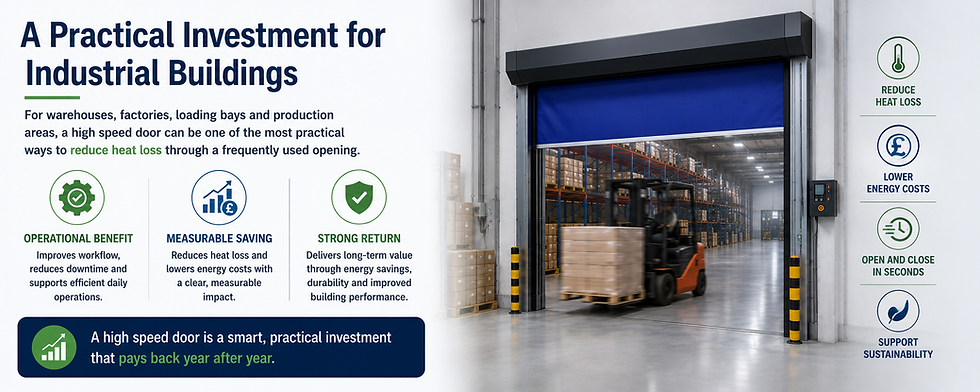
For warehouses, factories, loading bays and production areas, a high speed door can be one of the most practical ways to reduce heat loss through a frequently used opening.
It offers:
🟢 A clear operational benefit
🟢 Measurable energy savings
🟢 A strong long-term return on investment
Calculating Your Payback Period
Every site is different.
We can help assess your opening size, usage pattern and operating conditions to estimate the likely payback period for your building.
Contact us today to discuss your high speed door requirements or request a free site survey.


Energy Saving Doors
25 Britannia Square
Worcester
Worcestershire
WR1 3DH
United Kingdom
+44 1905 317878