
Air Quality & Contamination Control
Why Open Industrial Doorways Create More Than Energy Loss
When businesses think about industrial doorways, the conversation often begins with heat loss and energy efficiency.
However, every time a doorway opens, far more than heat can enter or escape. Dust, insects, moisture, airborne pollutants and even birds can enter the building, affecting product quality, workplace hygiene and operational performance.
For many organisations, particularly those involved in food production, pharmaceutical manufacturing, warehousing and temperature-controlled environments, contamination control is every bit as important as energy efficiency.
The challenge is that contamination is often invisible until problems begin to appear.
This is why understanding how air moves through industrial buildings is so important. As explained in our Buildings Breathe article, industrial buildings are constantly exchanging air with their surroundings. Every open doorway becomes part of that process.

What Happens When A Door Opens?
When an industrial door opens, internal and external air immediately begin to mix.
Wind pressure, temperature differences, forklift movements and natural air currents all contribute to this exchange.
As outside air enters the building, it can carry:
🟢 Dust and airborne debris
🟢 Insects and flying pests
🟢 Moisture and humidity
🟢 Vehicle emissions
🟢 Pollen and agricultural contaminants
🟢 Airborne pollutants
🟢 Birds seeking shelter or nesting opportunities
The longer a doorway remains open, the greater the opportunity for unwanted contaminants to enter. This is one reason why busy loading bays often experience higher levels of contamination than quieter parts of a facility.

The Hidden Sources Of Contamination
Many contamination problems originate outside the building.
Common external sources include:
🟢 Wind-blown dust
🟢 Traffic pollution
🟢 Agricultural debris
🟢 Insects
🟢 Bird activity around loading bays
🟢 Moisture carried in changing weather conditions
However, contamination can also be generated internally. Forklift movements, packaging operations, production processes and personnel traffic can all disturb particles already present within the building.
Our article on Forklift Traffic & Energy Loss explains how forklift movements act rather like a piston, pushing and pulling significant volumes of air through an opening and increasing air disturbance throughout the facility.

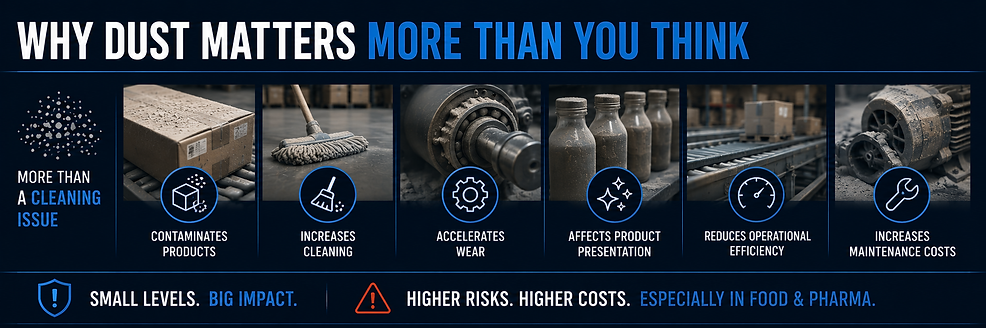
Why Dust Matters More Than Many Businesses Realise
Dust is often regarded as little more than a cleaning issue. In reality, excessive dust can have wider consequences.
It can:
🟢 Contaminate products
🟢 Increase cleaning requirements
🟢 Accelerate wear on equipment
🟢 Affect product presentation
🟢 Reduce operational efficiency
🟢 Increase maintenance costs
For manufacturers, distributors and logistics operators, even small levels of contamination can create unnecessary operational costs. For food and pharmaceutical facilities, the implications can be considerably more serious.
Food Production & Pharmaceutical Operations
In food and pharmaceutical environments, contamination control is often a critical operational requirement rather than simply a housekeeping issue.
Airborne particles, insects, bird droppings and environmental contaminants can all present potential risks to product integrity. Open doorways can compromise carefully controlled environments by allowing external contaminants to enter production, packaging or storage areas.
Maintaining environmental separation helps support:
🟢 Product quality
🟢 Hygiene standards
🟢 Regulatory compliance
🟢 Temperature control
🟢 Reduced risk of contamination events
Whilst contamination control always relies upon a combination of building design, procedures and good housekeeping, controlling unnecessary air exchange is often an important part of the overall strategy. This is also closely linked to the principles discussed in our Temperature Control section, where reducing air movement helps maintain more stable internal conditions.

Bird Ingress - An Often Overlooked Problem
One contamination source frequently overlooked in industrial buildings is bird ingress.
Warehouses, loading bays and manufacturing facilities can attract birds seeking shelter, warmth or nesting opportunities. Once inside a building, birds can create a range of operational problems.
These may include:
🟢 Contamination of products and packaging
🟢 Bird droppings (guano) damaging stored goods
🟢 Increased cleaning costs
🟢 Health and hygiene concerns
🟢 Damage to building infrastructure
🟢 Disruption to operations
🟢 Triggering of motion detectors and intrusion alarms outside working hours
Many warehouse operators have experienced false alarm activations caused by birds moving within the building overnight. For food production, pharmaceutical and hygiene-sensitive environments, bird ingress can be particularly undesirable due to the potential contamination risks involved.
Reducing doorway exposure time can significantly reduce the opportunity for birds to enter the building.

Controlling Air Movement Reduces Contamination
The same measures that help reduce heat loss often help reduce contamination.
By reducing the amount of air entering and leaving a building, businesses can often improve:
🟢 Cleanliness
🟢 Product protection
🟢 Temperature stability
🟢 Humidity control
🟢 Operational efficiency
High-speed industrial doors, environmental separation systems and improved building pressure management can all contribute towards a more controlled internal environment.
Our Building Pressure Explained guide explores how pressure differences influence airflow throughout industrial buildings and why controlling air movement is often the key to improving building performance.

Better Air Quality Often Means Better Energy Efficiency
Perhaps the most interesting aspect of contamination control is that it often aligns perfectly with energy efficiency.
The same air exchange that allows contaminants to enter a building also allows conditioned air to escape.
By reducing unnecessary air movement, businesses can often achieve:
🟢 Reduced contamination
🟢 Better temperature control
🟢 Lower energy consumption
🟢 Improved working conditions`
🟢 Reduced operating costs
In many cases, the measures that improve environmental control are the same measures that improve energy performance. The result is a cleaner, more controlled and more efficient industrial building.

Controlling What Enters Your Building
Whether the challenge is dust, insects, bird ingress, airborne pollution, temperature control or energy loss, controlling the movement of air is often at the heart of the solution.
Understanding how contaminants enter a building is the first step towards reducing their impact. The second is creating an environment where unnecessary air exchange is minimised, operational conditions are better controlled and products remain protected.