
Energy Efficiency Funding
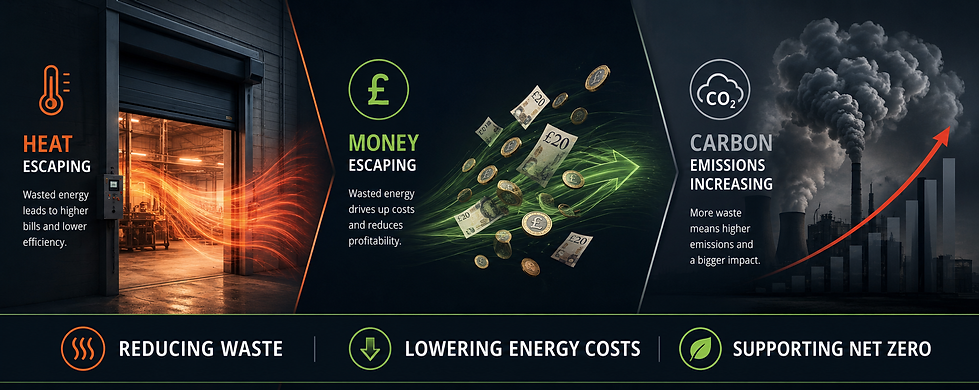
Industrial energy efficiency funding is increasingly focused on one core principle: reducing waste.
In many industrial and warehouse environments, significant amounts of heat, conditioned air and energy are lost every day through poorly controlled openings, inefficient access systems and uncontrolled air leakage. The result is not only higher energy bills, but increased carbon emissions, reduced environmental performance and unnecessary operational costs.
Many funding applications are strengthened by clear return on investment calculations that demonstrate the potential long-term energy and operational savings achievable through improved environmental control measures. In many cases, the estimated payback period for a high speed door installation can be surprisingly short when energy reduction and operational efficiency improvements are considered together.
Governments, local authorities and sustainability programmes recognise that improving building efficiency is often one of the fastest and most cost-effective ways to reduce energy consumption. As a result, many grants, tax incentives and support schemes are specifically designed to encourage businesses to reduce wasted energy and improve environmental control.
High speed doors, insulated industrial doors and environmental separation systems can all play a role in:
🟢 Reducing heat loss
🟢 Limiting uncontrolled airflow
🟢 Improving temperature stability
🟢 Lowering energy consumption
🟢 Supporting carbon reduction targets
🟢 Improving operational efficiency
This resource has been created to help industrial businesses understand the types of funding and support that may be available when investing in energy-saving industrial door solutions.
Why Governments Support Energy Reduction
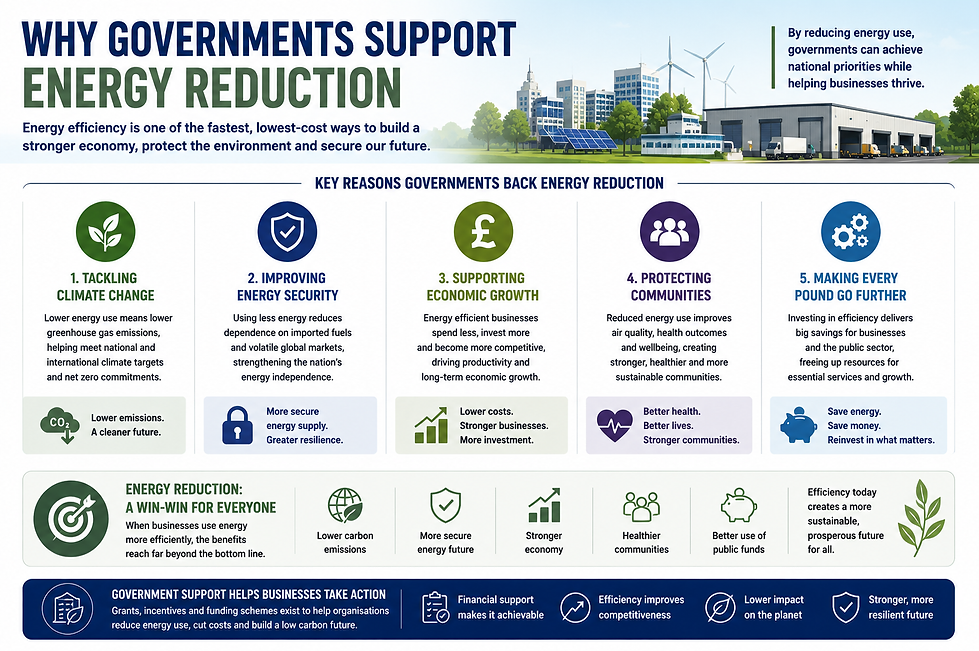
Governments around the world increasingly support energy efficiency projects because reducing energy consumption delivers benefits that extend far beyond individual buildings or businesses.
Lower energy demand helps reduce pressure on national infrastructure, improves energy security and supports long-term environmental targets. It also helps businesses become more competitive by lowering operating costs and improving efficiency.
In industrial and warehouse environments, energy reduction measures can have a particularly significant impact due to the large volumes of heated or cooled air involved in day-to-day operations.
Reducing unnecessary energy loss can help:
🟢 Lower carbon emissions
🟢 Reduce dependence on imported energy
🟢 Improve industrial productivity
🟢 Support sustainability targets
🟢 Improve environmental performance
🟢 Strengthen long-term economic resilience
For this reason, many governments, local authorities and regional organisations continue to encourage investment in:
🟢 Energy-efficient buildings
🟢 Improved insulation
🟢 Environmental control
🟢 Air leakage reduction
🟢 Efficient industrial equipment
🟢 Carbon reduction technologies
In many cases, grants, incentives and funding schemes are designed to help businesses accelerate these improvements while reducing the upfront cost of investment.
For industrial facilities, reducing uncontrolled heat loss and improving environmental control is increasingly recognised as an important part of improving both operational efficiency and long-term sustainability.
Energy Efficiency Grants
Industrial energy efficiency grants are designed to encourage businesses to reduce wasted energy, lower carbon emissions and improve the environmental performance of commercial buildings and operations. A significant proportion of industrial energy waste can arise from reducing heat loss through frequently used openings within warehouses, factories and temperature-controlled environments.
In practice, most schemes work by helping businesses offset part of the cost of installing energy-saving technologies or improving inefficient buildings and processes. This can include support for insulation, heating upgrades, renewable energy systems, LED lighting, process improvements and environmental control measures such as high speed doors and insulated industrial doors.
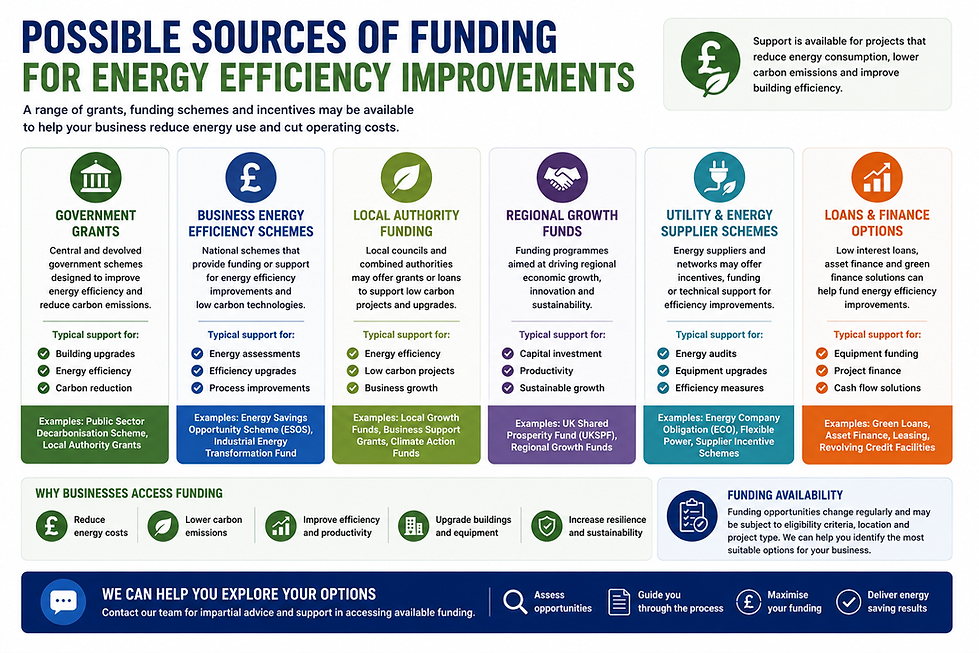
Funding is typically provided in one of four ways:
🟢 Direct grants towards capital costs
🟢 Match-funding schemes
🟢 Interest-free or low-interest green loans
🟢 Tax incentives and enhanced capital allowances
Most programmes focus on projects that can demonstrate measurable reductions in:
🟢 Energy consumption
🟢 Heat loss
🟢 Carbon emissions
🟢 Operational waste
🟢 Long-term running costs
The level of support available varies significantly depending on:
🟢 Location
🟢 Business size
🟢 Carbon savings achieved
🟢 Project type
🟢 Local authority or regional funding availability
Across the UK, support for business energy efficiency and decarbonisation runs into billions of pounds annually when central government schemes, local authority programmes, devolved administrations, innovation funds and NGO/community-backed initiatives are combined.
The UK Government has previously stated that “almost £5 billion” of funding was available to help businesses become greener through energy efficiency and carbon reduction initiatives.
In addition to national schemes, many councils and regional partnerships operate local grant programmes ranging from:
🟢 £1,000–£20,000 for SMEs
🟢 30–50% match funding for energy-saving improvements
🟢 Larger six-figure industrial decarbonisation grants for energy-intensive businesses
Examples across the UK include:
🟢 In our own county of Worcestershire, we have monitored grant programmes providing a total of £2.9 million across 420 projects
🟢 Local authority grants commonly offering £5,000–£50,000 towards carbon reduction projects
🟢 Scotland’s SME loan and cashback schemes providing loans of up to £100,000, together with grant support
While the funding landscape changes regularly, the overall direction is clear: reducing energy waste in industrial and commercial buildings is now viewed as a national economic and environmental priority.
This is one of the reasons why technologies that improve environmental separation — including high-speed doors, insulated shutters and airflow control systems — are increasingly recognised as part of wider industrial decarbonisation strategies.

Grants & Funding
Industrial energy efficiency grants are designed to encourage businesses to reduce wasted energy, lower carbon emissions and improve the environmental performance of commercial buildings and operations.
In practice, most schemes work by helping businesses offset part of the cost of installing energy-saving technologies or improving inefficient buildings and processes. This can include support for insulation, heating upgrades, renewable energy systems, LED lighting, process improvements and environmental control measures such as high speed doors and insulated industrial doors.
Funding is typically provided in one of four ways:
🟢 Direct grants towards capital costs
🟢 Match-funding schemes
🟢 Interest-free or low-interest green loans
🟢 Tax incentives and enhanced capital allowances
Most programmes focus on projects that can demonstrate measurable reductions in:
🟢 Energy consumption
🟢 Heat loss
🟢 Carbon emissions
🟢 Operational waste
🟢 Long-term running costs
Across the UK, support for business energy efficiency and decarbonisation runs into billions of pounds annually when central government schemes, local authority programmes, devolved administrations, innovation funds and NGO/community-backed initiatives are combined.
The UK Government has previously referred to “almost £5 billion” of support being available to help businesses become greener through energy efficiency and carbon reduction initiatives. However, the energy efficiency funding landscape is highly fluid and constantly evolving.
Grant programmes frequently:
🟢 Open and close with limited notice
🟢 Change eligibility criteria
🟢 Alter funding percentages
🟢 Pause applications when budgets are exhausted
🟢 Launch region-specific initiatives
🟢 Move focus between technologies and sectors
As a result, businesses should view grant funding as a dynamic environment rather than a fixed long-term resource.
At the time of publishing, all grant providers and support schemes referenced within this resource were active and operating. However, funding availability, application windows and qualification criteria can change rapidly. Businesses are therefore advised to verify all details directly with the relevant funding body or programme administrator before making financial or operational decisions.
Despite this changing landscape, the overall direction remains clear: reducing energy waste within industrial and commercial buildings is now viewed as a major economic and environmental priority across the UK.
This is one of the reasons why technologies that improve environmental separation — including high speed doors, insulated shutters and airflow control systems — are increasingly recognised as part of wider industrial decarbonisation strategies.
🟢 What it is: A mandatory energy assessment scheme for large organizations in the UK. Although not a direct grant, ESOS requires large factories to conduct energy audits every four years to identify energy-saving opportunities.
🟢 How it helps: While ESOS doesn’t provide funding, it highlights opportunities to reduce energy usage, which can lead to cost savings on energy bills. Once opportunities are identified, factories can apply for grants and incentives to fund recommended upgrades.
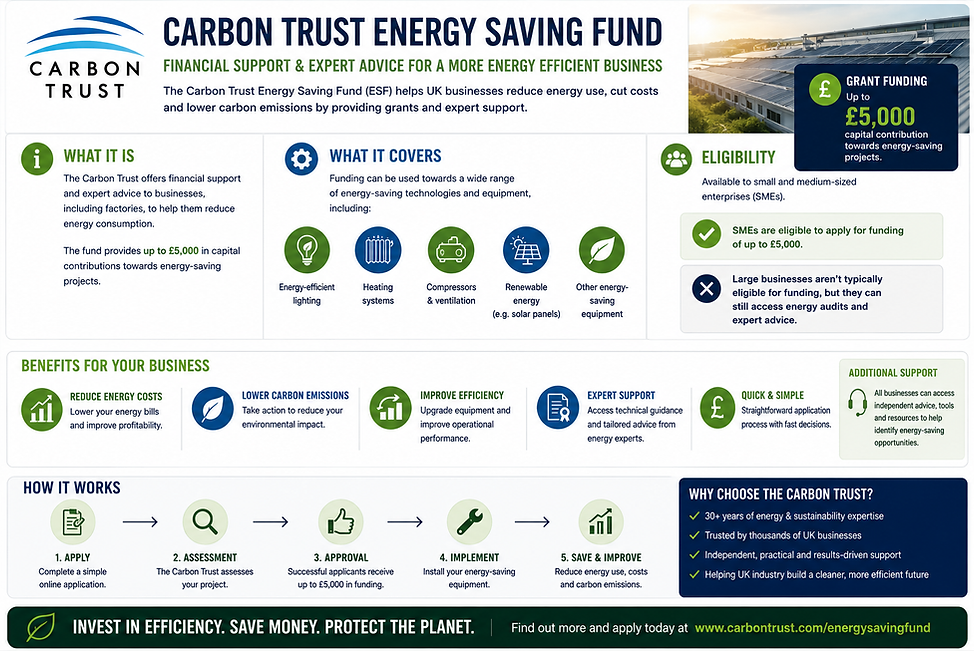
🟢 What it is: The Carbon Trust offers financial support and expert advice to businesses, including factories, to help them reduce energy consumption. The fund provides up to £5,000 in capital contributions towards energy-saving projects.
🟢 What it covers: Energy-efficient lighting, heating systems, compressors, renewable energy installations (e.g., solar panels), and other energy-saving equipment.
🟢 Eligibility: Available to small and medium-sized enterprises (SMEs). While large businesses aren’t typically eligible, they can still access energy audits and advice.
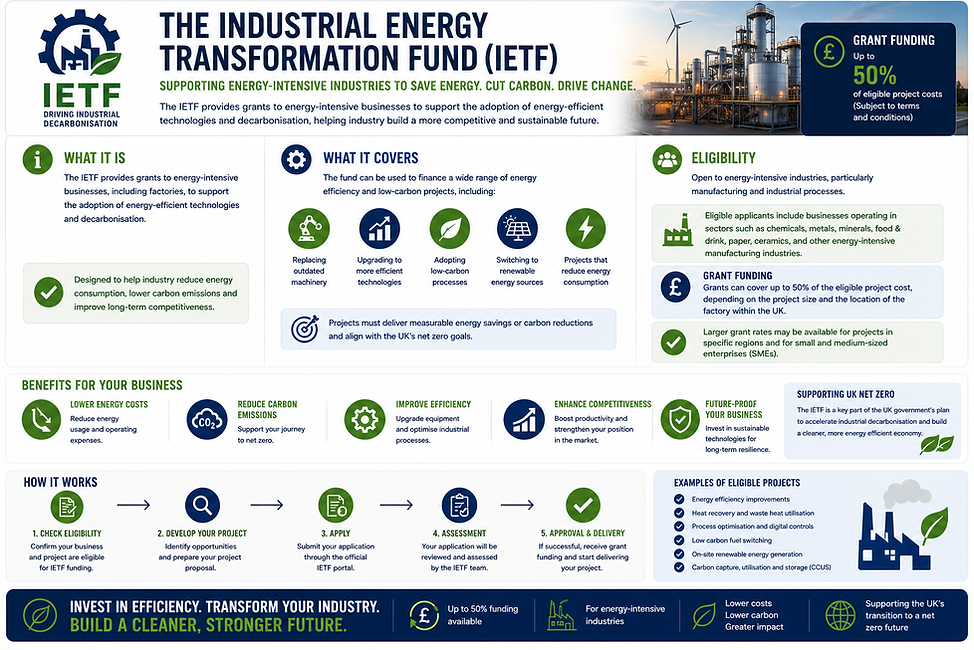
🟢 What it is: The IETF provides grants to energy-intensive businesses, including factories, to support the adoption of energy-efficient technologies and decarbonization.
🟢 What it covers: The fund can be used to finance energy efficiency projects, such as replacing outdated machinery, upgrading to more efficient technologies, or adopting low-carbon processes. Projects that reduce energy consumption or switch to renewable energy sources are eligible.
🟢 Eligibility: Open to energy-intensive industries, particularly manufacturing and industrial processes. Grants can cover up to 50% of the project cost, depending on the project size and the location of the factory.
🟢 What it is: This tax relief scheme allows businesses, including factories, to write off 100% of the cost of qualifying energy-saving equipment against taxable profits.
🟢 What it covers: The scheme encourages businesses to invest in energy-efficient technology, such as high-efficiency lighting, heating systems, and machinery.
🟢 Eligibility: Factories that invest in energy-efficient products listed on the government’s Energy Technology List (ETL) can claim this tax relief. For the period between April 2021 and March 2023, factories can claim a “super-deduction” of 130% for qualifying investments in energy-efficient equipment.
.png)
🟢 What it is: While not a direct grant, this scheme allows businesses to earn money by exporting surplus energy generated from renewable sources back to the grid.
🟢 What it covers: Factories that install renewable energy systems, such as solar panels or wind turbines, can sell excess energy to the grid, helping to offset energy costs.
🟢 Eligibility: Open to all sizes of businesses, including factories. The factory must generate electricity from eligible renewable sources.
🟢 What it is: LEPs are partnerships between local authorities and businesses that support economic growth in specific regions. Some LEPs offer grants and low-interest loans to businesses, including factories, to fund energy efficiency upgrades.
🟢 What it covers: Funding varies by region but can include grants for energy-efficient lighting, heating, machinery, and renewable energy installations
.
🟢 Eligibility: Available to businesses in specific regions, with a focus on SMEs. Check with your local LEP to see what support is available.
🟢 What it is: Salix Finance provides interest-free loans to public sector organizations to improve energy efficiency, but it also supports businesses through programs related to carbon reduction.
🟢 What it covers: Factories can access interest-free loans for projects like upgrading lighting, installing energy-efficient boilers, and optimizing energy use in industrial processes.
🟢 Eligibility: Mostly public sector organizations, but some private sector businesses involved in public services may be eligible for support.
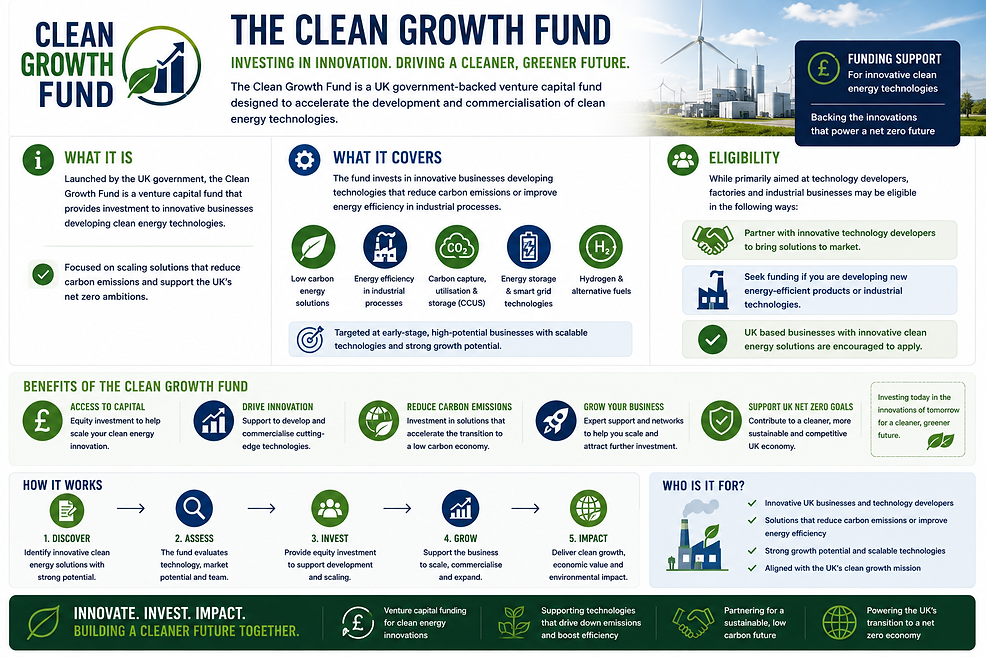
🟢 What it is: Launched by the UK government, this venture capital fund is designed to support the development of clean energy technologies.
🟢 What it covers: It’s targeted at innovative businesses developing technologies that reduce carbon emissions or improve energy efficiency in industrial processes.
🟢 Eligibility: While primarily aimed at technology developers, factories may partner with innovators or seek out funding if they’re developing new energy-efficient products.
🟢 What it is: The RHI incentivizes businesses to install renewable heating systems by providing payments for generating heat from renewable sources.
🟢 What it covers: Factories that install systems like biomass boilers, solar thermal panels, or heat pumps can receive regular payments based on the amount of heat generated.
🟢 Eligibility: Available to both large and small businesses, including factories, and applies to renewable heating systems installed on-site.

The Next Steps
Improving energy efficiency within industrial and commercial buildings is not always about large-scale redevelopment or major operational change.
In many cases, practical improvements such as high speed insulated door solutions, environmental separation, improved airflow control and reducing uncontrolled heat loss can contribute towards measurable long-term savings and improved building performance.
Funding and support schemes can help businesses accelerate these improvements, reduce payback periods and support wider sustainability objectives. We are always happy to offer practical guidance and advice, whether you are exploring a grant application, reviewing operational inefficiencies or simply trying to better understand where energy may be being lost within your building.
If you are considering applying for funding or reviewing possible energy reduction projects within your facility, you may also wish to use our Request Your ROI tool to better understand the potential payback period and operational savings available.
If you would like to discuss a potential project, arrange a site visit or review the options available for your operation, please contact us.

Energy Saving Doors
25 Britannia Square
Worcester
Worcestershire
WR1 3DH
United Kingdom
+44 1905 317878