

Industrial Energy Saving & Efficiency Knowledge Hub
Improving energy efficiency within industrial and commercial buildings involves far more than simply reducing heating usage or replacing equipment. Warehouses, factories and industrial premises can lose significant amounts of energy through uncontrolled airflow, poorly managed openings, temperature instability and inefficient operational practices.
In many environments, even relatively small improvements in environmental control can result in measurable reductions in energy loss, improved working conditions and lower operational costs. This section of our website has been created to provide practical guidance, technical information and industry insight into the wider factors that influence industrial energy performance.
The articles within this knowledge hub are designed to help building owners, facilities managers and operational teams better understand how energy is lost within industrial environments — and what practical measures can be taken to improve efficiency.
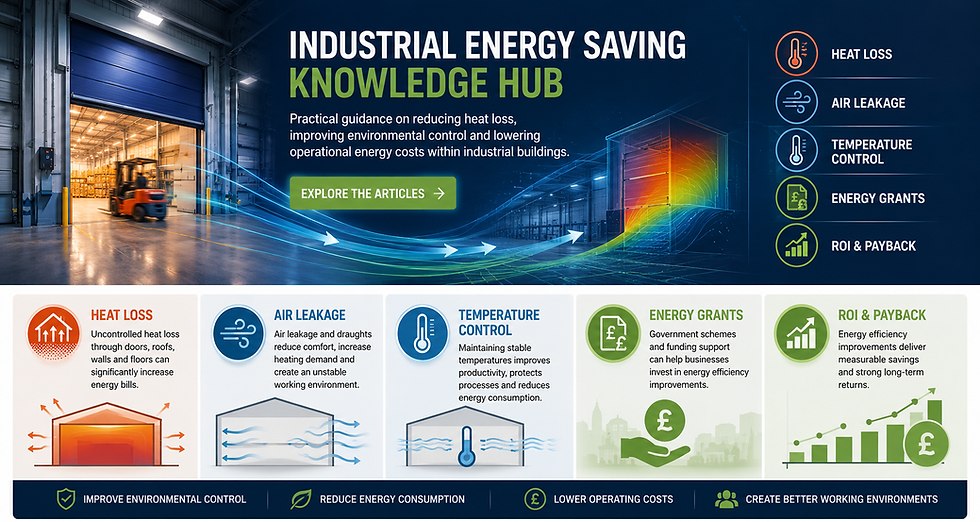
Practical Guidance For Industrial Environments
The information within this section is intended to provide practical and accessible guidance rather than overly technical theory.
Our aim is to help visitors better understand:
-
where energy loss commonly occurs
-
why environmental instability develops
-
how airflow behaves within industrial buildings
-
what operational factors influence efficiency
-
which types of improvements may help reduce energy waste
Whether you are researching a potential upgrade, seeking to reduce operational costs or simply trying to better understand industrial energy performance, these resources are designed to provide useful and practical insight.

What You Will Find Within This Section
Our energy saving articles cover a broad range of industrial and warehouse efficiency topics, including:
Heat Loss Through Industrial Openings
Large openings within warehouses and industrial buildings can allow substantial volumes of heated or conditioned air to escape. Understanding how and where this occurs is often the first step towards reducing unnecessary energy waste.

Air Leakage & Draught Control
Air movement within industrial buildings can have a major impact on comfort levels, environmental stability and heating efficiency. We explore how uncontrolled airflow develops and how it can be reduced.

Temperature Control Within Warehouses
Maintaining stable temperatures within industrial environments can be challenging, particularly where high traffic openings are involved. Our articles explain the practical considerations involved in managing internal temperatures more effectively.

Environmental Separation
Many industrial facilities require separation between operational areas to control temperature, contamination, dust, noise or airflow. This section explores how environmental separation contributes to building efficiency and operational performance.

U Values & Thermal Performance
Thermal performance terminology can often be confusing or misleading. Our guidance explains concepts such as U values and insulation performance in straightforward and practical terms.

Industrial Energy Reduction Strategies
Reducing energy usage within industrial premises often involves multiple improvements working together. We explore practical approaches that may help improve overall building efficiency and reduce operating costs.

Grant Funding & Energy Support
Government-backed schemes and energy reduction initiatives may be available to support certain efficiency improvements. This section provides general information regarding funding opportunities and wider energy reduction policies.

ROI & Payback Considerations
Many energy saving improvements can offer long-term operational savings. Our articles help explain how efficiency measures may contribute towards reduced running costs and improved operational performance over time.

In Conclusion
We hope you have found the information within this section useful and informative. Understanding how energy is lost within industrial buildings is often the first step towards improving efficiency, reducing operational costs and creating more controlled working environments.
While every building and operation is different, even relatively small improvements in areas such as airflow control, environmental separation and temperature stability can often make a meaningful long-term difference. Our aim is to provide practical guidance that helps businesses better understand the wider factors that influence industrial energy performance and operational efficiency.
Should you require any further information regarding industrial doors, environmental control or energy saving solutions within warehouses and industrial buildings, please feel free to get in touch with our team.

Energy Saving Doors
25 Britannia Square
Worcester
Worcestershire
WR1 3DH
United Kingdom
+44 1905 317878