
Building Pressure Explained
Understanding how invisible air movement influences energy performance, environmental control and door operation
Pressure is one of the least visible but most influential forces acting within industrial buildings. Although it cannot usually be seen directly, pressure differences affect energy use, comfort, humidity, environmental stability and even how industrial doors operate.
Many buildings unintentionally create pressure imbalance through extraction systems, heating, ventilation, process equipment and everyday operation. Once pressure differences develop, air begins moving through every available opening — including industrial doorways.
Understanding these forces helps explain why some buildings feel comfortable and efficient while others experience draughts, unstable temperatures, excessive heating costs and environmental control problems.

What Is Building Pressure?
Building pressure describes the balance between air entering and air leaving a building. When more air leaves than enters, negative pressure develops and external air is drawn inward. When more air enters than leaves, positive pressure occurs and air pushes outward.
Neither condition is automatically right or wrong. Some environments intentionally operate under controlled positive or negative pressure depending on process requirements. Problems tend to occur when pressure becomes uncontrolled or significantly different from design assumptions.
For industrial environments, pressure influences infiltration, temperature stability and operational performance. In some cases, pressure conditions may also influence how certain door systems behave during operation.

Why Pressure Differences Occur
Pressure differences are rarely created deliberately. Most commonly they develop gradually through normal operation.
Extraction systems, process equipment, ventilation units, heating systems, wind loading, vehicle movement and stack effect all influence how air moves through a building. When these influences become unbalanced, pressure begins to drive uncontrolled airflow.
Often the source of pressure is not obvious. A building may appear to have a “door problem” when the underlying issue is actually environmental imbalance elsewhere.

Negative Pressure & Door Behaviour
Industrial doors operate within an environment — not in isolation and pressure differences can influence the performance of high speed doors
Where significant negative pressure develops, airflow can become strong enough to influence opening behaviour, environmental separation and operational consistency. This is particularly relevant where extraction systems, process airflow or tall buildings create persistent inward pressure.
This does not necessarily indicate that a door has failed. In many cases the correct response is to understand and manage the environmental conditions rather than simply changing equipment.

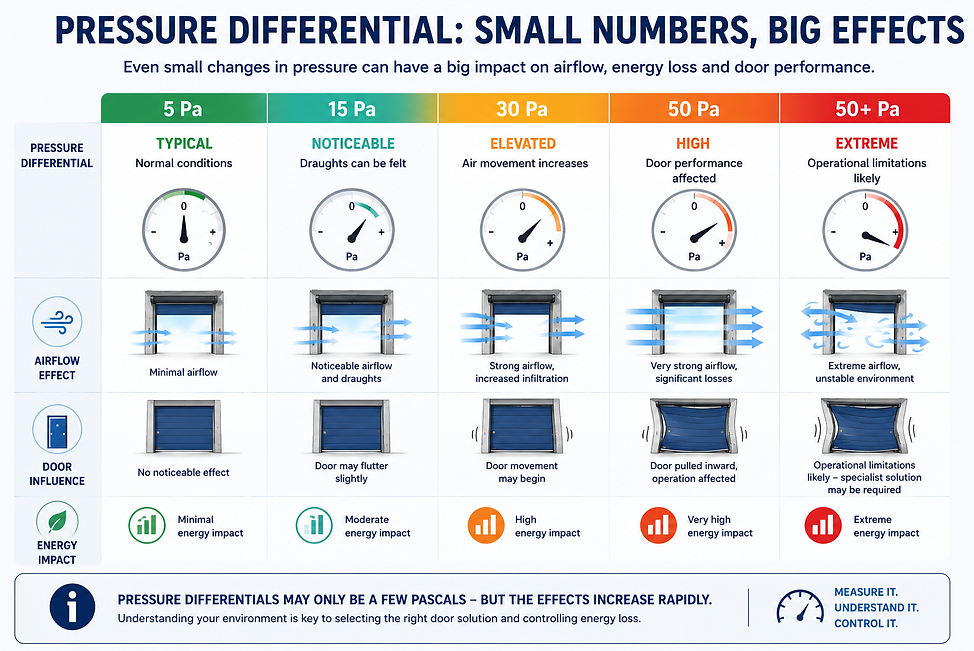
Pressure Differential: Small Numbers, Big Effects
Although pressure differences are often measured in relatively small numbers, their impact can be surprisingly significant. As pressure increases, air movement accelerates and conditioned air begins to escape through every available opening, gap and leakage path. The result is often increased heating demand, longer recovery periods and reduced environmental stability.
This is one reason why buildings with similar insulation levels can experience very different operating costs. Pressure-driven air exchange can introduce substantial energy losses that are not immediately visible but continue throughout the day. Understanding how air moves through a facility is therefore just as important as understanding the thermal performance of the building itself.
Many of these principles are explored in greater detail within our Heat Loss Guide, which explains how air movement, exposure time and environmental recovery contribute to the overall energy performance of industrial buildings.
Stack Effect Explained
Warm air naturally rises. In taller buildings this creates pressure differences between upper and lower levels.
As warm air escapes through higher areas, replacement air enters through lower openings. This process is known as stack effect and can continue continuously throughout the day.
Stack effect often becomes more pronounced in winter and can significantly influence temperature stability, air movement and energy demand.

Selecting the Right Door for the Environment
Not every environment behaves in the same way.
Different combinations of pressure, airflow, exposure and operational intensity influence which solutions may be most appropriate. Buildings with extraction, environmental zoning or frequent traffic patterns may require a different approach from general warehousing.
Considering environmental conditions during selection helps improve reliability, comfort and long-term performance.

Pressure Control Methods
Pressure problems are usually best addressed at source rather than simply treating the symptoms. Improving air balancing, reducing unnecessary exposure time and managing airflow patterns can often produce significant improvements in environmental stability and energy performance.
In some applications, additional measures may also help reduce unwanted air exchange. For example, strategically positioned air curtains can assist in controlling airflow across openings, helping to reduce infiltration and support environmental separation. While they do not create a complete seal, they can form part of a wider pressure management strategy when combined with suitable door systems and good operational practice.
The most effective solution will always depend on the specific building, its operation and the underlying cause of the pressure imbalance. Understanding how air moves through a facility is often the first step towards reducing energy loss and improving environmental control.

Can You Spot Pressure Problems?
Pressure issues are often hidden in plain sight.
Unexpected draughts, unstable temperatures, curtain movement, difficult openings and excessive energy use may all indicate that air movement deserves investigation.
Identifying symptoms early allows opportunities to improve environmental performance before problems become embedded into daily operation.

Final Thoughts
Pressure differences are often overlooked because they cannot be seen directly. However, the resulting air movement can influence temperature stability, humidity levels, environmental recovery and ultimately energy consumption.
For many facilities, reducing uncontrolled air exchange can produce measurable operational benefits. Understanding the financial impact of these losses is often the next step, which is why we have produced a dedicated guide to ROI savings and the factors that influence payback periods for environmental improvement projects.

Return on Investment
Energy-saving improvements are often evaluated on their technical performance, but the real question is usually much simpler: how long will it take for the investment to pay for itself?
The answer depends on a number of factors, including opening size, operating hours, traffic frequency, internal and external temperatures, energy costs and the amount of time that an opening remains exposed. Small changes in these variables can have a surprisingly large impact on annual energy consumption.
Our ROI Calculator has been developed to help estimate the potential savings associated with improved environmental control and reduced heat loss. By comparing your current operation with a proposed solution, it can provide an indication of both annual savings and likely payback period.