
Forklifts Move More Than Goods
How FLT Traffic Creates Hidden Energy Loss
Most warehouse managers focus on insulation, heating systems and lighting when looking for energy savings.
All of these are important. However, one of the largest causes of heat loss in many industrial buildings is often hiding in plain sight.
Forklift traffic.
Every time a forklift approaches a doorway, the building is temporarily connected to the outside environment.
🟢 Warm air can escape
🟢 Cold air can enter
🟢 Pressure changes begin to occur
🟢 Energy starts to move
In high-traffic environments, this process can happen hundreds of times every day. The surprising reality is that forklifts do far more than move goods. They also move air.

The Hidden Cost of Forklift Traffic
A forklift travelling through a doorway does not merely transport products from one location to another. It also disturbs the environment around it. As the vehicle passes through an opening it creates turbulence and pressure changes that encourage warm air to escape and colder external air to enter.
The larger the opening and the longer it remains exposed, the greater the exchange becomes. Many businesses spend thousands of pounds every year reheating air that has already been paid for once.
The problem is often invisible.
🟢 Nobody sees the heat escaping
🟢 Nobody notices the conditioned air leaving
Yet the heating system notices.
🟢 The energy meter notices
🟢 The operating budget notices

Forklifts Don't Just Move Goods
Most people think of forklifts as moving stock. In reality, they also move large quantities of air. As a forklift travels through an opening it behaves rather like a piston. It pushes air ahead of it and pulls air behind it.
The faster the movement and the larger the opening, the greater the disturbance. This is one reason why busy loading bays often experience disproportionately high levels of energy loss compared with quieter parts of the building.
If you would like to understand the broader relationship between airflow and energy efficiency, our article on Buildings Breathe explains how industrial buildings constantly exchange air with their surroundings.

Why Exposure Time Matters
The amount of energy lost through a doorway is largely determined by four factors:
🟢 Door size
🟢 Temperature difference
🟢 Frequency of operation
🟢 Door open time
Of these, door open time is often the easiest to overlook. A conventional industrial shutter may take between 45 and 90 seconds to complete a full cycle. A modern high-speed door may complete the same cycle in less than 20 seconds.
That difference may not sound significant. Until it happens thousands of times every year. Reducing exposure time dramatically reduces the volume of air exchanged between environments. Less air exchanged means less energy lost.

Small Delays Become Big Numbers
A single door cycle rarely causes concern. However, energy loss becomes significant when repeated throughout the working day.
Consider a typical warehouse:
🟢 18 forklift movements per hour
🟢 9 operating hours per day
🟢 250 operating days per year
This results in:
40,500 doorway exposures every year
Each exposure represents another opportunity for conditioned air to escape. Viewed individually, a single door cycle appears insignificant. Viewed collectively, the numbers become difficult to ignore.

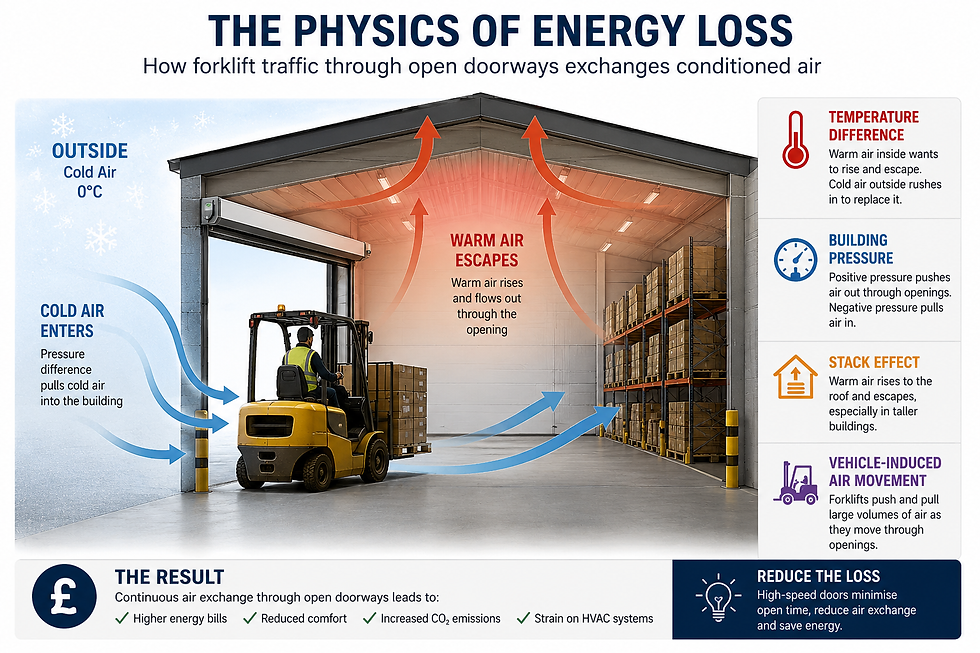
The Physics Behind The Loss
Several physical forces combine whenever a doorway is exposed.
Temperature Difference
Warm air naturally moves towards cooler environments.
Building Pressure
Pressure differences encourage airflow through openings.
Stack Effect
Warm air rises and seeks routes of escape.
Vehicle-Induced Air Movement
Forklifts physically push and pull air through the opening.
Together these forces create continuous energy loss whenever a doorway remains exposed. If you would like to explore these forces in greater detail, our guides to Building Pressure Explained and The Physics Of An Open Door explain exactly what happens when an opening connects two different environments.
Productivity Versus Energy Consumption
Warehouse managers are sometimes led to believe that they must choose between:
🟢 Energy efficiency
🟢 Operational efficiency
In reality, the opposite is often true. A faster doorway allows forklifts to move more efficiently while simultaneously reducing exposure time.
The result can be:
🟢 Lower heating costs
🟢 Improved workflow
🟢 Better temperature control
🟢 Reduced draughts
🟢 Improved employee comfort
🟢 Reduced energy consumption

Calculating Your Annual Energy Loss
Every building is different.
Potential energy savings depend upon:
🟢 Door dimensions
🟢 Internal temperature
🟢 Operating hours
🟢 Frequency of operation
🟢 Existing door speed
🟢 Local energy costs
🟢 Building usage patterns
By analysing these variables it is possible to estimate the annual cost of air loss through a frequently used doorway.
It is also possible to estimate the associated carbon emissions created by that wasted energy.
This is the principle behind our ROI Calculator, which estimates potential energy, carbon and financial savings from reducing doorway exposure time.

Why This Matters More Than Ever
Energy costs remain a major operating expense for many industrial facilities. At the same time, organisations are increasingly focused on sustainability, carbon reduction and environmental performance.
What makes forklift traffic particularly interesting is that it sits directly between operational efficiency and energy efficiency. Every unnecessary second that a doorway remains exposed increases:
🟢 Heat loss
🟢 Energy consumption
🟢 Carbon emissions
🟢 Operating costs
Reducing that exposure benefits all four simultaneously. This is one reason why energy-saving high-speed doors have become increasingly common in busy warehouse, manufacturing and distribution environments.

The Big Takeaway
Forklift traffic is not simply a logistics activity. It is also an airflow activity. Every movement through a doorway creates an opportunity for conditioned air to escape. Individually, these events appear insignificant.
Collectively, they can become one of the largest hidden causes of energy loss within an industrial building. Understanding this relationship is often the first step towards improving temperature control, reducing heating costs and creating a more energy-efficient warehouse environment.