
Record June Temperatures Highlight The Hidden Cost Of Open Industrial Doorways

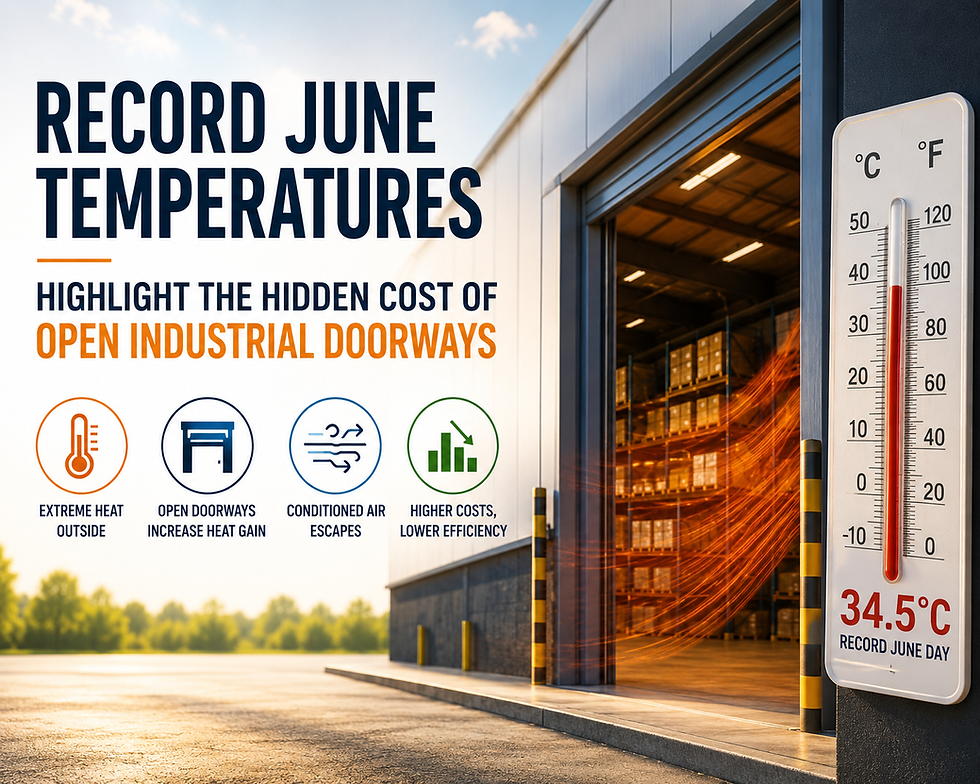
Today has seen some of the highest June temperatures ever recorded across parts of the United Kingdom.
For many people, extreme heat means uncomfortable offices, crowded beaches and discussions about climate change. For industrial facilities, however, record temperatures can present a very different challenge.
Warehouses, manufacturing facilities, distribution centres and production environments all rely upon maintaining suitable internal conditions for people, products and processes. During periods of extreme heat, this becomes increasingly difficult.
Whilst much attention is often given to insulation, HVAC systems and building fabric, one important factor is frequently overlooked: Operational doorways.
The Challenge Is Not Just Winter Heat Loss
When discussing industrial energy efficiency, conversations often focus on heat escaping from buildings during colder months.
However, the same principles apply in reverse during hot weather.
Every time a large industrial doorway opens, warm external air can enter the building whilst cooler conditioned air escapes. The larger the opening and the longer it remains open, the greater the opportunity for unwanted air exchange.
This can result in:
Increased cooling demand
Less stable internal temperatures
Reduced employee comfort
Increased HVAC operating costs
Greater energy consumption
Many businesses are surprised to discover just how much environmental separation can be affected by frequently used operational openings.
Industrial Buildings Are Constantly Breathing
Industrial facilities are not sealed boxes. Air naturally moves through buildings in response to temperature differences, pressure differences, wind effects and operational activity.
This process becomes increasingly noticeable during periods of extreme weather.
Large operational openings often become one of the most significant pathways through which external air enters the building.
Our article on Buildings Breathe explores this phenomenon in greater detail and explains why understanding air movement is becoming increasingly important for modern industrial facilities.
Why Door Speed Matters
A conventional industrial roller shutter may take 30 to 60 seconds to complete an opening and closing cycle. Multiply this by dozens or even hundreds of activations per day and the total annual exposure can become surprisingly significant.
This is where door speed becomes important. By reducing the amount of time an opening remains exposed, high speed doors can help support:
Improved temperature control
Reduced air exchange
Better environmental separation
Lower energy consumption
Improved operational efficiency
The benefits extend beyond winter heat retention. During hot weather, faster opening and closing cycles can also help reduce unwanted heat entering the building.
Understanding Open-Door Exposure
Many facility managers focus on how often a door opens.
However, the more useful question is often:
How long is the opening actually exposed each year?
A doorway that operates 20 times per hour for 10 hours per day can accumulate hundreds of hours of annual exposure. This is why we place such importance on measuring open-door exposure when carrying out ROI assessments. Exposure time provides a useful indicator of how much opportunity exists for uncontrolled air movement between internal and external environments.
Air Leakage And Environmental Control
Whenever a doorway is open, air naturally seeks equilibrium. Warm air, cool air, pressure differences and wind conditions all influence the movement of air through an opening.
Our articles on Air Leakage and Air Changes Per Hour explain how these factors can affect building performance, temperature stability and energy consumption. Whilst every facility is different, reducing unnecessary exposure time often forms an important part of a wider environmental control strategy.
What Does This Mean Financially?
Ultimately, most energy efficiency discussions come down to economics.
The question is not simply: "Can we reduce exposure?". The question is: "What is the value of reducing exposure?"
That is why we developed our Industrial Door ROI Assessment.
Using information about your doorway, operating patterns and facility conditions, we can produce a personalised report showing:
Open-door exposure analysis
Estimated annual energy savings
Carbon reduction opportunities
Estimated payback period
High speed door recommendations
The objective is to provide a practical assessment of how doorway performance may be affecting energy consumption and operating costs within your facility.
Extreme Weather Makes Doorway Performance More Important
Whether today's record temperatures represent a one-off event or part of a longer-term trend, businesses are increasingly having to manage both hotter summers and colder winters.
As energy costs remain under pressure and environmental performance receives greater scrutiny, the role of industrial doorways is becoming increasingly important.
A doorway is not simply an access point.
It is often one of the largest operational openings within a building and can have a significant influence on temperature control, environmental separation and energy efficiency.
Request Your Free Industrial Door ROI Assessment
If you would like to understand how your existing doorways may be affecting energy consumption, carbon emissions and operating costs, we can produce a personalised assessment tailored to your facility.
Our report includes open-door exposure calculations, estimated savings, carbon reduction analysis and indicative payback periods, helping you make informed decisions about future investment in doorway performance.


Comments