
How High Speed Doors Cut Winter Energy Costs

Energy costs remain a major concern for UK manufacturers, warehouses and distribution centres.
While businesses have limited control over the price they pay for energy, they have much greater control over how efficiently that energy is used.
For many industrial buildings, one area is still frequently overlooked: the doorway.
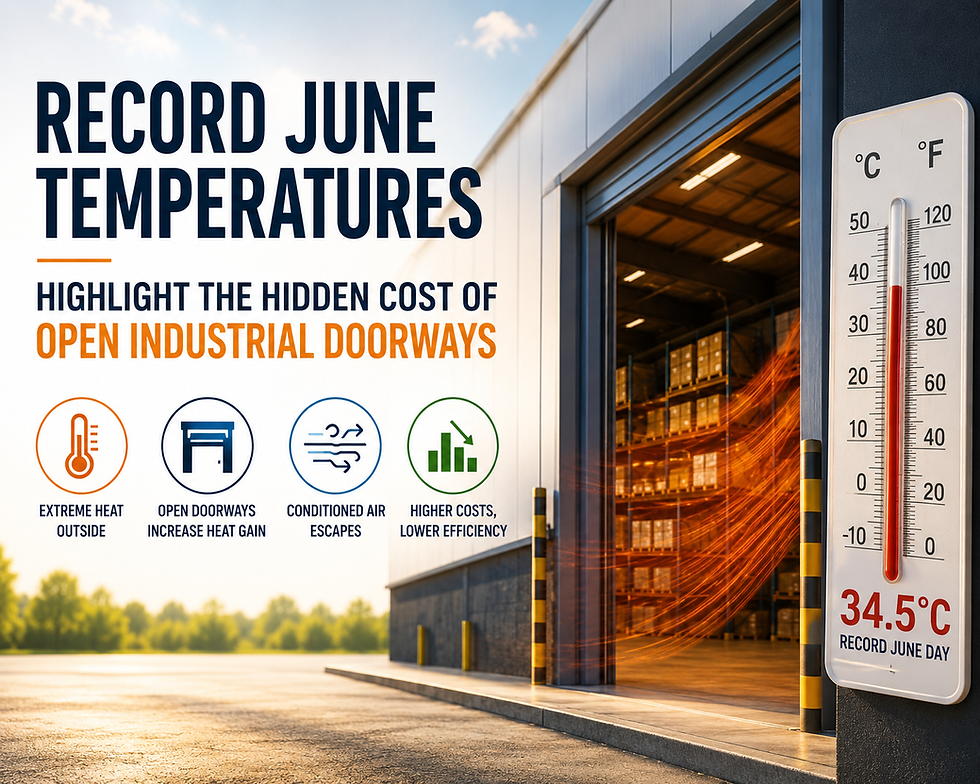
A large warehouse door may open dozens or even hundreds of times during a working day. Every time it opens, the building temporarily loses part of its environmental separation from the outside world.
Warm air can escape. Cold air can enter. Draughts develop. Heating systems work harder. And the longer the door remains open, the greater the opportunity for energy to be wasted.
This is why high speed doors are increasingly being considered not simply as industrial doors, but as part of a wider energy-efficiency strategy.
The Hidden Cost of an Open Warehouse Door
When looking at the energy performance of an industrial building, attention naturally turns to insulation.
Roof insulation, wall insulation, glazing and the U-value of doors all matter.
But there is an important difference between a wall and an industrial doorway.
Walls stay closed. Industrial doors don't.
The moment a door opens, the thermal performance of the closed door becomes temporarily irrelevant. Instead, the size of the opening, temperature difference, airflow and length of time the opening remains exposed become increasingly important.
Consider a busy warehouse with a large external roller shutter.
If the door operates slowly and remains open while a forklift passes through, the building may be exposed to outside conditions for a significant period during every cycle.
Multiply that by 20, 30 or 50 movements per hour and the accumulated open-door time can become considerable.
Door Speed Can Matter as Much as Door Insulation
This raises an important question when specifying an industrial door:
Should we only be asking how well the door insulates when closed?
In a frequently used opening, probably not.
We should also be asking:
How long is the doorway actually open?
A well-insulated door may perform extremely well while closed. But if operational requirements mean that it spends significant periods open throughout the working day, considerable air exchange can still occur.
A high speed door tackles the problem differently.
Rather than concentrating solely on thermal resistance, it opens and closes rapidly, reducing the period during which the building is exposed to external conditions.
In simple terms:
Less open time = less opportunity for uncontrolled air exchange.
Why High Speed Doors Can Reduce Energy Loss
High speed doors are specifically designed for frequently used industrial openings.
Depending on the application and door type, they can operate considerably faster than conventional roller shutters or sectional doors.
The objective is not simply to move the door faster.
The real benefit is to reduce doorway exposure time.
When appropriately specified, this can help to:
🟢 Reduce warm-air loss
🟢 Limit cold-air infiltration
🟢 Reduce draughts
🟢 Improve internal temperature stability
🟢 Reduce unnecessary demand on heating systems
🟢 Improve traffic flow
🟢 Maintain better separation between different working environments
The more frequently an opening is used, the more significant operating speed can become.
Think About Minutes, Not Millimetres
Industrial door specifications often concentrate on physical characteristics: curtain thickness, panel construction, seals and U-values.
These are important.
But for a busy operational doorway, another measurement deserves attention:
How many minutes each day is the building effectively open to the outside?
For example, imagine two doors installed into the same opening.
One takes considerably longer to complete its opening and closing sequence. The other is designed specifically for high-speed operation.
If that doorway operates only twice a day, the difference may have relatively little significance.
If it operates 200 times a day, the cumulative difference can be substantial.
This is why door selection should be based on how the building actually operates, rather than simply comparing products on a specification sheet.
Five Questions to Ask Before Winter
Before temperatures fall, businesses with frequently used warehouse and factory doors should consider five straightforward questions:
1. How often does the door operate?A doorway used five times a day presents a very different energy challenge from one used five times every ten minutes.
2. How long does each complete cycle take?Opening and closing time directly affects how long the building is exposed.
3. Does the door remain open unnecessarily?Manual controls and poorly positioned activation systems can result in doors remaining open long after vehicles or pedestrians have passed through.
4. Are the seals performing properly?Damaged guides, seals or curtains can allow unnecessary air leakage even when the door is closed.
5. Is the existing door still appropriate for the application?A conventional roller shutter may provide excellent security, but it may not be the most energy-efficient solution for an opening experiencing constant traffic.
Automatic Activation Can Make a Difference
Speed alone does not determine performance.
How the door is controlled can be equally important.
Radar detectors, induction loops, photocells, remote controls and other activation methods can allow a high speed door to respond to approaching traffic and close promptly once the opening is clear.
The objective should be simple:
Open when required. Close as soon as practicable.
Reducing unnecessary dwell time can improve environmental control without disrupting normal warehouse operations.
What Could Your Existing Door Be Costing You?
There is no meaningful single figure for the amount of energy a high speed door will save.
Every application is different.
Factors include:
🟢 Opening width and height
🟢 Internal temperature
🟢 External temperature
🟢 Number of activations
🟢 Operating hours
🟢 Existing door speed
🟢 Proposed door speed
🟢 Building pressure and airflow
🟢 Heating costs
That is why generic claims about energy savings should be treated cautiously.
A better approach is to assess the actual doorway.
At Energy Saving Doors, we can examine the opening dimensions, operating temperatures, traffic frequency and existing door cycle time to estimate the potential reduction in energy loss and assess the likely return on investment from installing a high speed door.
Energy Efficiency Is About the Building in Operation
A warehouse does not consume energy under laboratory conditions.
Doors open. Forklifts move. Vehicles arrive. Staff walk between areas. Wind acts on external openings and internal and external temperatures continually change.
Real energy efficiency therefore depends on how the building performs during normal operation.
For frequently used industrial openings, reducing the time for which the doorway remains exposed can be one of the practical measures available to improve that performance.
With energy costs remaining an important consideration for UK industry, this winter is a good time to look beyond the heating system itself and ask a different question:
Where is the heat actually going?
The answer may be through a doorway that is simply staying open for too long.
Is Your Industrial Door Wasting Energy?
If you operate a warehouse, factory, distribution centre or temperature-controlled facility, we can assess your existing doorway and recommend the most appropriate high speed door for the application.
We can also undertake an energy-saving and ROI assessment, using your actual door dimensions, operating frequency, temperatures and existing door cycle time.
Talk to Energy Saving Doors before winter and find out what your existing doorway could be costing you


Comments