
Factory Energy Savings: Tax Incentives & High-Speed Doors


How UK manufacturers can reduce energy costs, improve factory efficiency and explore available tax relief on qualifying investments.
Updated: October 2026
With energy costs continuing to place pressure on UK manufacturers, improving factory energy efficiency is becoming an increasingly important commercial consideration.
From upgrading manufacturing equipment to improving building insulation and reducing heat loss through frequently used doorways, businesses have numerous opportunities to reduce energy consumption and operating costs.
But what tax incentives and government support are available in 2026? And how can investing in energy-efficient industrial doors contribute to a wider energy-saving strategy?
1. Capital Allowances: Tax Relief on Factory Investment
One of the principal tax incentives available to UK businesses is the Annual Investment Allowance (AIA).
This allows businesses to deduct up to £1 million of qualifying expenditure on plant and machinery from their taxable profits, subject to the relevant eligibility rules.
Qualifying investments may include:
Manufacturing and production machinery.
Certain heating, ventilation and electrical systems.
Eligible energy-management equipment.
Other qualifying plant and machinery used in business operations.
For example, a company investing £50,000 in qualifying equipment could potentially deduct the full £50,000 from its taxable profits in the relevant accounting period.
At a corporation tax rate of 25%, this could represent a tax saving of £12,500, assuming sufficient taxable profits.
Important: Not all factory improvements qualify for the AIA. HMRC generally treats doors, gates and shutters as part of a building rather than plant and machinery. Consequently, an ordinary industrial door installation should not automatically be assumed to qualify for this relief.
2. Full Expensing: Another Incentive for Manufacturers
Full expensing allows qualifying companies to deduct 100% of expenditure on certain new and unused plant and machinery from their taxable profits in the year of investment.
This can make investment in modern, efficient manufacturing equipment more financially attractive.
For factory operators considering wider improvements, full expensing may support investment in qualifying production equipment and other eligible machinery.
However, as with the Annual Investment Allowance, the precise classification of expenditure matters.
Businesses should seek professional tax advice before assuming that particular building improvements or industrial door installations qualify.
3. Can Factory Insulation Improvements Qualify for Tax Relief?
Improving thermal insulation can help factories reduce heating demand, particularly where buildings have large external openings, extensive roof areas or poorly insulated structures.
Certain qualifying expenditure on building construction or renovation may be eligible for the Structures and Buildings Allowance (SBA).
This generally provides tax relief over an extended period rather than an immediate 100% deduction.
Eligibility depends on the nature of the works, the building and the expenditure involved. Routine repairs and replacement doors do not automatically qualify.
For businesses undertaking substantial factory improvements, it is worth asking their accountant whether any expenditure qualifies for this allowance.
4. New Government Support for Industrial Electricity Costs
An important development in 2026 is the British Industrial Competitiveness Scheme (BICS).
The Government opened applications on 1 October 2026, with a closing date of 30 November 2026.
The scheme is intended to reduce electricity costs for eligible manufacturers by providing exemptions from certain electricity policy costs.
Government estimates suggest that qualifying businesses could see electricity bills reduced by up to 25%, although actual savings depend on eligibility and individual circumstances.
To qualify, businesses must meet specific requirements relating to their manufacturing activities, products and electricity consumption.
Support is scheduled to begin in 2027.
Although BICS is not a tax incentive for installing energy-efficient doors, it is another opportunity for manufacturers to examine their overall energy expenditure.
5. The Hidden Energy Cost of Industrial Doorways
While tax incentives can help reduce the cost of qualifying investments, the operational savings achieved through improved factory efficiency can be equally important.
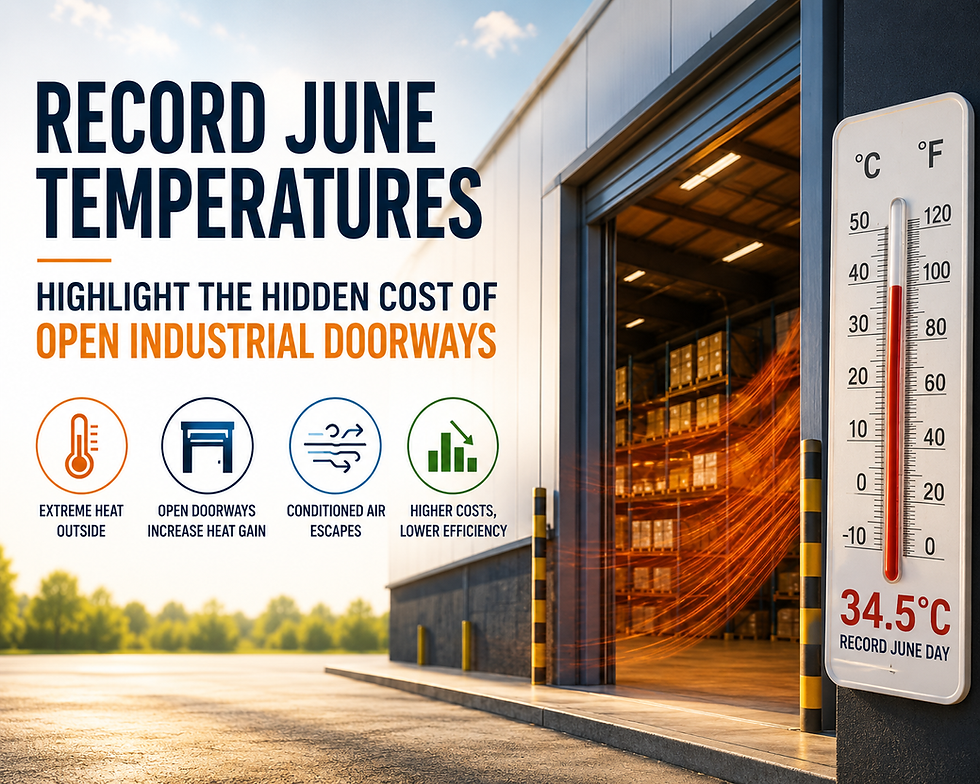
One frequently overlooked source of energy loss is the industrial doorway.
In factories, warehouses and distribution centres, large doors may open dozens or even hundreds of times throughout a working day.
Each opening creates an opportunity for warm internal air to escape and colder external air to enter.
This can increase the demand placed on heating systems, particularly during the winter months.
The extent of the energy loss depends on several factors:
The width and height of the doorway.
The difference between internal and external temperatures.
How frequently the door opens.
How long the doorway remains open.
Air movement, wind exposure and pressure differences.
The thermal performance of the closed door.
Reducing unnecessary doorway opening time can therefore form an important part of a factory's energy-efficiency programme.
6. How High-Speed Doors Can Reduce Factory Heating Costs
Traditional industrial roller shutters are often designed primarily for security and access control.
Although suitable for many applications, their relatively slow opening and closing speeds can result in significant periods during which a large doorway remains exposed.
Modern high-speed industrial doors are designed to reduce opening and closing times, helping to limit uncontrolled air exchange.
Consider a factory doorway used 10 times per hour over a 10-hour working day.
That represents 100 operating cycles daily.
If an existing shutter leaves the opening exposed for 120 seconds per cycle, compared with 20 seconds for a suitably specified high-speed door, the difference is substantial.
Operating characteristic | Existing shutter | High-speed door |
Opening exposure per cycle | 120 seconds | 20 seconds |
Daily operating cycles | 100 | 100 |
Total daily exposure | 200 minutes | 33 minutes |
Reduction in exposure time | — | Approximately 83% |
Illustrative comparison based on the stated cycle assumptions. Actual energy savings depend on temperature differences, airflow, door operation and other site conditions.
Reducing doorway exposure by approximately 83% does not necessarily mean reducing the building's total heating consumption by the same percentage.
Nevertheless, it demonstrates why door operating speed can be an important consideration when assessing factory energy efficiency.
7. Choosing the Right Energy-Efficient Industrial Door
Different factory applications require different solutions.
High-Speed PVC Doors
High-speed doors can be particularly effective where frequent pedestrian, forklift or vehicle movements require rapid access.
Their fast operation can help maintain separation between areas with different environmental conditions.
High-Speed Insulated Roller Shutters
For external factory openings where thermal insulation, security and frequent access are all important, high-speed insulated roller shutters may offer an effective combination of performance characteristics.
They combine an insulated door curtain with faster operation, helping reduce both heat transfer through the closed door and the time the opening is exposed.
Insulated Industrial Roller Shutters
Where opening frequency is relatively low, an insulated industrial roller shutter may provide an appropriate alternative.
The correct solution depends on the building, operational requirements and expected frequency of use.
8. Understanding the Return on Investment
When assessing the financial benefits of an energy-efficient industrial door, the purchase price should be considered alongside its potential operational savings.
A meaningful assessment should examine:
The installed cost of the proposed door.
Existing and proposed doorway exposure times.
Opening frequency throughout the working day.
Factory operating hours and annual working days.
Internal and external temperature conditions.
Energy prices and heating-system efficiency.
Estimated annual energy savings and investment payback.
For factories operating heated environments with frequently used external doorways, the potential savings can be significant.
However, calculations should be based on realistic site-specific information rather than generic claims about energy savings.
9. Are Grants Available for Energy-Efficient Factory Improvements?
In addition to national tax allowances, some businesses may be able to access regional or local funding programmes supporting energy-efficiency improvements.
Availability varies by location, business size, project type and funding period.
Some programmes may support energy audits, insulation improvements, heating upgrades or other measures designed to reduce energy consumption.
Businesses should check with their local authority, regional growth hub or relevant funding body before committing to expenditure.
Grant availability should never be assumed, and any application should be assessed against the current programme rules.
10. A Practical Approach to Reducing Factory Energy Costs
For manufacturers planning energy-efficiency improvements, a sensible starting point is to identify where energy is being wasted.
Heating systems, building insulation, production equipment and industrial doorways should all be considered.
In particular, factories with large external doors that operate frequently may benefit from reviewing the performance of their existing shutters.
A properly specified high-speed door can offer more than rapid access. It can contribute to better temperature control, improved working conditions and reduced unnecessary energy consumption.
Any available tax relief or government support should then be considered as part of the overall investment assessment.
Expert Advice from Energy Saving Doors
At Energy Saving Doors, we specialise in industrial door solutions designed to meet the operational requirements of factories, warehouses and distribution facilities.
Our experience covers high-speed doors, insulated roller shutters and specialist industrial door systems.
We can help businesses assess their existing doorways, identify suitable replacements and consider the potential energy-saving benefits of faster operation and improved insulation.
Considering an upgrade to your factory doors?
Contact Energy Saving Doors to discuss your requirements and explore how a suitable industrial door system could help reduce energy losses.
Telephone: 01905 317878Email: info@energysavingdoors.comWebsite: www.energysavingdoors.com
Tax information is provided for general guidance only and reflects published UK guidance as at October 2026. Eligibility for capital allowances, government schemes and grants depends on individual circumstances. Businesses should obtain advice from their accountant or tax adviser before making investment decisions.


Comments