
Fire Rated Roller Shutters
Protecting life, property and business continuity, fire rated roller shutters are a critical part of any building’s passive fire protection strategy. Designed to automatically close in the event of a fire, they help contain flames and smoke, maintaining compartmentation and allowing safe evacuation.
At Energy Saving Doors, we supply and install both industrial fire shutters for large openings and tube motor fire shutters for smaller applications, ensuring the correct solution for every environment.
Request a free site survey to ensure the correct specification for your premises.
Defining A Fire Shutter
Fire shutters are specialist roller shutters designed to close automatically in the event of a fire, forming a protective barrier that helps prevent the spread of flames and smoke between different areas of a building.
Unlike standard roller shutters, fire shutters are integrated with fire alarm systems and include fail-safe mechanisms to ensure closure even in the event of power failure.
Fire rated roller shutters play a vital role in modern building safety by maintaining fire compartmentation and preventing the spread of fire through openings such as doorways, corridors and service areas. Commonly installed in warehouses, factories, commercial kitchens and public buildings, fire shutters are designed to activate automatically when connected to a fire alarm system, ensuring reliable protection when it matters most.

Fire Rating Explained
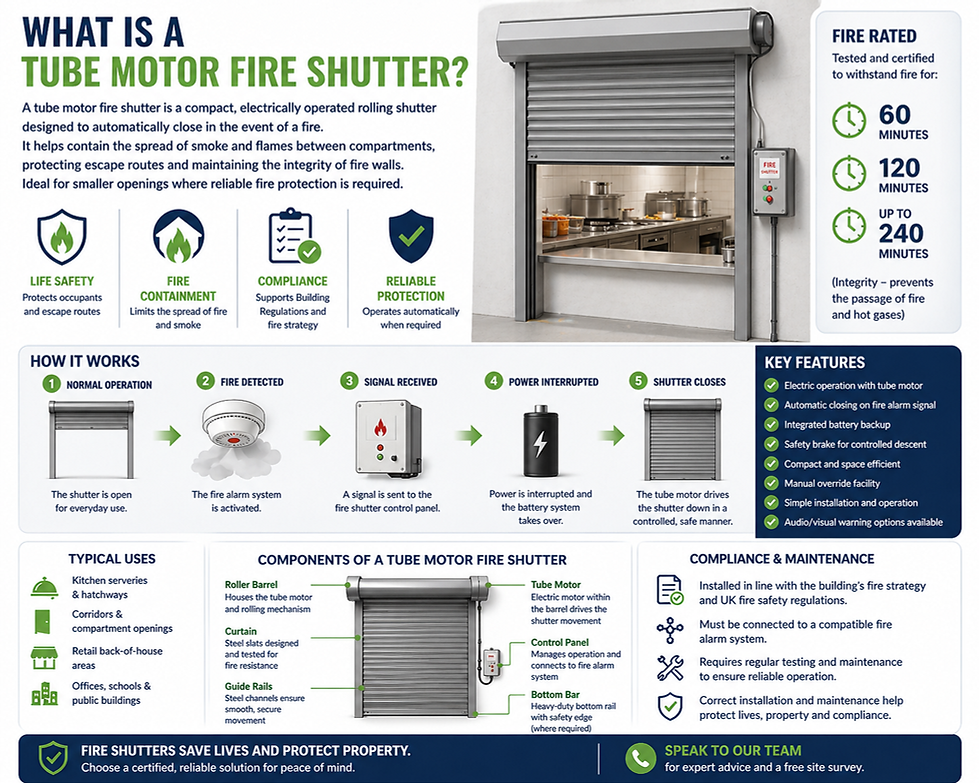
Fire shutters are typically rated based on how long they can withstand fire exposure:
🟢 60 minutes
🟢 120 minutes
🟢 Up to 240 minutes (industrial applications)
Key Distinction:
🟢 Integrity: Prevents flames passing through
🟢 Insulation: Limits heat transfer
It is important to distinguish between integrity and insulation. While integrity relates to stopping flames, insulation refers to limiting the transfer of heat from one side of the shutter to the other. Most industrial fire shutters are designed to provide integrity only, meaning they will contain the fire but may still allow heat to pass through. Insulated fire-rated systems are available, but these are typically different products and should be specified separately where required.
Energy Saving Doors’ fire shutters have been independently tested and accredited by Warringtonfire, one of the UK’s leading fire testing authorities. Warringtonfire operates under UKAS (United Kingdom Accreditation Service) accreditation, which is the government-recognised body responsible for ensuring that testing and certification organisations meet strict international standards.
In practical terms, this means the fire ratings quoted are not theoretical or assumed—they are proven through rigorous, independently verified testing. UKAS accreditation provides confidence that the testing process is impartial, consistent and carried out to recognised standards, giving you assurance that the product will perform as specified in the event of a fire.
Understanding fire shutter ratings is essential when specifying the correct system for your building. Fire rated roller shutters are generally tested for integrity, meaning they prevent flames from passing through for a defined period, typically 60 or 120 minutes. Unlike some fire doors, most roller shutters do not provide insulation against heat transfer, making it important to ensure the surrounding structure meets or exceeds the required fire rating.

Industrial Fire Shutters
Industrial fire shutters are designed to operate automatically in the event of a fire, forming a vital part of a building’s passive fire protection system. While they remain open during normal operation, their true function is activated when a fire alarm is triggered.
Upon receiving a signal from the fire alarm system, the shutter’s control panel initiates a controlled release. Rather than dropping instantly, the shutter descends at a regulated speed, often with an initial delay or staged closure if required. This ensures safe operation, allowing occupants time to clear the area while providing audible and visual warnings during movement.
The system is typically fail-safe, meaning that in the event of a power failure, the shutter will still close using a battery backup or gravity-assisted mechanism. A key safety feature within the assembly is the safety brake, which prevents uncontrolled descent and ensures the curtain lowers in a controlled and predictable manner.
Once fully closed, the shutter forms a fire-resistant barrier, helping to contain flames and limit the spread of smoke between compartments. This containment is crucial in protecting escape routes, reducing damage to property and supporting firefighting efforts.
After activation, the shutter can be reset—either manually or automatically depending on the system specification—once the alarm condition has been cleared and it is safe to do so.
In essence, industrial fire shutters are designed to react instantly and reliably when needed, operating in the background to provide a critical layer of protection without interrupting day-to-day operations.
How Industrial Fire Shutters Works
Industrial fire shutters are designed to operate automatically in the event of a fire, forming a vital part of a building’s passive fire protection system. While they remain open during normal operation, their true function is activated when a fire alarm is triggered.
Upon receiving a signal from the fire alarm system, the shutter’s control panel initiates a controlled release. Rather than dropping instantly, the shutter descends at a regulated speed, often with an initial delay or staged closure if required. This ensures safe operation, allowing occupants time to clear the area while providing audible and visual warnings during movement.
The system is typically fail-safe, meaning that in the event of a power failure, the shutter will still close using a battery backup or gravity-assisted mechanism. A key safety feature within the assembly is the safety brake, which prevents uncontrolled descent and ensures the curtain lowers in a controlled and predictable manner.
Once fully closed, the shutter forms a fire-resistant barrier, helping to contain flames and limit the spread of smoke between compartments. This containment is crucial in protecting escape routes, reducing damage to property and supporting firefighting efforts.
After activation, the shutter can be reset—either manually or automatically depending on the system specification—once the alarm condition has been cleared and it is safe to do so.
In essence, industrial fire shutters are designed to react instantly and reliably when needed, operating in the background to provide a critical layer of protection without interrupting day-to-day operations.

Tube Motor Fire Shutters
Fire Shutters for Smaller Openings
Compact, efficient and cost-effective, tube motor fire shutters are ideal for smaller openings where fire protection is required without the need for heavy industrial systems.
🔹 Key Features
🟢 Integrated tube motor system
🟢 Battery backup for emergency closing
🟢 Fire control panel (FCP Lite or similar)
🟢 Safety brake for controlled descent
🟢 Compact design for restricted spaces
🔹 How They Operate
🟢 Normal Operation: Operates electrically during normal use
🟢 Fire Alarm Activation: Power is interrupted
🟢 Automatic Closure: Battery system initiates closure
🟢 Controlled Descent: Shutter descends safely and automatically
Tube motor fire shutters provide an effective fire protection solution for smaller openings such as serveries, corridors and internal access points. Combining everyday convenience with automatic fire response, these shutters operate electrically under normal conditions but will close automatically when triggered by a fire alarm system. With integrated battery backup and compact design, tube motor fire shutters are widely used in commercial and public buildings where space is limited.
🔹 Typical Applications
🟢 Kitchen serveries
🟢 Corridors
🟢 Retail back-of-house areas
🟢 Internal compartmentation
🔹 Control & Activation Options
🟢 Wall-mounted push button control (hardwired)
🟢 Key switch operation
🟢 Fire alarm interface
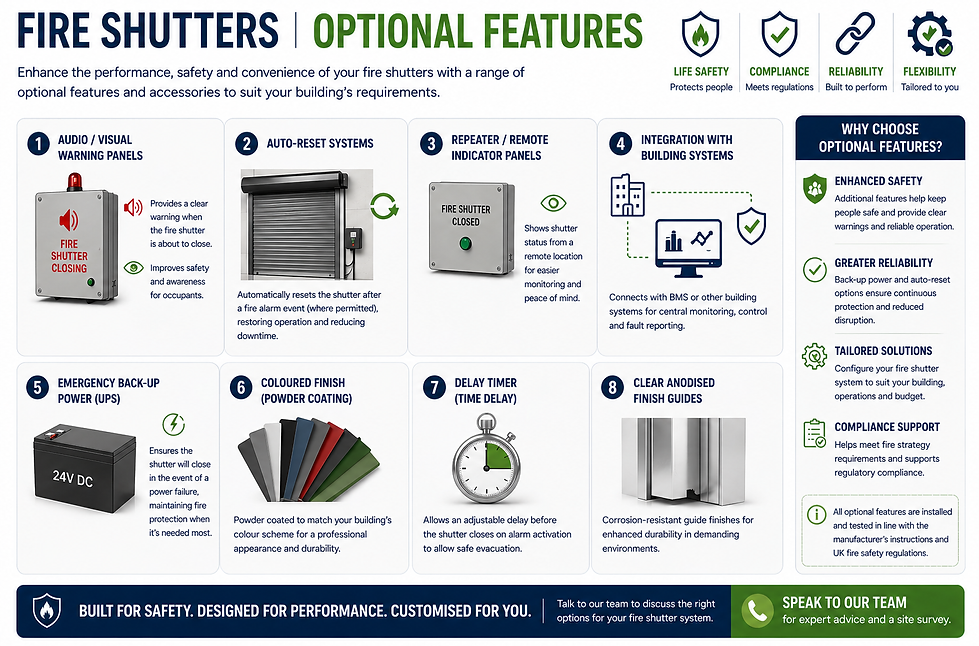
🟢 Optional audio-visual warning panels
🔹 Installation Requirements
🟢 13A switched fused spur
🟢 Fire alarm connection (by others)
🟢 Suitable mounting structure
Compliance & Legal Requirements
Fire shutters form part of a building’s fire safety system and must be correctly specified, installed and maintained.
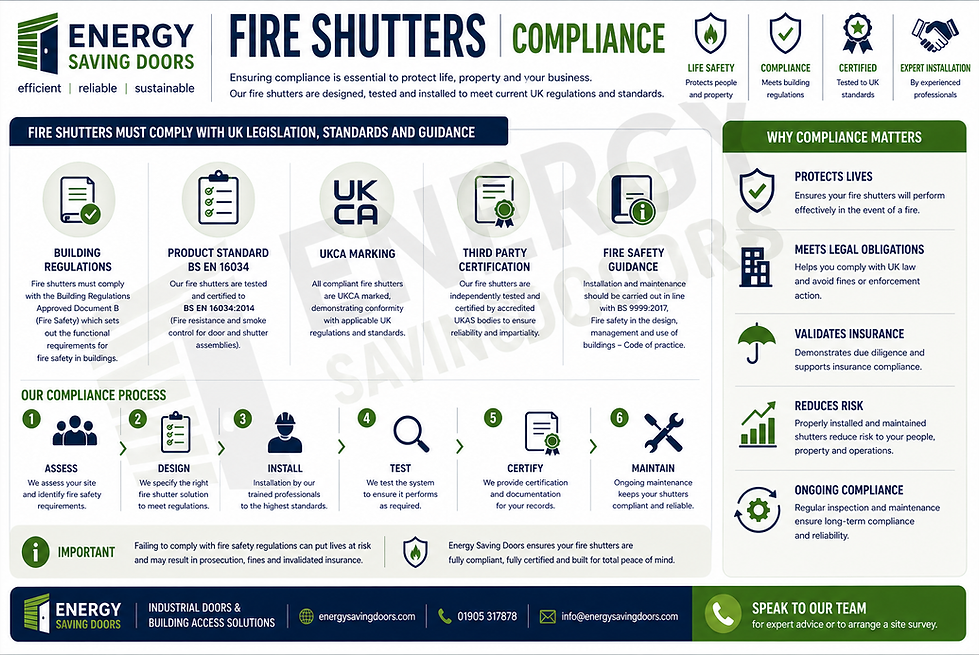
🟢 Must comply with fire safety regulations
🟢 Must be connected correctly to fire alarm systems
🟢 Must be regularly serviced
Compliance with fire safety regulations is essential when installing fire rated roller shutters. Under current legislation, building owners and responsible persons must ensure that fire protection systems are fit for purpose and properly maintained. Fire shutters must be correctly integrated with fire alarm systems and tested regularly to ensure reliable operation in the event of an emergency.
🔷 COMMON MISTAKES TO AVOID
🟢 Incorrect fire rating selection
🟢 Assuming insulation performance
🟢 Poor integration with the fire alarm system
🟢 Inadequate structural support
🟢 Lack of servicing
🔷 SERVICING & MAINTENANCE
Regular servicing is essential to ensure continued compliance and safe operation.
🟢 Routine inspections
🟢 Functional testing
🟢 Component checks
🟢 Legal compliance support
Regular maintenance of fire shutters is not only recommended but often a legal requirement. Scheduled servicing ensures that all components, including motors, release mechanisms and control systems, operate correctly when needed. Proper maintenance reduces the risk of failure, ensures compliance with fire safety regulations and extends the lifespan of the system.
🔷 CASE STUDIES / INSTALLATIONS
We have supplied and installed fire shutters across a wide range of sectors, delivering tailored solutions for both large industrial openings and smaller internal applications.
Common Mistakes To Avoid With Fire Shutters
Fire shutters are highly effective when correctly specified, installed and maintained—but there are a number of common mistakes that can compromise their performance when they are needed most.
One of the most frequent issues is incorrect specification. Not all fire shutters offer the same level of protection, and selecting a product without the appropriate fire rating or application suitability can leave a building non-compliant. It is essential that the shutter matches the required fire integrity period and is appropriate for the specific opening and environment.
Another common oversight is failing to ensure proper integration with the fire alarm system. Fire shutters rely on a signal to activate, and if this connection is not correctly installed or tested, the shutter may not operate in an emergency. It is also important to remember that fire alarm connections are typically carried out by others, and coordination between trades is critical.
Poor installation or unsuitable structural support can also undermine performance. Fire shutters must be installed into a structure capable of supporting both the shutter and the fire rating requirement. If the surrounding wall construction does not meet or exceed the shutter’s rating, the effectiveness of the entire system is compromised.
Lack of regular servicing is another key risk. Fire shutters are safety-critical systems and require routine inspection to ensure all components—such as release mechanisms, control panels and safety devices—are functioning correctly. Without maintenance, faults can go unnoticed until it is too late.
Finally, misuse in day-to-day operation can lead to problems. Blocking the shutter opening, interfering with guides, or modifying the system can prevent correct closure and invalidate compliance.
Avoiding these common mistakes ensures that your fire shutters will perform exactly as intended—providing reliable protection, supporting legal compliance and safeguarding both people and property in the event of a fire.

Points To Consider When Specifying A Fire Shutter
Specifying the correct fire shutter is a critical decision that directly impacts building safety, compliance and overall system performance. While the primary function is to contain fire, several key factors must be carefully considered to ensure the solution is both effective and appropriate for the application.
The first consideration is the required fire rating. Fire shutters are designed to provide fire integrity for a defined period—commonly 60, 120 minutes or more—and this must align with the building’s fire strategy and regulatory requirements. It is equally important to understand that most fire shutters provide integrity only, not insulation, unless specifically designed to do so.
Opening size and location also play a significant role. Larger openings or high-risk areas such as loading bays, service corridors and warehouse divisions may require more robust or specialised systems. The surrounding structure must also be capable of supporting the shutter and achieving the required fire rating, as the overall performance is dependent on both the product and its installation environment.
Integration with the fire alarm system is another essential element. The shutter must be correctly interfaced to ensure automatic activation in the event of a fire. Consideration should also be given to control methods, reset functionality and whether additional features such as audio-visual warning panels are required for safe operation.
Operational requirements should not be overlooked. In many cases, the shutter will remain open during normal use, so it is important to ensure it does not interfere with traffic flow, access or day-to-day activities. Where frequent operation is required, alternative door types or enhanced specifications may be more suitable.
Finally, ongoing maintenance and access for servicing should be factored into the specification. Fire shutters are safety-critical systems and must be regularly inspected to remain compliant and fully operational.
By carefully considering these factors at the specification stage, you can ensure that the fire shutter not only meets regulatory requirements but also integrates seamlessly into the building—providing reliable, long-term protection when it matters most.
Installation Requirements For Fire Shutters
Correct installation is essential to ensure that a fire shutter performs as intended in the event of a fire. As a safety-critical product, it is not simply a case of fitting a door into an opening—every element of the installation must support the overall fire protection strategy.
One of the most important considerations is the surrounding structure. The wall or supporting construction into which the shutter is installed must have a fire rating equal to or greater than that of the shutter itself. Without this, the effectiveness of the fire compartmentation is compromised, regardless of the shutter specification.
Adequate structural support is also required to carry the weight of the shutter assembly, including the barrel, guides and motor. Fixing points must be secure and appropriate for the substrate, whether steelwork, concrete or masonry, ensuring long-term stability and safe operation.
Power supply requirements must be planned in advance. Typically, a suitable electrical supply should be provided within close proximity to the motor position, allowing for safe commissioning and reliable operation. In addition, coordination with the fire alarm contractor is essential, as the shutter must be correctly interfaced to ensure automatic activation in an emergency.
Clearances and access are another key factor. Sufficient space must be allowed for the shutter to be installed, maintained and serviced safely. This includes access to control panels, override systems and any safety devices, as well as ensuring the opening itself remains unobstructed.
Finally, installation should always be carried out in accordance with relevant standards and best practice, with full testing and commissioning upon completion. This ensures that all safety features, control systems and automatic functions operate correctly before the system is handed over.
By meeting these installation requirements, you can be confident that the fire shutter will operate reliably, comply with regulations and provide effective protection when it is needed most.

Understand your legal obligations and ensure your fire shutters remain safe, compliant and efficient.
Explore our guides to legal requirements and what’s included in a professional service visit to keep your doors operating at peak performance.


Servicing & Legal Requirements


Fire Protection & Energy Efficiency
Fire shutters play a vital role in modern buildings by helping to prevent the spread of fire and protecting escape routes, assets and personnel. In many applications, they form an important part of the overall fire strategy and are designed to operate only in the event of an emergency.
However, whilst fire shutters provide essential fire compartmentation, they are not normally specified to improve operational efficiency or reduce energy consumption. In fact, many fire shutters remain fully open during normal day-to-day operation and only close when activated by the fire alarm system.
As a result, facilities managers often consider fire protection and energy efficiency as two separate requirements. A fire shutter may provide the necessary fire rating for a particular opening, whilst other openings within the same building may benefit from solutions designed to reduce heat loss, control air movement and improve traffic flow.
Where temperature control and energy efficiency are important considerations, our guides to Energy Saving and High Speed Roller Shutter Doors explain how reducing open-door exposure can help lower running costs and improve environmental control.
You may also wish to use our ROI Calculator to estimate the potential financial savings that can be achieved by reducing unnecessary air exchange through frequently used openings.

Fire-Rated Shutters Specified with Confidence
When it comes to fire protection, reliability and compliance are critical. We design, manufacture, and install fire rated roller shutters that are built to perform when it matters most.
Our shutters are produced using proven designs and high-quality components, ensuring consistent performance and full alignment with current UK standards. Each solution is specified to suit your opening, fire rating requirement, and building layout — not a one-size-fits-all approach.
With extensive experience across industrial, commercial, and trade environments, we understand the practical demands of installation and long-term use. Our team ensures that every shutter is installed correctly, commissioned safely, and ready to integrate with your fire strategy.
From initial advice through to installation and aftercare, the focus is on delivering a dependable, compliant solution that protects your building, your assets, and your people.
👉 Speak to our team to discuss your fire protection requirements or arrange a site survey.
Energy Saving Doors
25 Britannia Square
Worcester
Worcestershire
WR1 3DH
United Kingdom
+44 1905 317878