
How Much Heat Is Lost Through an Open Warehouse Door?
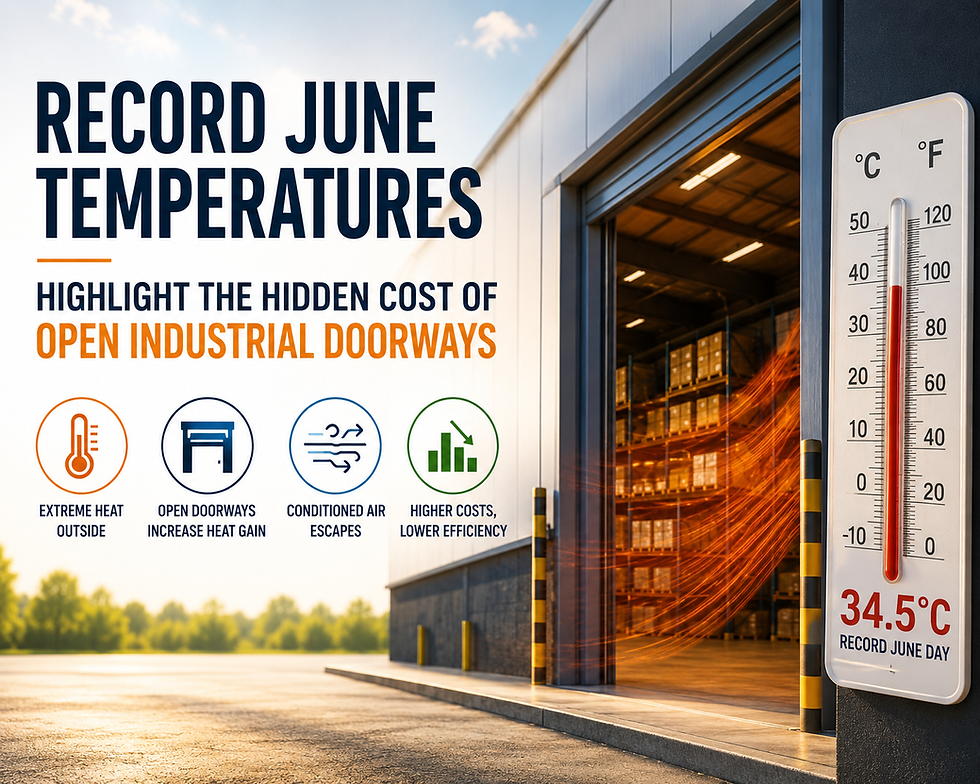
Industrial buildings lose heat in many different ways, but one of the largest and most overlooked sources of energy loss is often the simplest — an open doorway.
While insulation within walls and roofs is important, a frequently used warehouse opening can allow a significant amount of heated air to escape in a very short period of time. In busy environments, where doors may open dozens or even hundreds of times each day, this energy loss can become substantial.
For many businesses, improving the performance of industrial openings can provide a practical opportunity to improve environmental control, reduce draughts and lower overall operating costs.
Why Open Industrial Doorways Create Heat Loss
Warm air naturally moves towards colder air. When a warehouse or industrial building contains heated internal air and a door is opened, that conditioned air immediately begins to escape.
At the same time:
colder external air enters the building
wind pressure increases air exchange
forklifts and traffic movement disturb airflow
heating systems work harder to compensate
In taller buildings, the “stack effect” can make the problem even worse, with warmer air naturally rising and escaping rapidly through open high-level openings.
This means that even a relatively short door opening cycle can have a measurable effect on the internal environment.
This is particularly important in buildings where maintaining stable temperatures or improving environmental control is a priority.

Why Door Open Time Matters
Many traditional industrial doors simply remain open for too long.
In practice, the issue is often not just the number of times the door opens, but how long the opening remains exposed during each cycle.
Conventional roller shutters or sectional doors may:
accelerate slowly
open at low speeds
remain open unnecessarily
close slowly
be manually operated or delayed by traffic
Over the course of a working day, these delays can add up to hours of unnecessary exposure.
This is one of the reasons why many businesses are now reviewing the benefits of high speed doors in warehouse and industrial environments.
The Hidden Cost of Frequent Door Cycles
A warehouse opening used by forklifts or delivery vehicles may operate continuously throughout the day.
In busy facilities, it is common for:
loading bay doors
warehouse access points
production area openings
dispatch areas
cold storage entrances
to open many times per hour.
Even relatively small reductions in door open time can have a significant cumulative effect over:
weeks
months
years
This is especially relevant where buildings are:
temperature controlled
heated during winter
cooled during summer
separated into different environmental zones
In these environments, uncontrolled airflow can increase heating and cooling demand substantially.
Can High Speed Doors Reduce Heat Loss?
In many applications, yes.
A properly specified warehouse high speed door can help reduce the amount of time an opening remains exposed, helping to minimise unnecessary air exchange.
Typical benefits can include:
faster opening and closing cycles
reduced heat loss
improved environmental separation
reduced draughts
improved temperature stability
reduced airborne contamination
improved traffic flow
The effectiveness of a high speed door depends on the application, operating environment and traffic levels.
For example:
internal high speed doors may help separate different production or warehouse areas
external high speed doors can help improve environmental control at loading bays and external openings
ZIP high speed doors are often used where fast operation and effective sealing are important
high speed roller shutter doors can provide a combination of speed, insulation and physical security
Understanding Potential Energy Savings
Every building operates differently, so the level of potential energy saving will vary from site to site.
Factors that influence heat loss include:
opening size
internal temperature
external temperature
wind exposure
frequency of use
traffic levels
current door type
door open time
However, in many industrial buildings, reducing unnecessary exposure time can produce worthwhile operational savings.
This is why more businesses are now assessing:
ROI savings
estimated payback periods
long-term operational efficiency
rather than simply comparing initial door purchase costs.
Temperature-Controlled & Cold Room Environments
Heat loss can become even more important in:
cold rooms
chilled production facilities
food processing environments
pharmaceutical buildings
temperature-sensitive operations
In these applications, reducing airflow and maintaining environmental separation can be critical.
Openings in these environments often benefit from specialist solutions designed specifically for:
temperature retention
airflow reduction
rapid cycle operation
environmental stability
You can read more about this within our cold room energy guidance section.
More Than Just Energy Savings
Although reduced heat loss is often one of the main objectives, faster acting industrial doors can also help improve:
operational efficiency
workflow
staff comfort
environmental cleanliness
traffic movement
noise reduction
dust and draught control
For many warehouses and industrial facilities, these operational benefits can be just as valuable as the direct energy saving itself.
Reviewing Heat Loss Within Your Building
Many businesses are surprised by how much energy can potentially be lost through a frequently used industrial opening.
Even relatively small improvements in door performance can sometimes produce worthwhile operational and environmental benefits.
If you are reviewing heat loss, airflow or environmental separation within your facility, we are always happy to offer practical advice and guidance.
You can also request your ROI assessment or review one of our case studies to see how high speed doors are being used in real industrial environments.


Comments