
Understanding U-Values

The Key to Energy-Efficient Industrial and Commercial Doors
In the race toward net-zero targets, every component of a building’s envelope matters — not just the walls and roof. For industrial facilities, logistics centres, and commercial premises, the doors used for access, loading, and security are often the weakest link in the thermal chain.
Whether it’s a warehouse with constantly operated loading bays or a temperature-controlled production hall, heat loss through doors can significantly increase energy consumption and undermine carbon-reduction efforts. To control this, professionals turn to a single, measurable benchmark: the U-value.
What Is a U-Value?
The U-value measures how effectively a building element conducts heat. In straightforward terms, it indicates how much heat passes through one square metre of material for every degree of temperature difference between the inside and outside environments.
It’s expressed in Watts per square metre per degree Kelvin (W/m²·K), and the rule is simple:
Lower U-value = better insulation
Higher U-value = greater heat loss
For industrial and commercial doors, a low U-value means reduced thermal transfer between conditioned and unconditioned spaces — vital for controlling heating and cooling costs, maintaining product quality, and improving worker comfort.
Why U-Values Matter in Industrial Settings
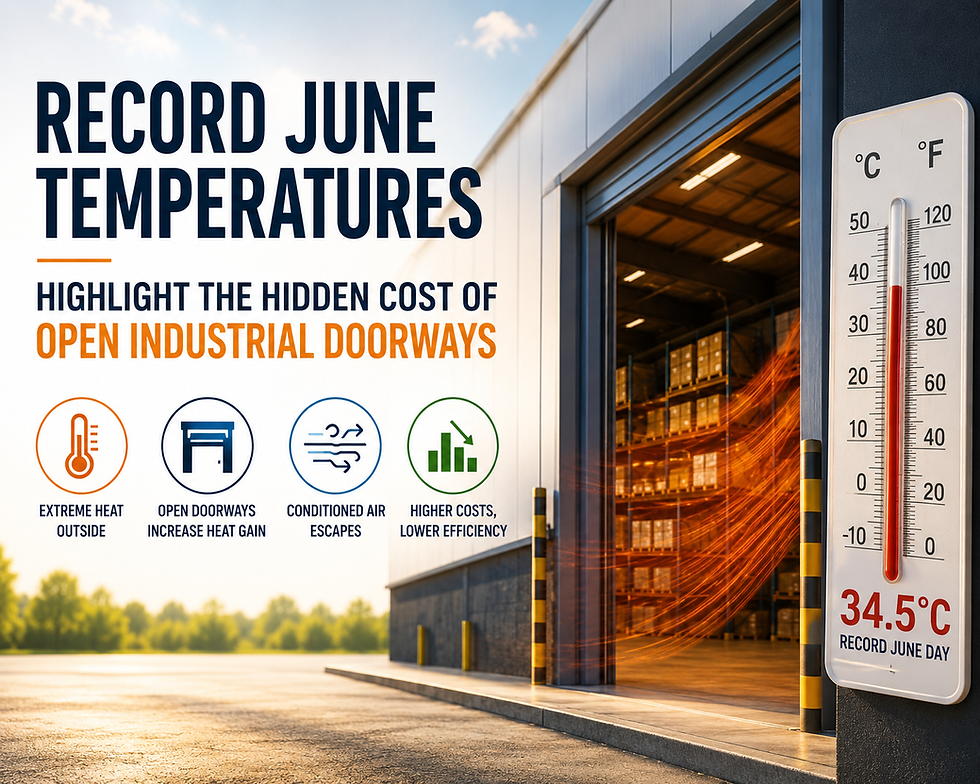
Unlike homes, industrial buildings often operate at scale, with large door openings, high-usage cycles, and wide temperature gradients between zones. Every time a door opens, conditioned air escapes, but the energy loss through the door surface itself also adds up.
Low-U-value doors play a crucial role in:
Reducing energy expenditure: Especially for temperature-controlled environments like food processing, pharmaceuticals, or cold storage.
Improving internal climate stability: Preventing temperature swings that can affect equipment performance and product consistency.
Meeting compliance standards: Supporting energy audits and ISO 50001 energy-management requirements.
Reducing CO₂ emissions: Contributing directly to corporate sustainability goals.
In short, controlling U-values isn’t just good engineering — it’s good business.
Typical U-Values for Industrial Door Types
Different door systems perform differently. The table below offers typical ranges for commonly used commercial and industrial doors:
Door Type | Typical U-Value (W/m²·K) | Energy Efficiency |
Uninsulated Steel Roller Shutter | 4.5 – 6.0 | Very Poor |
Insulated Sectional Overhead Door | 0.9 – 1.5 | Good |
High-Speed Insulated Door | 1.2 – 1.8 | Good |
Insulated Personnel / Fire Door (Steel or Composite) | 1.0 – 1.8 | Moderate to Good |
High-Performance Composite Door (Triple-Layer Core) | 0.6 – 1.0 | Excellent |
For context, Part L of the UK Building Regulations (2022) stipulates that industrial vehicle access doors in new buildings should not exceed a U-value of 1.5 W/m²·K, while personnel access doors must achieve 1.8 W/m²·K or better.
However, many organisations are setting voluntary targets below 1.0 W/m²·K to align with corporate sustainability policies and ESG reporting frameworks.
How U-Values Are Determined
A door’s U-value represents the combined thermal performance of the door panel, frame, seals, and any glazing. It’s determined through laboratory testing or thermal simulation using the following factors:
Thermal Conductivity (λ-value): The rate at which heat flows through the material.
Material Thickness: Thicker or multi-layer panels generally provide better insulation.
Thermal Bridging: Areas where materials (like metal frames) conduct heat faster than the core.
For industrial applications, whole-door U-values are essential. A door may have a well-insulated core but still perform poorly overall if the frame or seals allow heat leakage.
U-Values vs. R-Values
While U-values are standard in the UK and EU, you may also encounter R-values, particularly in North American specifications. The two are inverse measures:
R = 1 / U
So, a door with a U-value of 1.0 W/m²·K corresponds to an R-value of 1.0 m²K/W.In industrial procurement or global projects, converting between the two ensures consistent performance expectations across regions.
Key Factors Influencing U-Value in Industrial Doors
1. Core Insulation Material
The type and density of insulation inside the door determine much of its performance.
Polyurethane (PU) or Polyisocyanurate (PIR) foam cores deliver excellent insulation with U-values as low as 0.6 W/m²·K.
Mineral wool cores provide moderate insulation but enhanced fire resistance.
Uninsulated steel shutters have high U-values and are generally unsuitable for conditioned environments.
2. Door Construction and Design
Multi-layer “sandwich panel” doors with internal insulation outperform single-skin designs. Some modern industrial doors use thermal breaks to separate interior and exterior metal components, preventing heat bridging.
3. Glazing and Vision Panels
Where vision panels are required for safety or light transmission, triple-glazed, argon-filled units with low-emissivity coatings minimise losses. Always ensure that glazing U-values match or exceed the door panel’s performance.
4. Seals and Perimeter Gaps
High-usage industrial doors are prone to wear, which can degrade sealing performance.Compression gaskets, brush seals, or automatic bottom seals are essential to maintain airtightness and preserve the rated U-value.
5. Installation and Maintenance
Even the best-rated door can perform poorly if installed incorrectly. Proper alignment, frame sealing, and regular maintenance ensure the door retains its thermal integrity over its service life.
What’s a Good U-Value for Industrial Applications?
While regulations define minimum performance levels, the target depends on the facility type and energy strategy:
Facility Type | Recommended U-Value (W/m²·K) |
General Warehouse / Distribution Centre | ≤ 1.8 |
Temperature-Controlled Manufacturing | ≤ 1.2 |
Cold Storage / Freezer Enclosures | ≤ 0.6 |
Office or Mixed-Use Industrial Space | ≤ 1.4 |
Data Centres / Precision Facilities | ≤ 1.0 |
In high-energy-cost environments, the ROI from upgrading to a lower U-value door can be achieved in 2–4 years, particularly when integrated with automatic opening controls or air-curtain systems.
Quantifying the Impact of U-Value on Energy Costs
To illustrate the savings, consider a 5 m × 5 m (25 m²) sectional overhead door:
Door A (U = 3.5 W/m²·K): Heat loss = 3.5 × 25 × 20 = 1,750 W
Door B (U = 1.0 W/m²·K): Heat loss = 1.0 × 25 × 20 = 500 W
That’s a reduction of 1.25 kW of continuous heat loss per door.In a 10-door facility operating year-round, that could equate to over 100,000 kWh of avoided heat loss annually, depending on usage patterns — translating to thousands of pounds saved on energy bills and significant CO₂ reductions.
Checking and Verifying U-Values
When procuring industrial doors, always request evidence of whole-door U-value certification. Acceptable verification methods include:
EN ISO 10077-2 or EN ISO 12567-1 test reports
Manufacturer’s declaration of performance (DoP)
Independent certification from bodies such as the British Fenestration Rating Council (BFRC)
Also confirm that the door complies with UK Building Regulations Part L, and for projects seeking BREEAM, LEED, or EPC improvements, verify that the performance data aligns with the project’s sustainability criteria.
Beyond U-Values: The Complete Efficiency Picture
A door’s U-value is one metric, but it’s only part of the broader building performance ecosystem. Other considerations include:
Air Permeability: Tight seals and accurate fitting reduce uncontrolled infiltration.
Opening Speed: Fast-acting doors limit exposure time and minimise heat exchange.
Automation & Controls: Interlocked doors or airlocks prevent simultaneous openings in sensitive environments.
Durability: Insulation performance should be maintained over years of high-frequency operation.
Lifecycle Impact: Recyclable materials and sustainable manufacturing support environmental goals beyond thermal efficiency.
Choosing a low-U-value door from a reliable supplier means investing in long-term operational efficiency, not just regulatory compliance.
Innovation and Future Trends
Energy-saving technology for industrial doors is advancing quickly. The latest developments include:
Vacuum-insulated panels (VIPs) offering U-values below 0.4 W/m²·K.
Hybrid doors combining insulation with transparent nanogel glazing for daylighting without heat loss.
Smart monitoring systems that track door cycles, detect seal wear, and estimate energy losses in real time.
Recycled steel and low-carbon composite materials that reduce embodied emissions in construction.
As governments and industries tighten carbon-reduction requirements, door manufacturers are responding with products that integrate sustainability, performance, and resilience — ensuring that energy efficiency extends right to the building envelope’s smallest details.
Conclusion
For industrial and commercial buildings, U-values are far more than a technical specification — they are a strategic lever for energy management, cost control, and sustainability reporting.
A door with a low U-value can:
Reduce heating and cooling loads
Support compliance with Building Regulations and ISO standards
Extend equipment life by stabilising internal climates
Contribute measurable progress toward carbon-neutral goals
At EnergySavingDoors.com, we specialise in high-performance industrial door systems that combine durability, safety, and exceptional thermal insulation. Our range includes insulated sectional doors, composite personnel doors, and thermally broken aluminium systems, all independently tested for certified U-values.
Ready to enhance your facility’s energy performance?Explore our portfolio of energy-efficient industrial doors and speak to one of our technical consultants about meeting your next project’s sustainability and compliance targets.


Comments