
Smart doors, smarter savings.

Introduction: The Hidden Energy Drain You Walk Through Every Day
In many industrial and commercial buildings, energy managers invest heavily in insulation, HVAC efficiency, and LED lighting—yet overlook one of the biggest sources of energy waste: the doors.
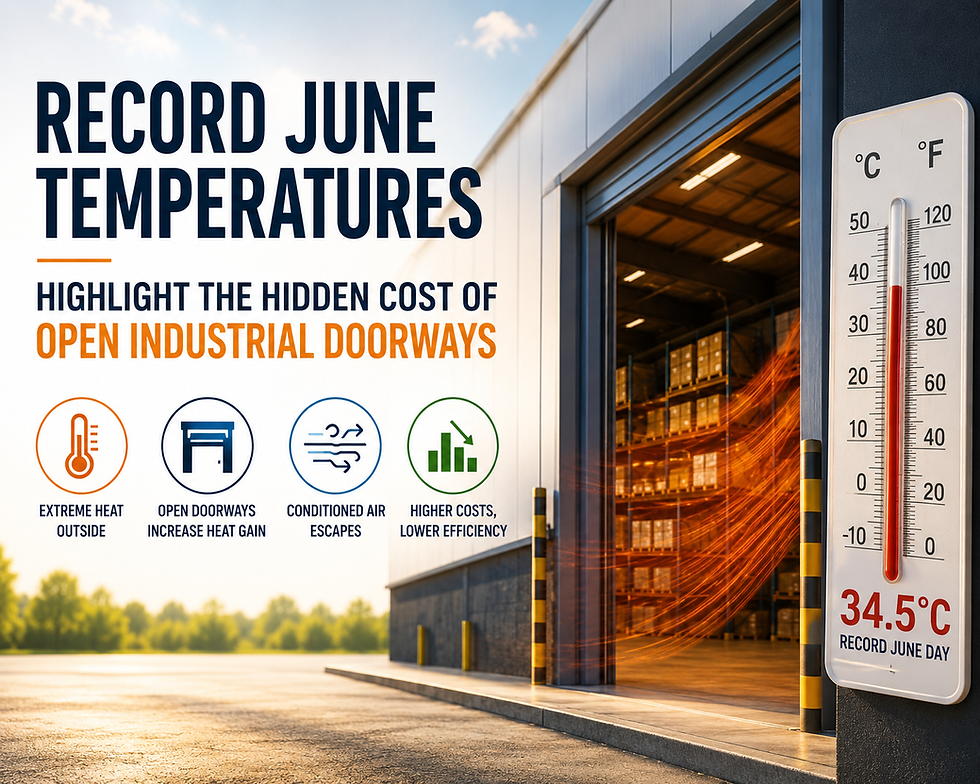
Every time a door opens, conditioned air escapes and unconditioned air rushes in. In heated warehouses, refrigerated areas, or clean production spaces, these air exchanges can undo hours of energy-efficient work. The culprit isn’t always the door itself, but how it’s used—or misused.
That’s where smart controls and automation come in. The technology now exists to ensure that doors open only when needed, close automatically, and adapt to usage patterns, minimising energy loss while improving safety, security, and workflow.
In this post, we’ll explore how smart door control systems work, what energy-saving benefits they deliver, and how to evaluate automation upgrades for your facility.
1. The Problem: Doors That Work Harder Than They Should
In most facilities, doors are opened far more often—and for longer—than necessary.
Forklift drivers, staff on foot, or delivery vehicles may leave a shutter or loading bay open between operations simply to avoid delays. In some sites, the door remains open 70–80% of the time during working hours.
The results are predictable:
Heat loss in winter, forcing boilers or heaters to work harder.
Cold loss in summer or refrigerated areas, increasing the load on chillers.
Humidity and dust ingress, which can compromise product quality.
Reduced comfort for staff, especially in areas near external openings.
Studies suggest that for industrial facilities, air leakage through open doors can account for 10–25% of total energy waste. And since energy prices remain volatile, that’s a cost no business can ignore.
2. What Is a Smart Door Control System?
A smart door control system uses sensors, automation, and programmable logic to control how and when doors operate. Rather than relying on manual operation (e.g., push buttons or pull cords), the system uses data and triggers to open and close doors optimally.
Common components include:
Motion sensors or infrared detectors that detect approaching traffic.
RFID or vehicle transponders that identify authorised vehicles and open doors automatically.
Timers and delay settings that ensure doors close quickly after the last movement.
Environmental sensors that detect temperature or pressure differentials and adjust door behaviour.
Integration with Building Management Systems (BMS) for centralised control and monitoring.
Access control integration to ensure that only authorised personnel trigger openings.
These elements work together to create an intelligent, responsive barrier—one that opens only when necessary and remains sealed the rest of the time.
3. How Automation Reduces Energy Waste
The key to energy savings is minimising door open time without disrupting workflow. Smart systems achieve this in several ways.
a. Automatic Closing
The simplest and most effective measure is automatic closing.With motion sensors or programmable timers, a smart control system can ensure a door closes as soon as the last object or person has passed. Even reducing open time by 10 seconds per operation can translate into substantial annual savings in heated or cooled environments.
b. Speed and Precision
High-speed doors—especially insulated ones—can open and close in just a few seconds. When combined with automation, this eliminates long periods where conditioned air can escape. Smart controllers can also adjust speed dynamically, slowing slightly for safety when pedestrian traffic is detected and increasing for vehicles.
c. Zoning and Interlocking
In environments where temperature control or contamination prevention is critical—such as food processing, pharmaceuticals, or cold storage—interlocking systems can ensure that only one door in a sequence opens at a time.This prevents cross-contamination and keeps internal pressure and temperature stable.
d. Data Logging and Analytics
Modern door control systems can log each opening and closing event. Facility managers can then analyse usage patterns, identify high-traffic periods, and even estimate air exchange rates.This data-driven insight supports further optimisation—adjusting door timing, repositioning sensors, or scheduling maintenance based on actual usage.
e. Integration with HVAC and Lighting Systems
Smart doors can communicate with a building’s HVAC system, triggering fans, heaters, or air curtains only when needed. For instance, an air curtain can activate automatically when a door opens, then deactivate immediately after closing.This targeted operation further reduces energy waste and extends equipment life.
4. Safety and Efficiency: A Win-Win
One misconception is that automation adds complexity or slows down operations. In reality, smart door controls improve both safety and efficiency.
a. Reduced Manual Interaction
Hands-free operation means less need for staff to stop, dismount vehicles, or search for controls. This not only saves time but also reduces repetitive strain injuries and collision risks.
b. Safer Traffic Flow
Sensors and warning systems ensure that doors open only when a person or vehicle is safely detected, and stop closing if an obstruction appears.Combined with visual indicators—like LED traffic lights or audible alerts—this creates a safer environment in busy loading areas.
c. Consistent Performance
Unlike manual operation, which can vary between users, smart systems guarantee consistent behaviour: same open time, same closing delay, same safety margin. That consistency supports both safety compliance and predictable energy performance.
5. Quantifying the Savings
Let’s consider a simplified example.
A typical warehouse has a 4m x 4m loading bay door that remains open an average of 3 minutes per cycle, 50 times a day. If automation reduces that open time to 1 minute per cycle, air exchange losses can drop by roughly two-thirds.
For a heated facility, that could equate to £3,000–£6,000 in annual energy savings per door—depending on climate, insulation, and energy costs.In a refrigerated site, where temperature differentials are greater, the savings can be even higher.
Over a system’s lifespan, the investment in automation often pays for itself within 2–4 years, not counting the added operational and safety benefits.
6. Retrofit vs New Installations
Smart controls aren’t only for new doors. Many existing doors can be retrofitted with automation components, including:
Motion or presence sensors
Control panels with programmable logic
Interlocking modules
Access control interfaces
Retrofit projects can be staged—starting with the most critical doors—and implemented with minimal disruption. For older or heavily used doors, however, replacement with a high-speed insulated model may yield better long-term ROI.
At Energy Saving Doors, we often assess each site individually to determine whether retrofit or replacement offers the best energy and cost outcome.
7. The Human Factor: Encouraging Smart Behaviour
Technology alone isn’t enough; staff behaviour plays a vital role. Even the best automation system can be overridden if operators prop doors open or disable sensors for convenience.
That’s why an effective strategy includes staff training and engagement:
Explain the energy cost of leaving doors open.
Demonstrate how automation improves comfort and workflow.
Encourage reporting of any malfunctioning sensors or delays.
Display simple “energy awareness” signage near high-traffic doors.
When people understand that smart doors make their jobs easier and safer, compliance naturally follows.
8. Building the Business Case
To justify investment in smart automation, focus on three key metrics:
Energy cost savings — model reductions in door open time and resulting heat loss.
Productivity gains — measure reduced waiting times, smoother logistics flow, fewer manual interventions.
Maintenance and lifespan improvements — automated systems avoid unnecessary wear and extend the lifespan of both doors and HVAC systems.
Combine these figures with potential carbon reduction data to strengthen sustainability reporting or ESG compliance. For some UK businesses, upgrades may even qualify for government grants or Enhanced Capital Allowances.
9. The Future: Connected, Data-Driven Door Management
Smart door technology continues to evolve. The next generation of systems will integrate even more deeply with IoT platforms and AI-driven building management.
Here’s what’s on the horizon:
Predictive maintenance using vibration or cycle-count data to alert engineers before failure.
Remote monitoring dashboards that display energy performance and usage statistics in real time.
Adaptive controls that learn patterns—adjusting opening speeds or delay times based on historical activity.
Cloud integration that links multiple sites for centralised energy management.
In short, the door of the future won’t just open and close—it will think, learn, and optimise.
10. Conclusion: The Smarter Way to Save Energy
Smart door controls and automation may not be the first thing that comes to mind when thinking about energy efficiency—but they should be.
Every unnecessary second that a door stays open costs money and carbon. By automating door systems, businesses can cut waste, enhance safety, and streamline operations—often with a payback period of just a few years.
Whether through retrofitting sensors, upgrading to high-speed insulated models, or integrating with a wider building management system, smart control is one of the simplest, smartest investments in energy efficiency today.
At www.EnergySavingDoors.com we design and install intelligent door systems that keep your operations running smoothly while reducing your energy bills.
If you’d like to explore how automation could transform your facility, contact us today for a free consultation—and start closing the door on energy waste.


Comments