

Air movement through a typical industrial doorway.
This figure illustrates the principal paths through which uncontrolled airflow can influence heat loss and environmental conditions.
H-029
CONTROLLING THE RATE OF HEAT FLOW
Heat flows continuously through every industrial building whenever there is a temperature difference between the inside and outside. However, not every building loses heat at the same rate. The speed at which heat passes through roofs, walls, floors, glazing and industrial door assemblies depends upon the thermal properties of the materials used and how they are combined within the building envelope. This article explains the factors that determine the rate of conductive heat transfer and why engineers focus on reducing heat flow rather than attempting to eliminate it entirely.
Understanding that heat moves by conduction is only the first step in understanding building physics. Engineers must also understand how quickly that heat moves through different building elements.
Some materials readily allow heat to pass, while others provide much greater resistance. Thickness, density, insulation and construction methods all influence the rate of heat transfer. By understanding these factors, engineers can design industrial buildings that require less energy to maintain comfortable internal conditions while continuing to support demanding operational requirements.
Temperature Difference Drives Heat Flow
OBSERVATION
Heat only flows when there is a temperature difference between two environments. The greater the difference between the temperature inside an industrial building and the temperature outside, the greater the driving force for conductive heat transfer. During colder weather, this increased temperature difference causes heat to move more rapidly through the building envelope.
ENGINEERING PRINCIPLE
EP03 – Industrial buildings function as integrated systems.
The rate of conductive heat flow depends upon the interaction between the building envelope and the surrounding environment. Engineers therefore evaluate seasonal conditions, operational temperatures and building construction together when assessing energy performance.
The movement of heat through solid materials is driven by temperature difference, often referred to as ΔT (Delta T). Whenever the internal temperature exceeds the external temperature, heat flows through the building envelope towards the colder environment. Larger temperature differences increase the rate of conductive heat transfer, while smaller differences reduce it. Engineers cannot eliminate this natural process, but they can significantly reduce its impact by improving insulation, selecting appropriate materials and designing building envelopes that resist heat flow more effectively.
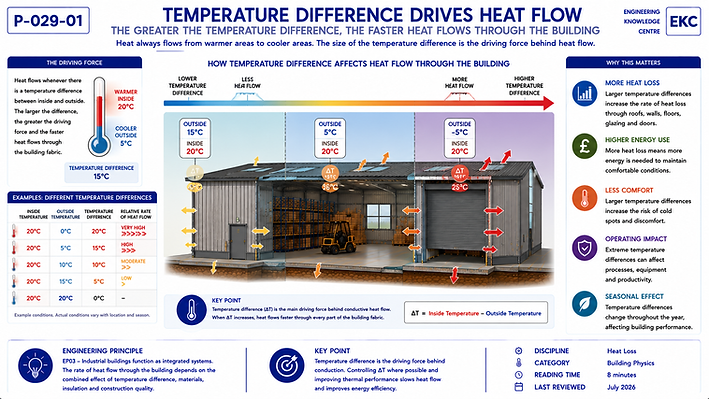
P-001 .This plate illustrates how temperature difference provides the driving force behind conductive heat transfer within industrial buildings. As the difference between internal and external temperatures increases, heat flows more rapidly through roofs, walls, floors, glazing and industrial door assemblies. Engineers cannot prevent this natural process, but they can reduce its impact by improving the thermal performance of the building envelope. Understanding the relationship between temperature difference and heat flow forms one of the fundamental principles of building physics.
ENGINEERING REFLECTION
Many people notice that buildings require more heating during winter but do not consider the engineering reason behind it. The explanation is straightforward. As the outside temperature falls, the temperature difference across the building envelope increases, causing heat to flow more quickly through roofs, walls, floors and industrial doors. Engineers understand that controlling this rate of heat transfer is fundamental to improving energy efficiency.
Material Properties Influence Heat Transfer
OBSERVATION
Construction materials differ considerably in the rate at which they conduct heat. Metals allow heat to pass rapidly, whereas insulation materials are specifically designed to resist heat flow. The thermal performance of the building envelope therefore depends greatly upon the materials selected during design and construction.
ENGINEERING PRINCIPLE
EP03 – Industrial buildings function as integrated systems.
Material selection influences the thermal performance of every building element. Engineers choose materials that work together to achieve structural integrity, operational durability and effective thermal resistance throughout the complete building envelope.
Each construction material possesses a thermal conductivity that determines how readily heat passes through it. High-conductivity materials such as steel readily transfer heat, while insulation products, air cavities and specialised thermal materials significantly reduce heat transfer. Engineers combine these materials carefully to create building elements that balance structural requirements with thermal performance. By selecting appropriate materials throughout the building envelope, they slow conductive heat flow and reduce long-term heating demand.
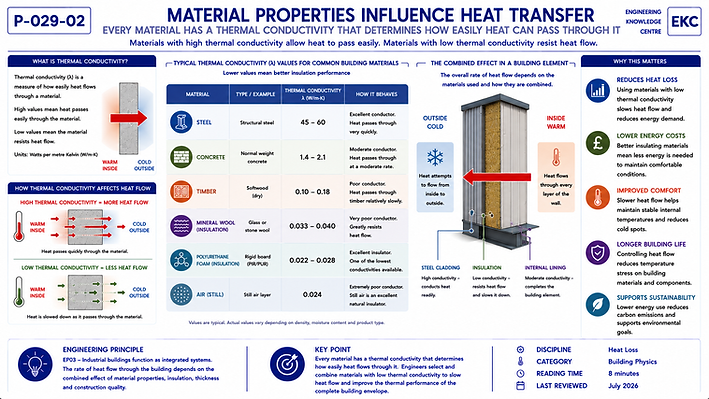
P-002. This plate demonstrates how the thermal properties of construction materials influence the rate at which heat passes through an industrial building. Materials with high thermal conductivity allow heat to transfer readily, while insulation materials provide greater resistance to heat flow. Engineers carefully select and combine materials throughout the building envelope to achieve an appropriate balance between structural performance, durability and energy efficiency.
ENGINEERING REFLECTION
Buildings are often judged by their appearance or structural strength, yet experienced engineers know that the hidden thermal properties of materials are equally important. Two wall systems may appear identical from the outside while performing very differently in terms of energy efficiency. Understanding material behaviour enables engineers to create buildings that require less energy throughout their operational life.
Thickness Makes a Difference
OBSERVATION
The thickness of insulation has a direct influence on the rate at which heat passes through the building envelope. Increasing insulation thickness forces heat to travel through more material, reducing the speed of conductive heat transfer and improving overall thermal performance.
ENGINEERING PRINCIPLE
EP03 – Industrial buildings function as integrated systems.
The effectiveness of the building envelope depends upon the combined interaction of material properties and construction thickness. Engineers optimise both factors together to achieve balanced thermal performance across the entire building.
Heat loses energy as it travels through insulating materials. Increasing insulation thickness extends the distance over which this transfer must occur, slowing the movement of heat from the warm interior to the colder exterior. Modern industrial buildings therefore incorporate carefully designed insulation systems within roofs, walls and industrial door assemblies to reduce conductive heat loss. Engineers determine appropriate insulation thicknesses by considering energy performance, construction practicality, operational requirements and economic value throughout the life of the building.
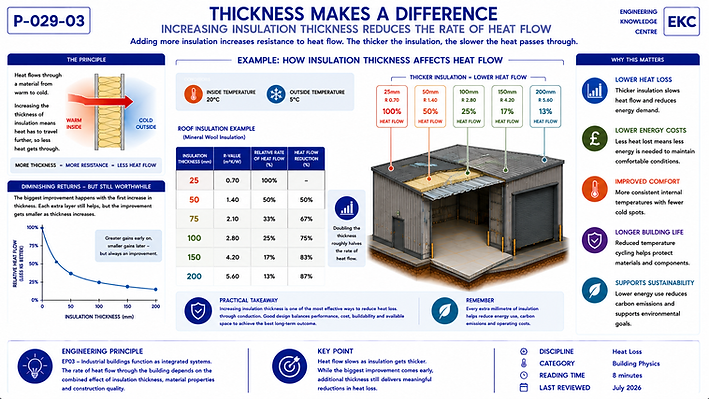
P-003. This plate illustrates how insulation thickness influences conductive heat transfer through the building envelope. Increasing the thickness of insulation increases thermal resistance, slowing the movement of heat from the warmer interior towards the colder external environment. Engineers determine appropriate insulation thicknesses by balancing thermal performance, construction practicality, operational requirements and long-term economic value to achieve efficient and sustainable building performance.
ENGINEERING REFLECTION
It is easy to assume that adding more insulation will always produce proportionally greater energy savings. In reality, each increase in insulation thickness continues to improve performance, but the rate of improvement gradually reduces. Engineers therefore balance thermal performance with cost, available space and practical construction considerations to achieve the most effective overall solution.
Construction Quality Matters
OBSERVATION
The thermal performance of a building depends not only upon good materials but also upon the quality of their installation. Poor workmanship, gaps, discontinuities, compressed insulation or poorly detailed junctions can significantly increase heat flow despite the use of high-performance construction products.
ENGINEERING PRINCIPLE
EP03 – Industrial buildings function as integrated systems.
The performance of the building envelope depends upon design, material selection and construction quality working together. Engineers evaluate these factors collectively because weaknesses in one area reduce the effectiveness of the whole system.
Heat naturally follows the easiest available pathway. Gaps between insulation panels, poorly sealed junctions, service penetrations, compressed insulation and discontinuities within the building envelope all create localised areas where heat transfer increases. Engineers therefore pay close attention to construction quality, ensuring that insulation remains continuous, thermal bridges are minimised and building details are completed to a consistently high standard. Good workmanship allows building materials to perform as designed and helps maintain long-term energy efficiency.
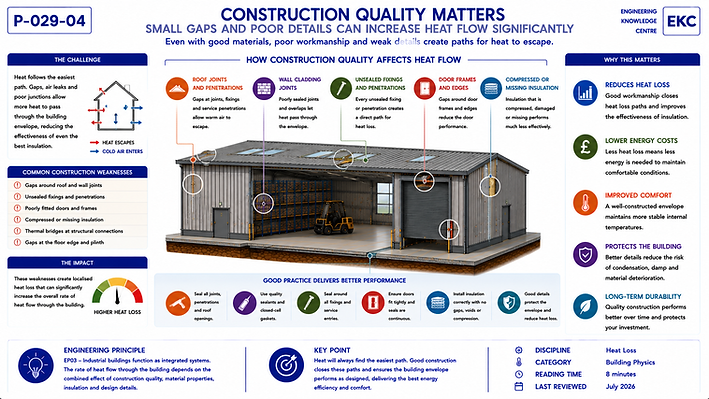
P-004. This plate illustrates the importance of construction quality in controlling conductive heat transfer. Gaps, poorly sealed joints, service penetrations, compressed insulation and inadequate detailing create unintended pathways that allow heat to bypass the thermal envelope. Engineers recognise that good workmanship is as important as material selection, ensuring insulation remains continuous and construction details perform as intended throughout the life of the building.
ENGINEERING REFLECTION
Even the highest-quality insulation cannot perform as intended if it is poorly installed. Experienced engineers recognise that careful detailing and good workmanship are just as important as material specification. Small defects repeated throughout a building can collectively have a significant impact on overall thermal performance.
Slowing Heat Flow Creates Better Buildings
OBSERVATION
Engineers cannot prevent heat from flowing whenever a temperature difference exists, but they can control the rate at which it moves through the building envelope. By improving materials, insulation, construction quality and design, they significantly reduce conductive heat loss while maintaining the operational effectiveness of the building.
ENGINEERING PRINCIPLE
EP03 – Industrial buildings function as integrated systems.
The rate of heat flow depends upon the combined interaction of temperature difference, material properties, insulation, construction quality and operational requirements. Engineers optimise these factors collectively to improve the performance of the complete industrial building.
Professional engineers begin by understanding the factors that influence conductive heat transfer before recommending improvements. They evaluate temperature differences, construction materials, insulation thickness, workmanship and building detailing to determine where heat is moving most rapidly through the envelope. By improving these factors together, engineers create buildings that require less heating energy, maintain more stable internal temperatures and provide improved comfort for occupants. The objective is not to stop heat flow entirely—which is impossible—but to control it intelligently so that the building performs efficiently throughout its operational life.
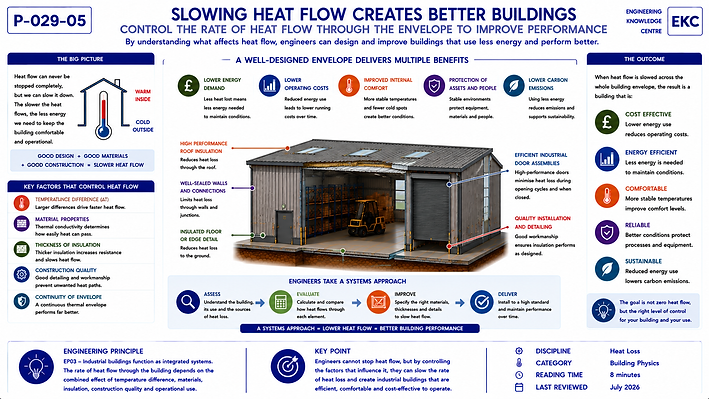
P-005. This plate brings together the principal factors that determine the rate of conductive heat flow within an industrial building. Temperature difference, material selection, insulation thickness and construction quality all contribute to the performance of the building envelope. Engineers evaluate these factors collectively to develop balanced solutions that reduce energy demand, improve occupant comfort and optimise the long-term operational performance of industrial buildings.
ENGINEERING REFLECTION
Energy-efficient buildings are not created by a single product or technology. Instead, they result from a series of engineering decisions that work together to slow the movement of heat while supporting the building's operational purpose. This integrated approach consistently delivers better long-term performance than concentrating on isolated improvements.
ENGINEERING BAR
At A Glance

Discipline
Heat Loss

Category
Building Physics

Reading time
8
mins

Last reviewed
July
In This Article
Temperature Difference Drives Heat Flow
Material Properties Influence Heat Transfer
Thickness Makes a Difference
Construction Quality Matters
Slowing Heat Flow Creates Better Buildings
Continue Reading
→
Why Does Heat Flow Through Building Materials?
→
Understanding U-Values in Industrial Buildings
→
Understanding Thermal Bridges in Industrial Buildings
Key Takeway
Engineers improve energy performance by slowing the rate at which heat flows through the building envelope using appropriate materials, insulation and construction techniques.
Reading Tip
Click any engineering plate to view it full size.
Engineering Summary Plate

The rate of conductive heat transfer depends upon material properties, insulation, thickness and temperature difference. Engineers evaluate these factors collectively to improve the thermal performance of industrial buildings and reduce long-term energy demand.
Engineering Summary
The rate of conductive heat transfer depends upon material properties, insulation, thickness and temperature difference. Engineers evaluate these factors collectively to improve the thermal performance of industrial buildings and reduce long-term energy demand.