

Air movement through a typical industrial doorway.
This figure illustrates the principal paths through which uncontrolled airflow can influence heat loss and environmental conditions.
H-042
WHAT HAPPENS EVERY TIME AN INDUSTRIAL DOOR OPENS
Whenever an industrial door opens, conditioned internal air is exchanged with external air. Understanding this process allows engineers to quantify energy loss, improve doorway performance and reduce unnecessary heating demand.
Air exchange is one of the least visible but most significant causes of energy loss in industrial buildings.
As soon as an industrial doorway opens, pressure differences and buoyancy combine to move large volumes of air between the inside and outside environments. Warm conditioned air leaves the building while cooler external air enters to replace it. The larger the doorway, the longer it remains open and the greater the temperature difference, the greater the resulting energy loss.
Understanding air exchange enables engineers to quantify these effects, compare engineering solutions objectively and identify improvements that deliver measurable reductions in energy consumption and operating costs.
What Is Air Exchange?
OBSERVATION
Every time an industrial doorway opens, air begins to move between the inside and outside environments. This movement occurs naturally because differences in temperature, pressure and wind continuously seek equilibrium.
The resulting air exchange carries heat, moisture, dust and contaminants through the opening, often increasing energy consumption and reducing environmental control.
ENGINEERING PRINCIPLE
EP02 – Air Moves From Areas Of Higher Pressure Towards Areas Of Lower Pressure.
Air is constantly seeking pressure equilibrium. Whenever a pressure difference exists between two connected spaces, air naturally flows from the higher-pressure region towards the lower-pressure region. Engineers consider pressure differences as one of the primary drivers of air movement within industrial buildings.
Air exchange describes the movement of air between two spaces through an available opening.
In industrial buildings this commonly occurs whenever loading doors, personnel doors or ventilation openings connect conditioned internal environments with external conditions.
The volume of exchanged air depends upon doorway size, pressure difference, temperature difference, wind conditions and the length of time that the opening remains available.

P-001 A professional engineering infographic introducing the concept of air exchange in industrial buildings. A warehouse loading doorway is shown fully open, with red arrows illustrating warmer internal air moving outward and blue arrows showing cooler external air entering the building. Engineering callouts explain the influence of temperature differences, pressure differences and airborne contaminants, while supporting panels describe how air exchange naturally occurs whenever an opening connects conditioned and external environments. A lower section highlights the transfer of heat, moisture, dust, odours and insects that accompanies uncontrolled air movement.
ENGINEERING REFLECTION
Air exchange is not caused by the doorway itself. The doorway simply provides the opportunity for natural pressure forces to move air between environments.
What Causes Air Exchange?
OBSERVATION
Many people assume that heat escapes through an open doorway because warm air simply rises.
While buoyancy contributes to air movement, several engineering forces normally act together to produce the overall air exchange observed within industrial buildings.
ENGINEERING PRINCIPLE
EP06 – Heat Is Transferred By The Movement Of Fluids And Gases.
Heat is transported whenever air moves. As warm and cool air circulate, thermal energy is carried with the airflow through convection. Understanding how air movement transfers heat allows engineers to predict energy loss, evaluate building performance and design effective environmental control strategies.
Engineering Explanation
Air exchange is influenced by:
temperature differences
pressure differences
stack effect
wind loading
mechanical ventilation
extraction systems
vehicle movement
operational activity.
The combined effect of these influences determines both the direction and volume of airflow through an opening.

P-002 A detailed engineering infographic explaining the natural and operational forces that drive air exchange in industrial buildings. A warehouse doorway forms the central illustration, with directional airflow arrows showing the combined effects of stack effect, temperature difference, wind pressure, mechanical ventilation, building pressure differences and vehicle movement. Supporting engineering panels explain how these influences interact to determine the direction, volume and consistency of airflow through an opening, emphasising that air exchange results from multiple engineering factors acting together.
ENGINEERING REFLECTION
Engineers rarely attribute building behaviour to a single cause. Air exchange usually results from several environmental forces acting simultaneously.
Why Does Opening Time Matter?
OBSERVATION
The amount of air exchanged through an opening changes dramatically according to how the building operates.
Two identical doorways may experience completely different environmental performance depending upon traffic frequency and opening duration.
ENGINEERING PRINCIPLE
EP04 – Buildings Continually Respond To Operational Activity.
Industrial buildings are dynamic environments. Every operational activity—including opening doors, moving vehicles, operating ventilation systems and changing occupancy—continuously alters airflow, pressure distribution and thermal performance. Building performance is therefore influenced as much by operation as by construction.
Air exchange is directly related to both doorway size and exposure time.
A doorway that remains open for sixty seconds allows substantially more air movement than one which opens and closes within only a few seconds.
For this reason, engineers frequently seek to reduce opening duration through improved operational practices or the installation of rapid-operating doors.

P-003 A comparative engineering infographic demonstrating how doorway opening duration influences the volume of exchanged air. Two industrial doorways are shown side by side, comparing a conventional roller shutter remaining open for sixty seconds with a high-speed door open for only five seconds. Engineering callouts compare air movement, estimated air exchange volume, heat loss and operating costs, while explanatory panels demonstrate how reducing opening time significantly improves environmental control and energy efficiency.
ENGINEERING REFLECTION
Reducing the time an opening exists often delivers greater benefit than attempting to reduce airflow while the opening remains available.
Why Is Air Exchange Important?
OBSERVATION
Air exchange affects far more than energy consumption.
Uncontrolled airflow influences comfort, product quality, moisture levels, dust movement, insects, odours and overall building performance.
ENGINEERING PRINCIPLE
EP03 – Industrial Buildings Function As Integrated Systems.
Building performance results from the interaction of many interconnected systems rather than the behaviour of individual components. Heating, ventilation, insulation, doorways, occupancy and operational activity continuously influence one another. Engineers therefore assess the complete system when evaluating environmental performance.
Reducing unnecessary air exchange can improve:
thermal comfort
heating efficiency
cooling performance
humidity control
dust reduction
contamination control
product quality
employee wellbeing
operational consistency.
Managing air exchange is therefore an important part of improving the overall performance of industrial buildings.

P-004 A comprehensive engineering infographic illustrating the wider impact of uncontrolled air exchange on industrial building performance. Multiple illustrated panels demonstrate how air movement influences thermal comfort, energy efficiency, humidity, dust and contamination, product quality, employee wellbeing and operational consistency. Supporting comparison panels summarise the negative consequences of uncontrolled air exchange alongside the benefits achieved through effective environmental control, reinforcing that managing airflow improves the performance of the whole building.
ENGINEERING REFLECTION
The consequences of uncontrolled air movement extend well beyond heating costs and influence almost every aspect of building performance.
How Can Air Exchange Be Reduced?
OBSERVATION
There is no universal solution for controlling air exchange.
Different buildings require different engineering approaches depending upon their operational requirements, environmental objectives and physical characteristics.
ENGINEERING PRINCIPLE
EP01 – Temperature Differences Drive Heat Transfer.
Whenever two environments exist at different temperatures, heat naturally flows from the warmer region towards the cooler one. The greater the temperature difference and the longer a pathway remains available, the greater the opportunity for heat transfer. Effective engineering seeks to manage both the driving temperature difference and the available pathways for energy loss.
The most effective engineering solutions reduce both the opportunity for air movement and the forces that drive it.
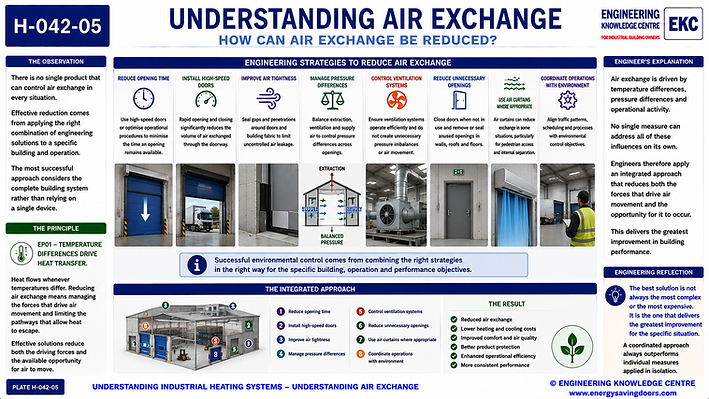
P-005 A professional engineering infographic presenting an integrated engineering strategy for reducing air exchange within industrial buildings. The central section illustrates multiple complementary engineering measures, including reducing door opening time, installing high-speed doors, improving airtightness, balancing pressure differences, optimising ventilation systems, eliminating unnecessary openings, applying air curtains where appropriate and coordinating operational practices. A lower building diagram demonstrates how these measures work together as part of an integrated engineering approach to improve environmental control, reduce energy consumption and enhance overall building performance.
ENGINEERING REFLECTION
The most effective engineering solutions reduce both the opportunity for air movement and the forces that drive it.
ENGINEERING BAR
At A Glance

Discipline
Building Physics

Category
Heat Loss

Reading time
7
mins

Last reviewed
July
In This Article
What Is Air Exchange?
What Causes Air Exchange?
Why Does Opening Time Matter?
Why Is Air Exchange Important?
How Can Air Exchange Be Reduced?
Continue Reading
→
Understanding Air Curtains and Industrial Doorways
→
Understanding Air Leakage
→
Air Leakage and Heat Loss
Key Takeway
Every industrial doorway opening creates air exchange. Managing the frequency, duration and characteristics of these exchanges is one of the most effective ways to improve industrial building energy performance.
Reading Tip
Click any engineering plate to view it full size.
Engineering Summary Plate

Air exchange occurs whenever an industrial doorway opens, allowing conditioned internal air and external air to move between environments. The volume of exchanged air depends upon doorway size, opening duration, temperature differences and pressure conditions. Engineers study air exchange to quantify energy losses, improve doorway performance and identify engineering solutions that reduce heating demand, improve environmental control and enhance the overall efficiency of industrial buildings.
Engineering Summary
Air exchange occurs whenever an industrial doorway opens, allowing conditioned internal air and external air to move between environments. The volume of exchanged air depends upon doorway size, opening duration, temperature differences and pressure conditions. Engineers study air exchange to quantify energy losses, improve doorway performance and identify engineering solutions that reduce heating demand, improve environmental control and enhance the overall efficiency of industrial buildings.