

Air movement through a typical industrial doorway.
This figure illustrates the principal paths through which uncontrolled airflow can influence heat loss and environmental conditions.
B-003
THE SYSTEMS ENGINEERING APPROACH
Industrial buildings should never be viewed as collections of independent components. Every system influences every other system, requiring engineers to consider the complete building before making individual improvement decisions.
Changing one aspect of a building often affects several others. Improvements to insulation influence heating requirements. Changes to ventilation alter pressure conditions. Door performance affects air movement, environmental control and heating efficiency. Even relatively small modifications can produce wider effects that are not immediately obvious when individual building elements are considered in isolation.
Systems engineering recognises these interactions and evaluates the complete building before recommending improvements. By understanding how individual components influence one another, engineers can develop coordinated solutions that improve overall performance, maximise energy efficiency and ensure that investment delivers reliable, measurable and long-term operational benefits.
Thinking Beyond Individual Components
OBSERVATION
Industrial buildings do not operate as collections of separate components. Every part of the building influences the performance of the others, creating a complex engineering system in which heating, insulation, ventilation, industrial doors, occupancy and operational activities continuously interact. Improving one element may enhance or limit the effectiveness of another, depending upon how the building functions as a whole. Engineers therefore begin every assessment by considering the complete system rather than focusing on individual features. This broader perspective provides a more accurate understanding of building behaviour and creates opportunities for improvements that deliver greater overall performance and long-term operational value.
ENGINEERING PRINCIPLE
EP03 – Industrial Buildings Function As Integrated Systems
Industrial buildings should be understood as integrated engineering systems in which every component contributes to overall performance. Considering individual elements in isolation may overlook important interactions that influence efficiency and environmental control.
Industrial buildings operate as interconnected engineering systems in which every component contributes to overall performance.
Heating, insulation, ventilation, industrial doors, occupancy and operational activity continually interact, influencing environmental conditions throughout the building.
By understanding these relationships, engineers develop solutions that improve the performance of the entire building rather than concentrating upon isolated components.

P-001 An Engineering Knowledge Centre infographic encouraging engineers to think beyond individual building components. The warehouse illustration compares assessing isolated elements with adopting a whole-building systems approach, showing how interactions between ventilation, occupancy, equipment, weather, industrial doors, controls and the building envelope lead to better engineering decisions and improved building performance.
ENGINEERING REFLECTION
Engineers achieve better outcomes when they view buildings as complete systems rather than collections of unrelated components.
Understanding System Interactions
OBSERVATION
Engineering improvements rarely act independently. Changes made to insulation, heating systems, ventilation, industrial doors or operational procedures often influence several other aspects of building performance at the same time. A modification that appears beneficial in isolation may reduce the effectiveness of another system if these interactions are not properly understood. Professional engineers therefore study how building systems work together before recommending improvements. Understanding these relationships allows solutions to complement one another, producing greater energy efficiency, improved environmental control and more reliable long-term performance than isolated engineering interventions could ever achieve.
ENGINEERING PRINCIPLE
EP03 – Industrial Buildings Function As Integrated Systems
Changes made to one building system frequently influence several others. Engineers therefore consider the wider consequences of any proposed improvement before recommending a solution.
Engineering improvements rarely affect only one part of a building.
Reducing air leakage may improve heating efficiency. Changes to ventilation can alter pressure conditions. Improving industrial door performance may reduce energy consumption while also enhancing comfort and productivity.
Considering these interactions enables engineers to anticipate both the benefits and consequences of proposed improvements before implementation.
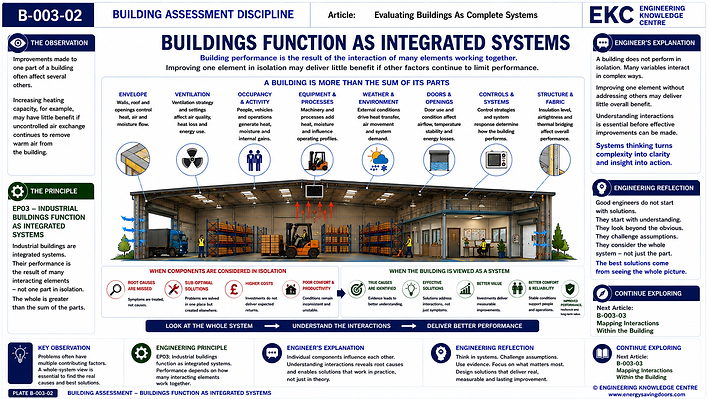
P-002 This engineering plate illustrates that industrial buildings should be assessed as integrated systems rather than as a collection of individual components. Using a warehouse cutaway, it demonstrates how building fabric, ventilation, occupancy, operational processes, environmental conditions, industrial door operation and control systems interact continuously to influence overall performance. The plate reinforces the principle that improvements made to a single element, such as increasing heating capacity, may deliver only limited benefits if related issues, including uncontrolled air exchange, remain unresolved. It highlights the importance of systems thinking when diagnosing building performance and prioritising engineering improvements.
ENGINEERING REFLECTION
An improvement that appears beneficial in isolation may produce unintended consequences elsewhere. Systems thinking helps engineers recognise these interactions before changes are made.
How Buildings Function As Integrated Systems
OBSERVATION
Building performance is shaped by a chain of interconnected causes and effects rather than isolated events. A cold working area, excessive heating demand or noticeable draught may all originate from several interacting factors that influence one another throughout the building. Engineers therefore seek to understand these relationships before proposing solutions, recognising that treating the visible symptom rarely resolves the underlying problem. By identifying the true causes of performance issues, engineers can recommend improvements that address the source of the problem, producing more effective, reliable and sustainable long-term outcomes for both the building and its occupants.
ENGINEERING PRINCIPLE
EP03 – Industrial Buildings Function As Integrated Systems
Understanding the relationships between building systems enables engineers to identify solutions that improve overall performance rather than addressing isolated symptoms.
Systems engineering focuses upon relationships rather than individual components.
Rather than asking whether one element performs well, engineers examine how it influences the performance of every other system within the building.
This broader perspective often reveals opportunities that would remain hidden if individual systems were considered independently.
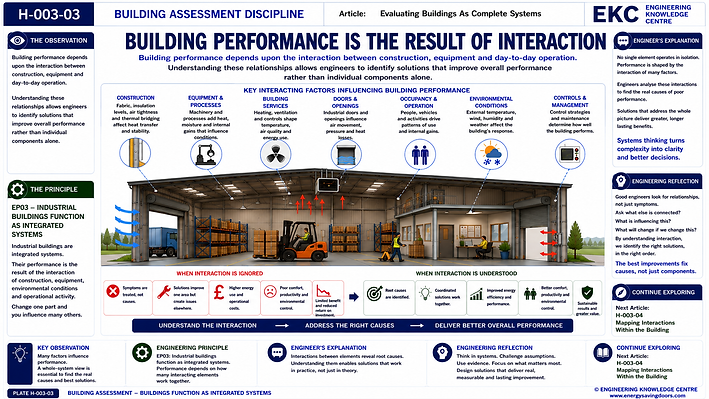
P-003 his engineering plate illustrates that industrial building performance is determined by the interaction between construction, equipment, environmental conditions and day-to-day operational activity rather than by any individual component in isolation. Using a cutaway warehouse illustration, it demonstrates how building fabric, heating, ventilation, industrial doors, occupancy, machinery and environmental influences continuously affect one another. The plate reinforces the systems engineering principle that meaningful improvements are achieved by understanding these relationships and addressing the underlying causes of poor performance, enabling coordinated solutions that deliver greater energy efficiency, operational reliability and long-term building performance.
ENGINEERING REFLECTION
Successful engineering depends as much upon understanding relationships as understanding individual technologies.
Seeing The Bigger Engineering Picture
OBSERVATION
Engineering decisions are most successful when they consider how the entire building responds rather than concentrating on individual components. Upgrading one system without understanding its influence on the wider building may produce only limited benefits or even create unintended consequences elsewhere. Engineers therefore evaluate proposed improvements within the context of the complete building, considering interactions between the building fabric, environmental control systems, operational activity and occupant requirements. This integrated approach allows engineering decisions to maximise overall building performance while reducing the risk of solving one problem only to create another.
ENGINEERING PRINCIPLE
EP05 – Engineering Decisions Should Be Evidence Based
Engineering recommendations should reflect a complete understanding of how the building behaves. Decisions supported by systematic evidence are more likely to deliver reliable long-term performance improvements.
Understanding the complete engineering picture requires information from many different sources.
Operational observations, environmental measurements and engineering knowledge are combined to understand how the building behaves as an integrated system.
This holistic approach enables engineers to identify practical improvements that achieve measurable benefits across multiple aspects of building performance.
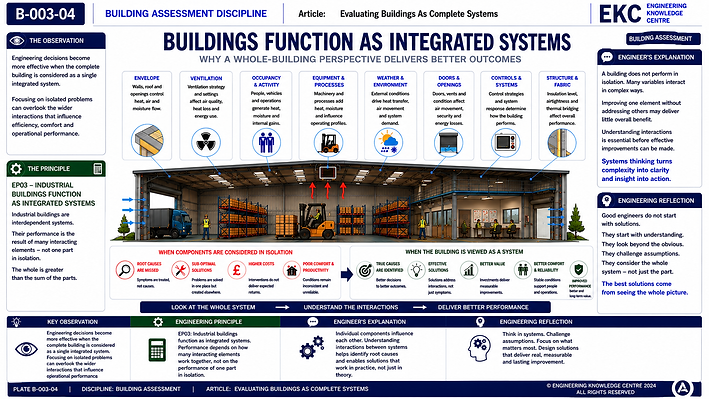
P-004 TThis Engineering Knowledge Centre plate explains why industrial buildings should be assessed as complete engineering systems rather than as collections of independent components. Using a detailed warehouse cutaway illustration, it demonstrates how the building envelope, ventilation, occupancy, equipment, weather, doors, controls and structural fabric interact continuously to determine overall performance. The infographic contrasts isolated problem-solving with a systems-based approach, showing how understanding these interactions leads to more effective engineering decisions, improved energy efficiency, enhanced occupant comfort and better long-term operational performance.
ENGINEERING REFLECTION
Looking beyond isolated problems often reveals opportunities that would otherwise remain hidden. Good engineering considers both the detail and the bigger picture
Developing Integrated Engineering Solutions
OBSERVATION
The greatest improvements in building performance are rarely achieved through a single engineering intervention. Lasting success is normally delivered by combining complementary measures that support one another as part of an integrated improvement strategy. Enhanced insulation, effective airtightness, efficient heating, controlled ventilation, well-managed industrial doors and good operational practices each contribute towards overall performance, but their combined effect is often significantly greater than the sum of their individual benefits. Engineers therefore develop coordinated solutions that strengthen the entire building system, producing greater energy efficiency, improved environmental control, reduced operating costs and more sustainable long-term performance.
ENGINEERING PRINCIPLE
EP03 – Industrial Buildings Function As Integrated Systems
Successful engineering solutions combine complementary improvements that work together. Considering the interaction between systems allows engineers to maximise overall building performance.
Long-term improvements are usually achieved through a combination of complementary measures.
Improving insulation, reducing air exchange, optimising heating systems and refining operational practices often deliver greater benefits together than any single intervention alone.
Systems engineering helps engineers develop coordinated improvement strategies that maximise overall building performance while supporting operational requirements.
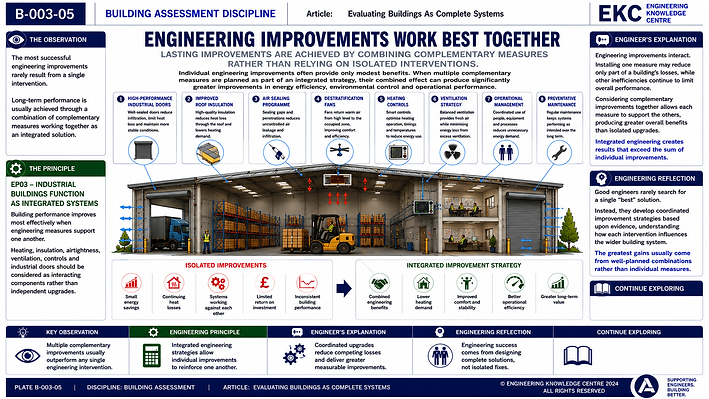
P-005 This plate demonstrates how the greatest improvements in building performance are achieved by combining complementary engineering measures rather than relying on isolated interventions. It illustrates how insulation, airtightness, heating, ventilation, operational management and industrial doors interact to improve energy efficiency and environmental control.
ENGINEERING REFLECTION
Long-term building performance is usually achieved through a series of complementary improvements rather than a single engineering intervention.
ENGINEERING BAR
At A Glance

Discipline
Building Assessment

Category
Systems Thinking

Reading time
8
mins

Last reviewed
July
In This Article
Thinking Beyond Individual Components
Understanding System Interactions
How Buildings Function As Integrated Systems
Seeing The Bigger Engineering Picture
Developing Integrated Engineering Solutions
Continue Reading
→
This is a title. Click here
→
This is a title. Click here .
→
This is a title. Click here
Key Takeway
The most effective engineering solutions optimise the performance of the whole building rather than individual components.
Reading Tip
Click any engineering plate to view it full size.
Engineering Summary Plate

Systems engineering evaluates the relationships between building fabric, environmental control, operational activity and occupant behaviour. This integrated approach produces solutions that deliver greater long-term performance than isolated improvements.
Engineering Summary
Systems engineering evaluates the relationships between building fabric, environmental control, operational activity and occupant behaviour. This integrated approach produces solutions that deliver greater long-term performance than isolated improvements.