

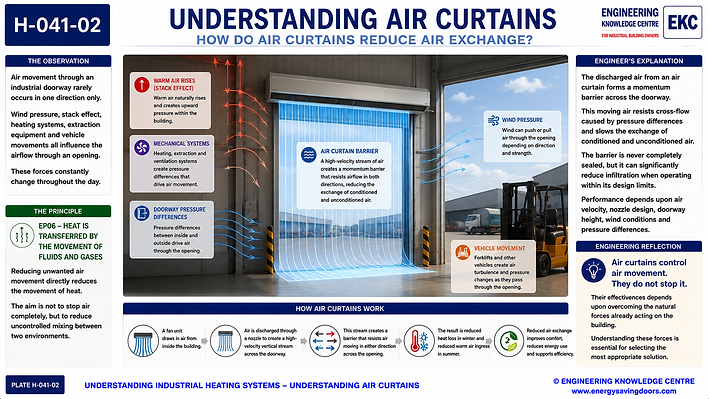
Air movement through a typical industrial doorway.
This figure illustrates the principal paths through which uncontrolled airflow can influence heat loss and environmental conditions.
H-041
MANAGING AIR MOVEMENT IN BUILDING OPENINGS
ENGINEERING
KNOWLEDGE
CENTRE
EKC
What Is An Air Curtain?
OBSERVATION
An air curtain is often installed above an industrial doorway with the expectation that it will prevent heat loss whenever the door is open. While air curtains can provide valuable benefits, their effectiveness depends heavily upon the application, building conditions and operational requirements.
Many industrial buildings experience large pressure differences, frequent forklift movements and significant air exchange through open doorways. In these environments, an air curtain alone may not always provide the level of environmental separation that is expected.
Understanding both the strengths and limitations of air curtains is therefore essential when selecting the most appropriate doorway solution.
ENGINEERING PRINCIPLE
EP02 – Air moves from areas of higher pressure towards areas of lower pressure.
An air curtain attempts to create a controlled stream of moving air that acts as an aerodynamic barrier between two environments. Rather than physically closing an opening, it reduces the exchange of air by introducing a continuous high-velocity airflow across the doorway.
An air curtain consists of a fan unit mounted above an opening which discharges a continuous sheet of air vertically across the doorway.
When correctly selected and commissioned, this airflow reduces the movement of warm air out of the building and limits the ingress of colder external air. The effectiveness of the barrier depends upon air velocity, nozzle design, doorway height, wind conditions and pressure differences between the two environments.
Unlike a physical door, the opening remains fully accessible at all times.

ENGINEERING REFLECTION
Air curtains do not stop air movement; they attempt to control it. Their performance depends upon overcoming the natural forces already acting within the building.
How Do Air Curtains Reduce Heat Loss?
OBSERVATION
Air movement through an industrial doorway rarely occurs in one direction only. Wind pressure, stack effect, heating systems, extraction equipment and vehicle movements all influence the airflow through an opening.
These forces constantly change throughout the day.
ENGINEERING PRINCIPLE
EP06 – Heat is transferred by the movement of fluids and gases.
Reducing unwanted air movement directly reduces the movement of heat.
The discharged air creates a momentum barrier across the doorway.
This moving air resists cross-flow from pressure differences and slows the exchange of conditioned and unconditioned air.
The barrier is never completely sealed, but it can significantly reduce infiltration when operating within its design limits.
Performance depends upon maintaining sufficient air velocity all the way to floor level.
ENGINEERING REFLECTION
The objective is not to stop air completely, but to reduce uncontrolled mixing between two environments.
Where Are Air Curtains Most Effective?
OBSERVATION
Industrial doorways vary enormously.
A loading dock operating continuously throughout the day presents a very different engineering challenge from a pedestrian entrance that opens only occasionally.
No single environmental control solution is appropriate for every application.
ENGINEERING PRINCIPLE
EP03 – Industrial buildings function as integrated systems.
Doorways, heating systems, ventilation, occupancy and building operation must be considered together.
Air curtains perform particularly well where:
pedestrian access is frequent
doors remain open for extended periods
visibility and unrestricted movement are priorities
environmental separation is desirable but complete sealing is unnecessary.
Typical applications include retail entrances, reception areas, internal temperature zones and some industrial pedestrian doors.
They become progressively less effective as doorway height increases and pressure differences become more severe.

ENGINEERING REFLECTION
Engineers select solutions according to building performance rather than product popularity.
Air Curtains vs High-Speed Doors
OBSERVATION
Many warehouse owners assume that an air curtain and a high-speed door perform the same function.
Although both influence environmental control, they operate using entirely different engineering principles.
ENGINEERING PRINCIPLE
EP04 – Buildings continually respond to operational activity.
Engineering solutions should minimise uncontrolled environmental change during normal operation.
An air curtain attempts to reduce air exchange while the doorway remains open.
A high-speed door reduces the time during which the opening exists.
Modern high-speed doors complete an opening and closing cycle in only a few seconds, significantly reducing the duration of heat loss, air infiltration, dust ingress and environmental disturbance.
In many industrial applications, both technologies may be used together where operational requirements justify the investment.

ENGINEERING REFLECTION
Reducing opening time often provides greater benefit than attempting to control airflow through a permanently open doorway.
Selecting The Right Solution
OBSERVATION
Selecting an environmental control system requires consideration of far more than equipment specification.
Building geometry, operational activity, temperature difference, wind exposure and energy objectives all influence the final engineering solution.
ENGINEERING PRINCIPLE
EP01 – Temperature differences drive heat transfer.
The greater the temperature difference and the longer an opening remains available, the greater the opportunity for unwanted heat transfer.
Engineers evaluate doorway performance by considering:
frequency of operation
opening duration
building pressure conditions
temperature differential
wind exposure
operational requirements
traffic type
energy performance objectives.
An air curtain may provide an effective solution where access must remain unrestricted.
Where maximum environmental separation and energy efficiency are required, a well-selected industrial door—particularly a high-speed door—will often deliver significantly greater overall performance.

ENGINEERING REFLECTION
The most effective solution is usually the one that addresses the underlying cause of heat loss rather than simply reducing its effects.
Every time an industrial doorway opens, the building environment changes. Warm conditioned air escapes while cooler external air enters to replace it, affecting temperature stability, heating demand and occupant comfort.
Air curtains are often used to reduce this air exchange by creating a high-velocity barrier across the opening. Their effectiveness, however, depends upon doorway size, operating conditions, traffic patterns and the overall building design.
Engineers therefore evaluate air curtains alongside industrial door performance, opening frequency, air permeability and building operation to determine the most effective engineering solution for each application.
Industrial doorways create one of the largest pathways for uncontrolled air movement within industrial buildings. Understanding how air curtains and industrial doors influence airflow helps engineers improve environmental control and reduce unnecessary energy loss.
AT A GLANCE

Discipline
Building Physics

Category
Heat Loss

Reading time
6
mins

Last reviewed
July
IN THIS ARTICLE
Understanding Air Leakage
The Key Measurements
Engineering Principles
Practical Example
Engineering Relfection
Summary
KEY TAKEAWAY
Air curtains can reduce uncontrolled air movement, but their performance depends upon the operational characteristics of the doorway and the wider building system in which they operate.
CONTINUE READING
→ Building Pressure
→ Stack Effect
→ Buildings Breath
→ Air Cnanges Per Hour
→
What Measurements Matter Most?
→
Understanding Air Leakage
CONTINUE READING
Engineering Summary
Air curtains are designed to reduce uncontrolled air movement through industrial doorways by creating a high-velocity stream of air across an opening. Their effectiveness depends upon doorway dimensions, operating conditions, traffic frequency and the wider building environment. Engineers assess air curtains alongside industrial door performance, air permeability and operational activity to determine the most appropriate solution for controlling heat loss and maintaining environmental stability.
Understanding Air Curtains and Industrial Doorways
Industrial doorways create one of the largest pathways for uncontrolled air movement within industrial buildings. Understanding how air curtains and industrial doors influence airflow helps engineers improve environmental control and reduce unnecessary energy loss.