

Air movement through a typical industrial doorway.
This figure illustrates the principal paths through which uncontrolled airflow can influence heat loss and environmental conditions.
B-004
GATHERING ENGINEERING EVIDENCE
EKC
Engineering decisions should always be supported by evidence. Observations, measurements and operational data provide the information needed to understand how an industrial building behaves under normal working conditions.
Beginning With Observation
OBSERVATION
Every engineering investigation begins by observing how a building behaves before any measurements are taken. Experienced engineers examine the condition of the building fabric, industrial doors, heating systems, ventilation, occupancy and operational activity to identify patterns that may explain how the building is performing. These initial observations help establish where further investigation is required and ensure that subsequent measurements are focused on the most significant aspects of building performance. Careful observation provides valuable engineering context, enabling evidence to be interpreted more effectively and helping engineers distinguish between normal operating behaviour and conditions that may require further investigation.
ENGINEERING PRINCIPLE
EP05 – Engineering Decisions Should Be Evidence Based
Engineering investigations begin by collecting reliable evidence. Observation provides context, while systematic measurements enable engineers to understand the underlying causes of building behaviour.
Engineering assessments begin by understanding the building before collecting detailed measurements.
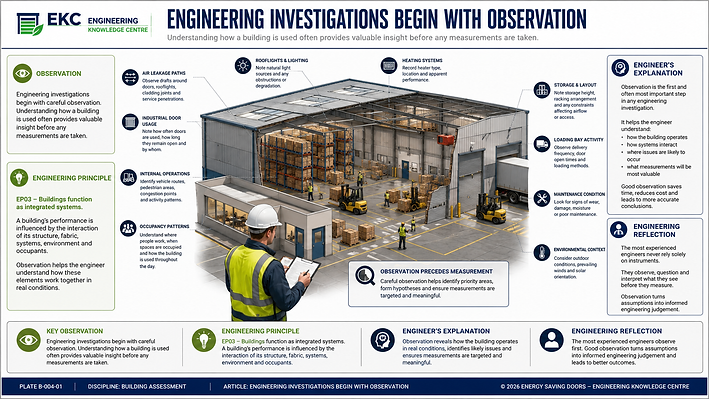
P-001 This plate illustrates how careful observation forms the foundation of every engineering investigation. Before measurements are taken, engineers study building operation, occupancy, industrial door usage, equipment, maintenance condition and environmental influences to determine which measurements will provide the greatest insight.
ENGINEERING REFLECTION
Observation is often the engineer's most valuable tool. Before measuring a building, it is important to understand how it behaves during normal operation.
Building An Evidence Base
OBSERVATION
Reliable engineering evidence is collected through a structured and methodical process rather than by recording isolated observations. Engineers combine visual inspections, environmental measurements, operational information, maintenance records and discussions with building users to develop a complete understanding of building performance. Each source of information contributes part of the overall picture, allowing findings to be verified by comparison with other evidence. This systematic approach reduces the likelihood of incorrect conclusions, improves confidence in engineering assessments and ensures that recommendations are supported by objective evidence rather than assumptions or incomplete information gathered from a single source.
ENGINEERING PRINCIPLE
EP05 – Engineering Decisions Should Be Evidence Based
Reliable engineering evidence is obtained through structured observation, careful measurement and objective analysis. This process provides the information needed to evaluate building performance accurately.
Reliable engineering evidence is gathered using a structured and repeatable process.
Observations are supported by objective measurements, ensuring that conclusions are based upon verifiable information rather than assumptions.
Combining qualitative observations with quantitative data provides engineers with a more complete understanding of building performance.
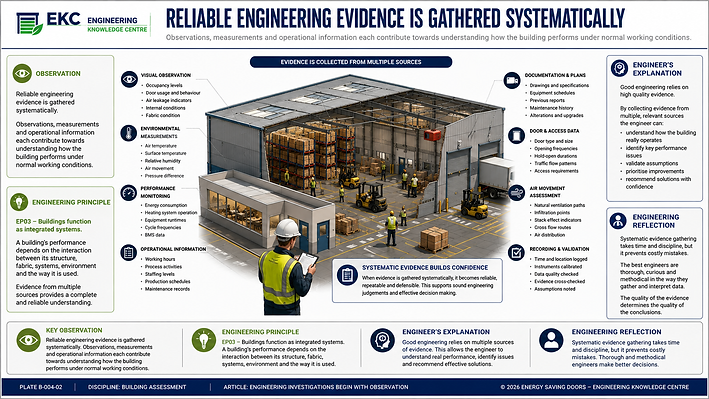
P-002 This plate explains how reliable engineering evidence is gathered from multiple complementary sources, including visual observations, environmental measurements, operational information and building documentation, to develop an accurate understanding of building performance.
ENGINEERING REFLECTION
Reliable evidence builds confidence. The more accurately engineers understand the building, the more confidently they can recommend improvements.
Understanding Measurements In Context
OBSERVATION
Engineering measurements only become meaningful when they are interpreted within the context of how the building operates. A temperature reading, airflow measurement or pressure difference may appear significant in isolation, yet its true importance depends upon factors such as occupancy, production activity, weather conditions and industrial door usage at the time it was recorded. Engineers therefore seek to understand the operational circumstances surrounding every measurement before drawing conclusions. By combining measured values with observations of building operation, they develop a more accurate understanding of performance and avoid recommendations based upon data that has been considered without appropriate engineering context.
ENGINEERING PRINCIPLE
EP03 – Industrial Buildings Function As Integrated Systems
Measurements should always be interpreted within the wider context of the building. Individual readings become meaningful when considered alongside the interaction between building systems and operational activity.
Measurements become significantly more valuable when interpreted alongside operational information.
For example, temperature readings may only become meaningful when considered alongside industrial door usage, occupancy levels or heating operation.
Understanding this wider context enables engineers to identify the true causes of building behaviour rather than simply recording its symptoms.

P-003 This plate demonstrates that engineering measurements only become meaningful when interpreted within their operational context. Temperature, airflow and pressure readings are shown alongside building activity to illustrate how context transforms isolated data into engineering understanding.
ENGINEERING REFLECTION
Measurements become meaningful when combined with operational understanding. Numbers alone rarely explain why a building performs as it does.
Observing Buildings Under Normal Operation
OBSERVATION
Industrial buildings are dynamic environments whose performance changes continuously throughout the day. External weather conditions fluctuate, production processes begin and end, occupancy levels vary and industrial doors open and close in response to operational activity. Heating and ventilation systems also respond to these changing demands, creating environmental conditions that rarely remain constant for long. Engineers recognise that a single snapshot of building performance is unlikely to represent normal operation and therefore assess buildings over representative periods wherever possible. Understanding these daily variations provides a more realistic picture of how the building performs under genuine operating conditions.
ENGINEERING PRINCIPLE
EP04 – Buildings Continually Respond To Operational Activity
Building conditions are continually changing. Engineers therefore observe environmental performance over representative operating periods to understand how normal activity influences overall behaviour.
Buildings rarely perform consistently throughout the day.
Environmental conditions change continuously as weather, occupancy and operational activities vary.
Engineers therefore gather evidence during representative operating conditions to ensure that recommendations reflect how the building normally behaves rather than unusual or short-term circumstances.
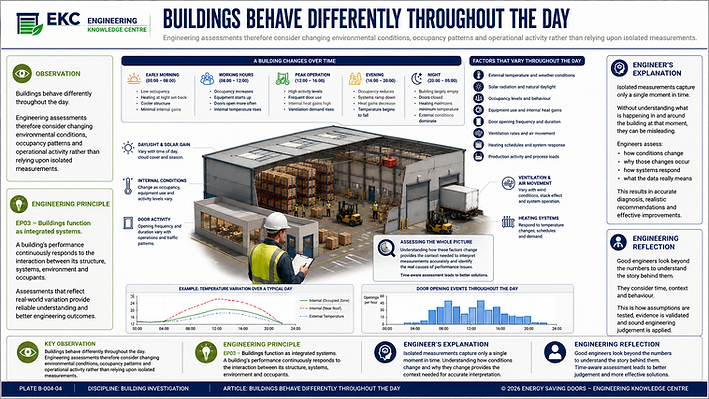
P-004 This plate shows how environmental conditions within industrial buildings change continuously throughout the day. It illustrates the influence of occupancy, production activity, weather, heating operation and industrial door usage on engineering assessments.
ENGINEERING REFLECTION
Engineering assessments should reflect how buildings are actually used, not simply how they were designed to operate.
Collecting The Right Evidence
OBSERVATION
Successful engineering investigations are not defined by the quantity of information collected but by the relevance and quality of the evidence obtained. Engineers carefully select observations and measurements that answer specific engineering questions rather than attempting to record every available piece of data. Targeted evidence allows the underlying causes of performance issues to be identified more efficiently while avoiding unnecessary complexity and distraction. By focusing on the information that genuinely influences engineering decisions, investigations become more effective, conclusions become more reliable and recommendations can be developed with greater confidence, accuracy and practical value for the building operator.
ENGINEERING PRINCIPLE
EP05 – Engineering Decisions Should Be Evidence Based
The quality of engineering decisions depends upon the quality of the evidence available. Collecting relevant, reliable information enables engineers to recommend improvements with confidence.
Engineering evidence should always support decision-making.
Collecting unnecessary information increases assessment time without necessarily improving understanding.
By focusing upon the most relevant observations and measurements, engineers develop efficient assessments that provide meaningful recommendations for improving building performance.

P-005 This plate explains that effective engineering investigations prioritise relevant evidence rather than excessive data collection. It demonstrates how selecting the right information leads to clearer engineering understanding and better-informed decisions.
ENGINEERING REFLECTION
Collecting evidence is only the beginning. The real value lies in transforming information into practical engineering decisions
Changing one aspect of a building often affects several others. Improvements to insulation influence heating requirements. Changes to ventilation alter pressure conditions. Door performance affects air movement, environmental control and heating efficiency. Even relatively small modifications can produce wider effects that are not immediately obvious when individual building elements are considered in isolation. Successful improvements therefore depend upon understanding how the building operates as an interconnected system.
Systems engineering recognises these interactions and evaluates the complete building before recommending improvements. By understanding how individual components influence one another, engineers develop coordinated solutions that improve overall performance, maximise energy efficiency and ensure that investment delivers reliable, measurable and sustainable long-term operational benefits.
Reliable engineering recommendations are built upon evidence collected through systematic observation and measuremen
Beginning With Observation
Building An Evidence Base
Understanding Measurements In Context
Observing Buildings Under Normal Operation
Collecting The Right Evidence

Discipline
Building Assessment

Category
Engineering Investigation

Reading time
8
mins

Last reviewed
July
→
What Measurements Matter Most?
→
Understanding Air Leakage
AT A GLANCE
IN THIS ARTICLE
CONTINUE READING
KEY TAKEAWAY
Engineering Summary
Engineering evidence combines visual observation, operational understanding and quantitative measurement to develop an accurate picture of building performance. This evidence-based approach reduces uncertainty and supports better engineering decisions.