

Air movement through a typical industrial doorway.
This figure illustrates the principal paths through which uncontrolled airflow can influence heat loss and environmental conditions.
B-013
VERIFYING ENGINEERING IMPROVEMENTS
The completion of engineering work should never mark the end of an assessment. Professional engineers verify that improvements have achieved their intended objectives by comparing measured building performance before and after implementation. Verification transforms assumptions into evidence, demonstrates the value of investment and provides confidence that engineering decisions have delivered measurable benefits.
Engineering improvements are undertaken to solve identifiable problems, but no engineer should assume that every modification automatically delivers the expected result. Buildings behave as integrated systems, and changes to one element can influence many others. Professional engineers therefore verify completed work by measuring building performance after implementation and comparing the results with the original assessment. This process confirms whether objectives have been achieved, identifies any unintended consequences and provides objective evidence that future engineering decisions can build upon. Verification closes the engineering loop and transforms improvement into measurable performance.
Installation Does Not Guarantee Performance
OBSERVATION
Completing an engineering installation or remedial project does not automatically guarantee improved building performance. Industrial buildings behave as integrated systems, and the true effectiveness of any improvement can only be confirmed through objective measurement after implementation.
ENGINEERING PRINCIPLE
EP05 – Engineering decisions should be based upon measured evidence.
Professional engineering requires verification. Every completed improvement should be measured under normal operating conditions to confirm that the intended engineering objectives have been achieved
Engineering solutions are designed to improve measurable building performance, but operational conditions, building interactions and environmental influences may all affect the final outcome. Professional engineers therefore undertake post-installation verification to confirm that improvements have delivered the expected reductions in heat loss, uncontrolled air movement, energy consumption or operational disruption. Objective verification replaces expectation with evidence.

P-001 A professional engineering infographic explaining why completed engineering installations must be verified through objective measurement. A newly installed high-speed industrial door forms the central illustration, surrounded by engineering callouts highlighting system interaction, operating conditions, environmental influences and maintenance. Supporting panels explain that engineering success is confirmed by measured building performance rather than simply completing an installation, emphasising the importance of post-installation verification under real operating conditions.
ENGINEERING REFLECTION
Completing the work is only one milestone.
Successful engineering is measured by improved building performance, not by the completion of an installation.
Before And After Measurements Provide Engineering Evidence
OBSERVATION
Without measurements taken before and after an engineering improvement, it becomes difficult to determine whether building performance has genuinely improved or whether observed changes simply reflect normal operating variation.
ENGINEERING PRINCIPLE
EP05 – Engineering decisions should be based upon measured evidence.
Comparable measurements collected before and after an engineering intervention provide objective evidence that allows engineers to quantify performance improvements with confidence.
Every improvement deserves a meaningful comparison.
Baseline measurements transform future observations into engineering evidence.
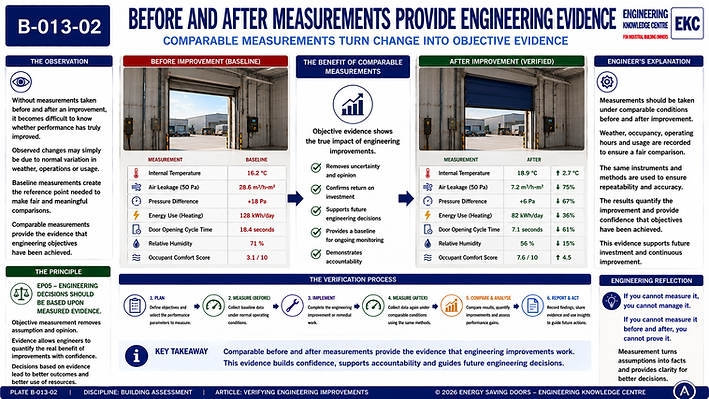
P-002 A detailed engineering infographic comparing building performance before and after engineering improvements. Side-by-side warehouse doorway images display baseline measurements alongside verified post-improvement results for internal temperature, air leakage, pressure difference, energy use, door cycle time, humidity and occupant comfort. Supporting panels describe the verification process and demonstrate how comparable measurements provide objective evidence that engineering objectives have been achieved
ENGINEERING REFLECTION
Every improvement deserves a meaningful comparison.
Baseline measurements transform future observations into engineering evidence.
Buildings May Respond In Unexpected Ways
OBSERVATION
Buildings do not always respond exactly as predicted. Improvements to one building element can alter airflow, pressure relationships, heating performance and environmental conditions elsewhere within the building.
ENGINEERING PRINCIPLE
EP03 – Industrial buildings function as integrated systems.
Industrial buildings operate as interconnected systems. Modifying one component may influence the behaviour of many others, making post-installation verification essential.
Reducing air leakage may alter ventilation effectiveness. Faster industrial doors may influence internal pressure balance. Heating improvements may affect air circulation and temperature distribution. Engineers therefore verify the performance of the complete building rather than focusing solely upon the upgraded component, ensuring that overall building performance has genuinely improved.
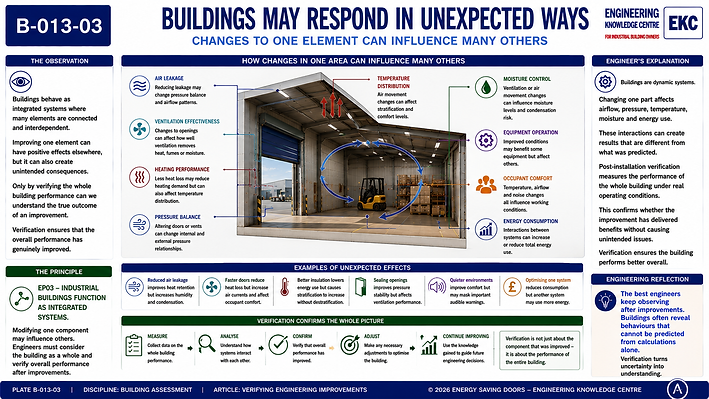
P-003 A technical engineering infographic illustrating how improvements to one building element can influence many interconnected systems. A cutaway industrial warehouse shows interactions between air leakage, ventilation, heating performance, pressure balance, temperature distribution, moisture control, equipment operation, occupant comfort and energy consumption. Supporting engineering panels explain why whole-building verification is essential after improvements to identify both intended benefits and unexpected system interactions.
ENGINEERING REFLECTION
The best engineers continue observing after improvements have been completed.
Buildings often reveal behaviours that cannot be predicted from calculations alone.
Verification Builds Engineering Confidence
OBSERVATION
Verified engineering results provide confidence for building owners, facilities managers, engineers and financial decision-makers by demonstrating that investment has produced measurable operational benefits.
ENGINEERING PRINCIPLE
EP05 – Engineering decisions should be based upon measured evidence.
Measured evidence validates engineering decisions, reduces uncertainty and provides confidence that engineering objectives have been successfully achieved.
Post-installation verification demonstrates whether engineering objectives have been achieved while providing valuable documentation for maintenance planning, future upgrades and investment decisions. Verified performance strengthens accountability, improves engineering judgement and gives stakeholders confidence that resources have delivered measurable value.
B-013-05
Observation
Every verified engineering project contributes to a growing understanding of how a building performs. This knowledge supports future improvements and enables engineers to optimise building performance throughout its operational life.
Section Heading
Measured Success Supports Future Improvements
Engineering Principle Name
EP04 – Buildings continually respond to operational activity.
Engineering Principle Text
Each cycle of measurement, verification and improvement expands engineering knowledge, supporting continuous optimisation and better long-term building performance.
Engineering Reflection
Every measurement tells part of the building's story.
Every verified improvement adds to the knowledge that guides the next engineering decision.
Engineering Explanation
Professional engineers view verification as the beginning of the next improvement cycle rather than the end of a project. Performance data gathered after each completed improvement creates a valuable engineering history that supports preventative maintenance, future investment and increasingly accurate engineering recommendations. Over time, this growing body of measured evidence enables buildings to operate more efficiently, more reliably and with greater confidence.

P-004 A comprehensive engineering infographic demonstrating how objective verification builds confidence in engineering decisions. Side-by-side panels compare uncertain outcomes before verification with confirmed results after objective measurement, highlighting validated performance improvements, stakeholder confidence, reduced risk and measurable return on investment. Supporting sections explain how verified evidence supports building owners, facilities managers, engineers and financial decision-makers while creating a reliable record of engineering performance.
ENGINEERING REFLECTION
Confidence comes from evidence, not expectation.
Objective verification allows future engineering decisions to be based upon proven performance.
Measured Success Supports Future Improvements
OBSERVATION
Every verified engineering project contributes to a growing understanding of how a building performs. This knowledge supports future improvements and enables engineers to optimise building performance throughout its operational life.
ENGINEERING PRINCIPLE
EP04 – Buildings continually respond to operational activity.
Each cycle of measurement, verification and improvement expands engineering knowledge, supporting continuous optimisation and better long-term building performance.
Professional engineers view verification as the beginning of the next improvement cycle rather than the end of a project. Performance data gathered after each completed improvement creates a valuable engineering history that supports preventative maintenance, future investment and increasingly accurate engineering recommendations. Over time, this growing body of measured evidence enables buildings to operate more efficiently, more reliably and with greater confidence.

P-005 A professional engineering infographic illustrating how verified engineering projects contribute to continuous building optimisation. A central circular improvement cycle follows the stages of measuring, improving, verifying, learning and refining future decisions, while supporting panels explain how verification creates an expanding performance history that improves maintenance planning, investment decisions, operational efficiency and long-term building performance. The infographic reinforces that every verified improvement contributes to smarter future engineering decisions.
ENGINEERING REFLECTION
Every measurement tells part of the building's story.
Every verified improvement adds to the knowledge that guides the next engineering decision.
ENGINEERING BAR
At A Glance

Discipline
Building Assessment

Category

Reading time
6
mins

Last reviewed
July
In This Article
Installation Does Not Guarantee Performance
Before And After Measurements Provide Engineering Evidence
Buildings May Respond In Unexpected Ways
Verification Builds Engineering Confidence
Measured Success Supports Future Improvements
Continue Reading
→
This is a title. Click here
→
This is a title. Click here .
→
This is a title. Click here
Key Takeway
Engineering improvements should always be verified using objective measurements rather than assumptions.
Reading Tip
Click any engineering plate to view it full size.
Engineering Summary Plate

Illustrates how ongoing measurement and analysis reveal changing building performance, identify emerging faults, verify improvements and support proactive maintenance, energy efficiency, environmental control and long-term operational optimisation.
Engineering Summary
Professional engineering does not end when installation is complete. Objective verification confirms that improvements have achieved their intended outcomes, validates investment decisions and provides reliable evidence for future optimisation.