

Air movement through a typical industrial doorway.
This figure illustrates the principal paths through which uncontrolled airflow can influence heat loss and environmental conditions.
D-024
INDUSTRIAL DOORS IN COLD STORAGE FACILITIES
Cold storage facilities depend upon maintaining controlled temperatures despite frequent movement through operational doorways. Industrial doors must provide efficient access while limiting warm air infiltration, cold air loss, moisture movement and unnecessary refrigeration demand.
Cold storage facilities create demanding conditions for industrial doorways because significant temperature differences may exist between adjoining environments. Whenever a door opens, this separation is temporarily removed, allowing air movement that can increase refrigeration demand, introduce moisture and disturb temperature stability. Frequently used openings therefore require careful consideration of operating speed, opening duration, sealing, insulation, activation and traffic patterns. The appropriate solution depends upon both the temperature difference and how the doorway is used. Effective application engineering reduces unnecessary exposure while maintaining efficient movement of people, forklifts and materials, helping refrigeration systems maintain controlled conditions with lower avoidable energy demand throughout operations.
Maintaining the Thermal Boundary
OBSERVATION
Cold-storage doorways create necessary access points through an otherwise highly controlled thermal envelope. Whenever the door opens, the physical separation between the refrigerated space and the warmer adjoining environment is temporarily removed.
ENGINEERING PRINCIPLE
EP01 — Cold-storage doorways must maintain effective thermal separation between environments with significantly different temperatures while providing the access required by the operation.
The greater the temperature difference across a doorway, the greater the potential for unwanted heat transfer. Door construction, sealing and operating behaviour should therefore be considered together when maintaining the thermal boundary.
Cold stores depend upon maintaining a controlled temperature considerably below adjoining spaces. When closed, insulation and perimeter sealing help restrict heat transfer through the doorway. When the door opens, however, that resistance is temporarily removed. Effective cold-storage doorway engineering therefore combines appropriate insulation and sealing with operation that restores the thermal boundary as quickly as practical after traffic has passed.

P-001 Shows how cold-storage doorways form part of the insulated thermal envelope, demonstrating how temperature differential, insulation, perimeter sealing and rapid operation work together to maintain separation and reduce refrigeration demand.
ENGINEERING REFLECTION
A highly insulated cold store can still experience substantial energy loss through a frequently used doorway. The performance of the opening therefore matters as much as the surrounding insulated envelope.
Controlling Air Exchange Through Open Doorways
OBSERVATION
Opening a cold-storage doorway allows warmer external air and colder internal air to interact. Temperature and pressure differences can produce substantial air exchange even when the doorway remains open for relatively short periods.
ENGINEERING PRINCIPLE
EP02 — Air exchange through cold-storage doorways must be controlled by minimising the size and duration of the open pathway between environments with different temperatures and pressures.
Temperature and pressure differences create air movement through an open doorway. Opening dimensions, duration, traffic behaviour and surrounding pressure conditions therefore influence the volume of air exchanged.
Cold dense air tends to move outward through the lower part of an opening while warmer air can enter above it, producing simultaneous two-way exchange. Wind, ventilation and pressure differences may increase this movement. Rapid opening and closing, appropriate activation and minimising unnecessary opening height or duration can significantly reduce the quantity of air exchanged during normal operation.

P-002 Illustrates how temperature and pressure differences drive warm and cold air through open cold-store doorways, showing how opening size, duration and surrounding airflow determine air exchange and associated refrigeration demand.
ENGINEERING REFLECTION
The most effective thermal door cannot insulate an opening while it is physically open. Reducing unnecessary open time is therefore fundamental to controlling cold-store energy loss.
Managing Moisture, Condensation and Ice
OBSERVATION
Warm air entering a refrigerated environment can carry significant moisture. As this air cools, water vapour may condense or freeze on surfaces around the doorway, floor, door components and refrigeration equipment.
ENGINEERING PRINCIPLE
EP03 — Moisture control at cold-storage doorways must be considered as part of the interaction between air exchange, temperature, refrigeration, drainage and door operation.
Moisture entering with infiltrating air can condense or freeze when exposed to cold surfaces. Reducing air exchange therefore helps control both thermal load and moisture-related problems.
When warm humid air enters a cold environment, its ability to retain water vapour decreases. Condensation may form and, where surface temperatures are sufficiently low, subsequently freeze. Ice around thresholds can create slip hazards and interfere with door operation, while frost can increase refrigeration demand. Controlling infiltration, maintaining seals and coordinating doorway operation with the wider refrigeration environment helps manage these effects.

P-003 Shows how warm humid air entering a cold store can cool, condense and freeze around the doorway, creating ice, safety hazards, equipment problems, increased refrigeration demand and potential operational disruption.
ENGINEERING REFLECTION
Air infiltration into a cold store introduces more than heat. It also introduces moisture, which can create additional operational, maintenance and safety consequences.
Supporting Frequent Cold-Store Traffic
OBSERVATION
Cold-storage doorways often serve forklifts, pallet trucks and pedestrians moving products between temperature zones. Frequent access can create tension between maintaining efficient traffic flow and preserving environmental separation.
ENGINEERING PRINCIPLE
EP04 — Cold-storage door operation must respond to actual traffic frequency, approach behaviour and movement requirements while minimising unnecessary exposure of the refrigerated environment.
Activation, opening speed, opening height and closing sequence should correspond with the traffic using the doorway. Access should be provided when required without leaving the thermal boundary open unnecessarily.
Forklifts may require rapid, repeated access through cold-storage boundaries. Sensors, induction loops and other activation systems can help coordinate door movement with approaching traffic. Correct positioning and control settings can reduce premature opening, unnecessary waiting and excessive open time. Effective operation therefore supports productivity while limiting air exchange and refrigeration demand.

P-004 Illustrates how sensor activation, rapid operation, controlled opening height, automatic closure and clear traffic routes allow frequent cold-store access while minimising open time, air exchange and unnecessary refrigeration demand.
ENGINEERING REFLECTION
A cold-store door should not simply operate quickly; it should operate intelligently in response to traffic so that each opening is only as large and as long as necessary.
Reliability in Temperature-Controlled Operations
OBSERVATION
Cold-storage doors can form critical components of refrigeration and logistics operations. Failure may leave an opening exposed, restrict product movement and increase heat and moisture infiltration into the controlled environment.
ENGINEERING PRINCIPLE
EP03 — Cold-storage door reliability must be evaluated according to operating duty, temperature conditions and the doorway’s importance to environmental control and operational continuity.
Doors operating in refrigerated environments should be specified, installed and maintained for the temperature, operating frequency and environmental conditions they experience throughout their service life.
Low temperatures, frequent cycling, condensation, ice and impact can place demanding conditions upon door components, seals, controls and safety systems. Appropriate specification, correct installation and planned inspection help maintain reliable operation. Where a doorway protects a critical refrigerated area, preventative maintenance and rapid fault response become part of protecting both operational continuity and the controlled environment.

P-005 Shows how specification, suitable components, installation, responsive operation, planned maintenance and performance review combine to maintain reliable cold-store doors, protecting temperature control, products, safety, energy efficiency and operational continuity.
ENGINEERING REFLECTION
The consequence of cold-store door failure extends beyond the cost of repairing the door. Every additional period of uncontrolled opening can affect temperature, energy demand, product movement and operating conditions.
ENGINEERING BAR
At A Glance

Discipline
Industrial Doorway Engineering

Category
Application Engineering

Reading time
6
mins

Last reviewed
August
In This Article
Maintaining the Thermal Boundary
Controlling Air Exchange Through Open Doorways
Managing Moisture, Condensation and Ice
Supporting Frequent Cold-Store Traffic
Reliability in Temperature-Controlled Operations
Continue Reading
→
This is a title. Click here
→
This is a title. Click here .
→
This is a title. Click here
Key Takeway
Cold storage doorway performance depends upon minimising unnecessary environmental exposure. Insulation is important when the door is closed, but operating speed, sealing, activation and traffic behaviour determine how effectively separation is maintained during repeated use.
Reading Tip
Click any engineering plate to view it full size.
Engineering Summary Plate
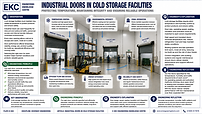
Illustrates when industrial door insulation provides meaningful benefit, showing how temperature difference, opening frequency, closed periods, doorway size and environmental conditions determine the value of improved thermal performance.
Engineering Summary
Cold storage doorways separate environments with significant temperature differences, making uncontrolled air exchange particularly important. Frequent opening can introduce warmer air and moisture while increasing refrigeration demand. Effective application engineering considers operating frequency, speed, opening duration, insulation, sealing, activation, safety and traffic requirements together. Matching the door system to actual operating conditions helps maintain temperature stability, reduce unnecessary environmental exchange and support efficient movement without imposing avoidable loads upon refrigeration equipment.