

Air movement through a typical industrial doorway.
This figure illustrates the principal paths through which uncontrolled airflow can influence heat loss and environmental conditions.
D-040
INDUSTRIAL DOOR RISK ASSESSMENT AND HAZARD IDENTIFICATION
Industrial door safety begins with identifying credible hazards, understanding who may be exposed and assessing how doorway design, operation and environment influence risk.
Industrial doors operate where people, vehicles, machinery and building systems frequently interact. Effective risk assessment therefore requires more than examining the door as an isolated product. Engineers should consider how the doorway is approached, activated, travelled through and maintained, together with the consequences of foreseeable abnormal conditions. Hazards may arise from moving components, closing edges, vehicle movements, restricted visibility, control failures, unexpected activation or inappropriate operating arrangements. Identifying these hazards provides the foundation for determining suitable protective measures. A structured assessment considers who may be exposed, how harm could occur and whether the complete installed door system provides proportionate and reliable risk reduction
Hazard Identification Begins with the Complete Doorway Environment
OBSERVATION
Industrial doorways bring together moving machinery, vehicles, pedestrians and building operations within a relatively confined area. Hazards may arise from the door itself, from traffic passing through the opening, or from the interaction between the door and its surroundings. Effective risk assessment therefore begins by identifying the complete operating environment rather than considering the door as an isolated machine.
ENGINEERING PRINCIPLE
EP05 – Engineering Decisions Should Be Evidence Based
Hazards should be identified from observed operating conditions, equipment characteristics and foreseeable interactions rather than assumptions about how a doorway is intended to be used.
Hazard identification should examine the door leaf or curtain, guides, closing edges, drive system, controls, safety devices and structural interfaces together with vehicle routes, pedestrian movements and adjacent working areas. Engineers should also consider visibility, lighting, approach speeds, queuing, restricted clearances and activities occurring close to the opening. Observing the doorway during normal operation frequently reveals hazards that cannot be identified from drawings or equipment specifications alone.
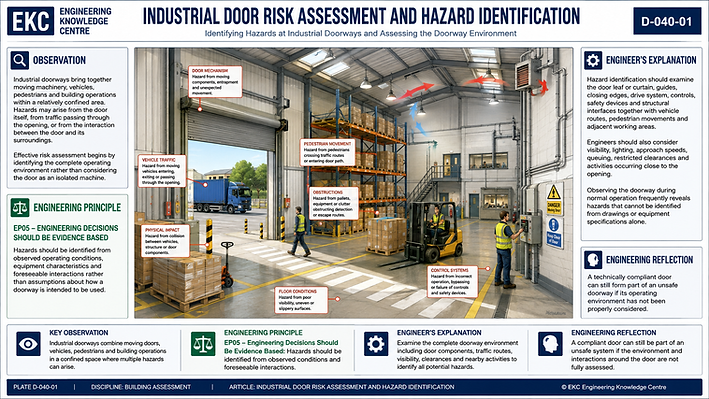
P-001 Industrial doorway assessment showing how moving doors, vehicles, pedestrians, controls and surrounding activities combine to create hazards requiring systematic identification.
ENGINEERING REFLECTION
A technically compliant door can still form part of an unsafe doorway if its operating environment has not been properly considered.
Risk Develops Through Interaction at the Opening
OBSERVATION
Many significant doorway risks occur when pedestrians, vehicles and moving door components occupy the same space. Forklift trucks, pallet movements and pedestrians may approach an opening from different directions while the door is opening or closing. The resulting risk depends not simply upon door movement, but upon the frequency, timing and predictability of these interactions.
ENGINEERING PRINCIPLE
EP04 – Operational Activity Determines Engineering Response
The appropriate engineering response should reflect the frequency, pattern and nature of activity occurring through and around the doorway.
Assessment should consider traffic frequency, vehicle type, pedestrian presence, direction of travel, approach speed and the likelihood of simultaneous movements. Particular attention should be given to mixed pedestrian and vehicle routes. Where frequent interaction occurs, engineering measures may include physical segregation, controlled activation, warning systems, presence detection or changes to the operating sequence. Risk assessment should therefore reflect actual traffic behaviour rather than nominal doorway use.

P-002 Industrial doorway illustrating how traffic frequency, pedestrians, forklifts and door movements interact, demonstrating why risk depends upon actual operational activity.
ENGINEERING REFLECTION
The same industrial door can represent very different levels of risk depending upon how frequently it operates and who or what passes through it.
Moving Door Components Create Predictable Hazard Zones
OBSERVATION
Powered industrial doors introduce mechanical movement into an occupied working environment. Depending upon the door design, hazards may include impact, crushing, trapping, drawing-in, shearing or unexpected movement. The location and severity of these hazards vary according to the construction, operating principle and speed of the door.
ENGINEERING PRINCIPLE
EP03 – Industrial Doorways Are Integrated Engineering Systems
Safe doorway performance depends upon the interaction of mechanical components, control systems, safety devices, users and the surrounding building environment.
Engineers should identify areas where people or vehicles could encounter moving components during normal operation, foreseeable misuse or equipment failure. Particular consideration should be given to closing edges, guide areas, counterbalance systems, drive mechanisms and accessible moving parts. Protective devices such as safety edges, photocells and light curtains should then be evaluated against the identified hazards. Their positioning, coverage and response should correspond to the actual risk zone rather than simply satisfying a standard equipment configuration.

P-003 Powered industrial door showing mechanical hazard zones including closing edges, guides, drive components and safety systems where impact, trapping or crushing may occur.
ENGINEERING REFLECTION
Safety cannot be assessed solely by confirming that individual safety devices are present; their effectiveness depends upon the complete operating system.
Foreseeable Abnormal Conditions Form Part of Risk Assessment
OBSERVATION
Industrial doors do not always operate under ideal conditions. Users may walk beneath closing doors, vehicles may stop within openings, safety devices may become obstructed or damaged, and doors may be operated differently during production pressures, maintenance or emergencies. A meaningful risk assessment must therefore extend beyond intended normal operation.
ENGINEERING PRINCIPLE
EP05 – Engineering Decisions Should Be Evidence Based
Engineering assessment should consider credible operating conditions and foreseeable behaviour, including abnormal circumstances that can reasonably be expected during the service life of the installation.
Assessment should consider foreseeable misuse, temporary obstruction, control failure, damaged safety devices, power interruption, manual operation and maintenance activities. Engineers should distinguish between highly improbable events and behaviours that are reasonably foreseeable within a busy industrial environment. Where foreseeable actions could defeat or bypass existing safeguards, additional engineering or operational controls may be necessary. Designing around realistic behaviour produces more resilient safety arrangements than relying exclusively upon procedural compliance.

P-004 Industrial doorway illustrating foreseeable misuse and abnormal conditions including obstructed sensors, manual operation, power interruption, maintenance activity and unsafe user behaviour.
ENGINEERING REFLECTION
A risk assessment based only upon correct operation may underestimate the hazards that develop during the everyday life of an industrial doorway.
Risk Assessment Must Lead to Proportionate Engineering Action
OBSERVATION
Identifying a hazard is only the beginning of the risk assessment process. The purpose of assessment is to determine whether existing safeguards provide adequate protection and, where they do not, to identify proportionate measures that reduce risk to an acceptable level.
ENGINEERING PRINCIPLE
EP06 – Risk Should Be Reduced Through Engineering Controls
Where reasonably practicable, identified hazards should be reduced through engineering design and protective measures before reliance is placed upon procedures, warnings or user behaviour.
Risk reduction may involve eliminating a hazard, separating pedestrians and vehicles, modifying the door arrangement, introducing protective guarding, improving detection coverage or changing activation and control logic. Warning signs, training and operating procedures remain important, but should not substitute for practicable engineering controls. Following modification, the doorway should be reassessed to confirm that the measures introduced have reduced the original risk without creating new hazards. Risk assessment should therefore be regarded as an iterative engineering process throughout the operational life of the door.

P-005 Industrial doorway demonstrating how identified hazards are translated into proportionate engineering controls, protective devices, traffic management, maintenance and subsequent reassessment.
ENGINEERING REFLECTION
The strongest risk assessment is one that produces clear, proportionate and verifiable improvements to the doorway system.
ENGINEERING BAR
At A Glance

Discipline
Door Performance

Category
Industrial Door Safety Systems

Reading time
8
mins

Last reviewed
August
In This Article
Hazard Identification Begins with the Complete Doorway Environment
Risk Develops Through Interaction at the Opening
Moving Door Components Create Predictable Hazard Zones
Foreseeable Abnormal Conditions Form Part of Risk Assessment
Risk Assessment Must Lead to Proportionate Engineering Action
Continue Reading
→
This is a title. Click here
→
This is a title. Click here .
→
This is a title. Click here
Key Takeway
Industrial door risk assessment should consider the complete doorway in use. Hazards arise from the interaction between the door, people, vehicles, controls, surrounding environment and foreseeable operating conditions.
Reading Tip
Click any engineering plate to view it full size.
Engineering Summary Plate

Engineering summary illustrating how integrated safety devices detect hazards, prevent unsafe movement, stop or reverse doors, provide warnings and maintain reliable protective performance.
Engineering Summary
Industrial door risk assessment identifies credible hazards, considers who may be exposed and evaluates how harm could occur during normal, abnormal and maintenance activities. Assessment should encompass the complete installed doorway, including movement zones, controls, safety devices, traffic patterns and surrounding operations. Findings then inform proportionate protective measures and provide an engineering basis for design, commissioning, inspection and subsequent review as operating conditions change.