

Air movement through a typical industrial doorway.
This figure illustrates the principal paths through which uncontrolled airflow can influence heat loss and environmental conditions.
D-018
UNDERSTANDING INDUSTRIAL DOOR OPERATING SPEED
Operating speed is one of the defining engineering characteristics of an industrial door because it directly influences environmental control, operational efficiency and energy performance. While insulation and sealing determine how a closed door performs, operating speed determines how long the doorway remains open and exposed to uncontrolled air exchange. Faster opening and closing cycles can significantly reduce heat loss, maintain pressure relationships and improve traffic flow in busy facilities. This article explains why operating speed matters, how engineers evaluate it alongside building operation, and why selecting the correct door speed delivers benefits far beyond simply reducing waiting time.
Every time an industrial door opens, the environmental separation between two areas is temporarily lost. Warm air escapes, cold air enters, pressure relationships change and contaminants may move between environments. The duration of this opening is largely determined by the operating speed of the door. Faster opening and closing reduces exposure time, limiting uncontrolled air exchange and improving operational efficiency. Engineers therefore evaluate operating speed alongside traffic frequency, building use, environmental requirements and lifecycle performance when selecting industrial doors. Understanding operating speed enables facilities to improve environmental control, reduce energy consumption and increase productivity while maintaining safe and reliable operation.
Operating Speed Determines Doorway Exposure Time
OBSERVATION
Every time an industrial door opens, the environmental separation between two areas is temporarily removed. Operating speed determines how long the doorway remains open and therefore how much uncontrolled air exchange can occur.
ENGINEERING PRINCIPLE
EP04 – Building performance is influenced by operational activity as well as physical construction. Reducing doorway open time improves environmental control, operational efficiency and energy performance.
Operating speed directly influences doorway exposure time, making it one of the most important factors affecting real-world building performance.
Whenever a door opens, conditioned air begins moving between adjacent environments. The longer the opening remains exposed, the greater the opportunity for heat loss, air exchange and contaminant transfer. Engineers therefore evaluate door operating speed because reducing exposure time significantly improves environmental control and overall building efficiency.

P-001 - Engineering infographic illustrating the relationship between industrial door operating speed and doorway exposure time. A warehouse cutaway shows an open industrial doorway with warm air escaping and colder external air entering. Supporting annotations explain how reducing the period for which the doorway remains open limits uncontrolled air exchange, heat loss and environmental disruption. A comparison section contrasts the benefits of shorter opening times with the effects of prolonged doorway exposure, demonstrating why operating speed is an important component of environmental and energy performance.
ENGINEERING REFLECTION
The environmental performance of an industrial door depends not only on how well it performs when closed, but also on how quickly it restores environmental separation after each operation.
Faster Doors Reduce Uncontrolled Air Exchange
OBSERVATION
Reducing the amount of time a doorway remains open limits the volume of air exchanged between environments, improving thermal efficiency and environmental stability.
ENGINEERING PRINCIPLE
EP02 – Environmental separation depends upon controlling the movement of air between adjacent environments. Reducing doorway open time limits uncontrolled air movement.
Shorter opening times reduce uncontrolled air exchange, helping maintain temperature, pressure relationships and environmental separation.
Air movement accelerates whenever an industrial doorway is open. Faster opening and closing cycles reduce the duration of this exposure, limiting heat loss, cold air ingress, dust transfer, humidity changes and pressure imbalance. In facilities with frequent door cycles, operating speed often has a greater influence on environmental performance than insulation alone.
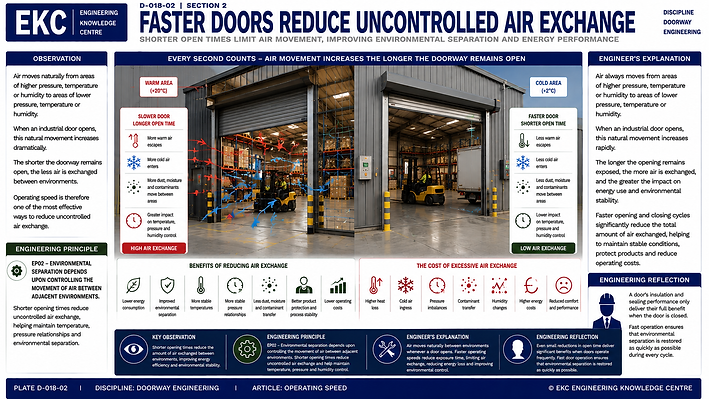
P-002 - Engineering infographic showing how faster industrial door opening and closing cycles reduce the volume of air exchanged between adjoining environments. The warehouse illustration uses airflow indicators to demonstrate movement through an open doorway, while supporting panels identify the resulting effects on temperature, pressure, humidity, contaminant transfer and energy consumption. The plate contrasts controlled, shorter-duration opening cycles with excessive air exchange and demonstrates how rapid restoration of environmental separation supports more stable internal conditions.
ENGINEERING REFLECTION
Even relatively small reductions in opening time can deliver substantial improvements when doors operate hundreds of times each day.
Operating Speed Improves Productivity
OBSERVATION
Operating speed influences not only environmental performance but also the efficiency of people, vehicles and material handling throughout the facility.
ENGINEERING PRINCIPLE
EP04 – Operational efficiency improves when engineering systems minimise unnecessary delays while maintaining safe operation.
Appropriately specified operating speeds improve traffic flow, reduce waiting times and increase operational efficiency without compromising safety.
Forklift trucks, pallet movements and vehicle traffic frequently pause while doors complete their operating cycle. Slow doors increase waiting times, reduce throughput and encourage unsafe behaviours such as tailgating or holding doors open. Engineers therefore balance operating speed with traffic intensity, safety systems and operational requirements to maximise productivity.

P003 - Engineering infographic demonstrating how industrial door operating speed affects traffic flow, waiting times and productivity. A busy warehouse environment with forklifts, personnel and material movements illustrates how slow door cycles can create bottlenecks at frequently used openings. Comparative panels show the operational benefits of faster door cycles against the consequences of slower operation, including congestion, delays, increased energy consumption and reduced productivity. The plate establishes operating speed as both an environmental and operational performance consideration.
ENGINEERING REFLECTION
An industrial door should never become a bottleneck. Well-matched operating speeds allow production and logistics to flow smoothly while maintaining environmental control.
Operating Speed Must Match the Application
OBSERVATION
The fastest industrial door is not always the most appropriate solution. Engineers select operating speeds according to building use, environmental demands and traffic characteristics.
ENGINEERING PRINCIPLE
EP01 – Engineering solutions should be optimised for their operating environment. Operating speed should be matched to the operational demands of the facility.
Door speed should be selected according to traffic frequency, environmental requirements, door size, safety systems and operational conditions.
Cold storage facilities, clean manufacturing environments and high-frequency logistics operations often benefit from very fast door cycles. Other applications may prioritise structural strength, security or wind resistance over maximum speed. Engineers therefore evaluate operational objectives before selecting the most appropriate industrial door system.

P-004 - Engineering infographic explaining why industrial door operating speed should be selected according to the requirements of the application rather than simply specifying the fastest available door. Different operating environments illustrate how traffic frequency, environmental separation, doorway size, safety requirements and operational priorities influence appropriate speed selection. Supporting comparisons show the benefits of correctly matching speed to application and the risks of incorrect specification, reinforcing the importance of balancing environmental performance, traffic flow, reliability, safety and whole-life cost.
ENGINEERING REFLECTION
Good engineering selects the correct level of performance for the application rather than simply choosing the highest available specification.
Operating Speed Supports Whole-Building Performance
OBSERVATION
Operating speed contributes to the effectiveness of the complete environmental control strategy and should be considered alongside insulation, airtightness, pressure management and HVAC systems.
ENGINEERING PRINCIPLE
EP03 – Building systems achieve optimum performance when every engineering component contributes effectively to the objectives of the complete building system.
Industrial door operating speed should be integrated with building environmental control systems to maximise energy efficiency, operational reliability and whole-life performance.
Operating speed interacts continuously with heating, ventilation, air conditioning, building pressure control, traffic management and automation systems. Engineers therefore assess door speed as one element of an integrated environmental strategy rather than an isolated product specification. This coordinated approach reduces energy consumption, improves internal stability, enhances operational efficiency and lowers long-term operating costs while supporting the performance of the entire building.

P-005 - Engineering infographic presenting industrial door operating speed as one component of a coordinated environmental control strategy. A detailed warehouse cutaway identifies the interaction between rapid door operation, thermal insulation, airtightness, pressure management and HVAC systems. Airflow and heat movement annotations demonstrate how these systems work together to reduce uncontrolled air exchange, maintain stable internal conditions and limit energy loss. The plate reinforces the principle that effective environmental control depends upon the integration of individual building systems rather than the performance of any single component in isolation.
ENGINEERING REFLECTION
Fast door operation delivers its greatest value when combined with effective insulation, airtightness, pressure control and intelligent building management. Together these systems create a more efficient, productive and resilient industrial building.
ENGINEERING BAR
At A Glance

Discipline
Industrial Doorway Engineering

Category
Engineering Characteristics

Reading time
9
mins

Last reviewed
August
In This Article
Operating Speed Determines Doorway Exposure Time
Faster Doors Reduce Uncontrolled Air Exchange
Operating Speed Improves Productivity
Operating Speed Must Match the Application
Operating Speed Supports Whole-Building Performance
Continue Reading
→
This is a title. Click here
→
This is a title. Click here .
→
This is a title. Click here
Key Takeway
Operating speed determines how long an industrial doorway remains open, making it one of the most important factors affecting environmental control, energy efficiency and operational productivity.
Reading Tip
Click any engineering plate to view it full size.
Engineering Summary Plate

Shows how pressure-driven airflow continues while an industrial doorway remains open, demonstrating why reducing opening duration limits cumulative air exchange, energy loss and environmental disturbance while improving building performance.
Engineering Summary
Operating speed affects how long a doorway remains open during each cycle. Faster operation can limit air exchange and keep frequent traffic moving, but the fastest door is not always the right specification. Engineers assess traffic intensity, environmental requirements, safety and reliability before selecting from the high-speed door range for a particular opening.