

Air movement through a typical industrial doorway.
This figure illustrates the principal paths through which uncontrolled airflow can influence heat loss and environmental conditions.
D-004
BALANCING ACCESS WITH ENVIRONMENTAL CONTROL
Every industrial doorway represents a compromise between two competing engineering objectives. On one hand, buildings require rapid, unrestricted access for vehicles, goods and personnel to support efficient operations. On the other, they must maintain stable internal temperatures, pressure relationships, cleanliness and environmental conditions. Every door opening temporarily weakens the building envelope, allowing heat, air and contaminants to move between environments. Effective doorway engineering therefore seeks to minimise these unavoidable losses without restricting operational activity. This article examines how engineers balance access requirements with environmental control to achieve efficient, productive and energy-conscious industrial buildings.
Industrial buildings cannot function without movement. Raw materials arrive, finished products leave, vehicles circulate and people move continuously throughout the working day. Every doorway must therefore accommodate operational access while simultaneously maintaining the environmental conditions required by the building. These objectives often conflict because increasing accessibility generally increases heat loss, air exchange and pressure disturbance. Engineers resolve this challenge by considering doorway size, opening frequency, operating speed, traffic patterns, environmental separation and control strategies together rather than independently. Understanding how these competing requirements interact enables industrial door systems to support both operational productivity and effective environmental control without unnecessary compromise.
Access and Environmental Control Must Coexist
OBSERVATION
Every industrial doorway exists to allow the movement of people, vehicles and goods. However, every opening also temporarily interrupts the building envelope, allowing heat, air, pressure and contaminants to move between environments.
ENGINEERING PRINCIPLE
EP08 - Effective industrial doorway engineering balances operational access with environmental control to optimise whole-building performance.
Industrial doorways should be designed to support operational productivity while minimising unnecessary environmental disturbance.
Industrial buildings cannot operate without movement. Vehicles, personnel and materials must pass through doorways continuously, yet every opening reduces environmental separation. Good engineering does not attempt to eliminate doorway movement but instead seeks to reduce its impact through appropriate door selection, operating speed, control systems and building design.

P-001 A detailed engineering infographic illustrating how industrial doorways must balance operational access with environmental control. A central cutaway warehouse shows an open industrial doorway connecting external and internal environments, with airflow arrows demonstrating the movement of heat, air, pressure, moisture and contaminants. Observation, Engineering Principle, Engineer's Explanation and Engineering Reflection panels explain that every doorway opening temporarily interrupts the building envelope. Supporting engineering icons highlight operational access, environmental impact, engineering solutions, balanced design and improved building performance.
ENGINEERING REFLECTION
How effectively do your industrial doorways balance the need for operational access with maintaining stable internal environmental conditions?
Every Door Opening Has an Environmental Cost
OBSERVATION
Whenever an industrial door opens, conditioned internal air and external air begin to mix. The greater the opening, the longer it remains open and the larger the temperature or pressure difference, the greater the environmental disturbance.
ENGINEERING PRINCIPLE
EP09 - Every industrial door opening creates environmental exchange that should be minimised through good engineering.
Doorway operation should minimise unnecessary heat transfer, air movement and environmental disruption while maintaining operational effectiveness.
Each opening permits heat transfer, uncontrolled airflow, pressure equalisation, moisture movement and contaminant ingress. Although these effects cannot be eliminated completely, engineers reduce their magnitude by selecting appropriate doorway systems, increasing operating speed and reducing unnecessary opening duration.

P-002 A technical engineering infographic explaining that every industrial door opening has an environmental cost. The warehouse cutaway illustrates the exchange of conditioned internal air and external air through an open loading bay, with airflow arrows identifying heat transfer, pressure equalisation, moisture ingress and contaminant movement. Engineering panels explain how opening size, duration, temperature difference, pressure difference and opening frequency influence environmental losses, while demonstrating how engineering solutions reduce unnecessary energy consumption and environmental disturbance.
ENGINEERING REFLECTION
Are your industrial doorways opening only when operationally necessary, or are unnecessary openings increasing environmental losses?
Operational Efficiency and Environmental Efficiency Are Connected
OBSERVATION
Improving operational flow often improves environmental performance because faster, more efficient movement reduces the time that doorways remain open.
ENGINEERING PRINCIPLE
EP10 - Efficient operational movement often delivers improved environmental performance.
Doorway engineering should improve operational throughput while simultaneously reducing environmental exposure.
Reducing waiting times, eliminating unnecessary delays and improving traffic flow all reduce door opening duration. High-speed industrial doors, intelligent controls and well-planned traffic routes allow buildings to maintain productivity while reducing heat loss and air exchange.

P-003 A professional engineering infographic comparing inefficient and efficient industrial operations to demonstrate the relationship between operational efficiency and environmental performance. Side-by-side warehouse illustrations show how reduced waiting times, improved traffic flow, high-speed doors and intelligent controls shorten door opening times and reduce environmental exposure. Supporting engineering panels explain that smoother operations reduce heat loss, air movement and energy consumption while simultaneously improving productivity, environmental stability and operational efficiency.
ENGINEERING REFLECTION
Could changes to traffic management or doorway operation improve both productivity and environmental performance simultaneously?
Engineering Is About Optimising the Balance
OBSERVATION
Completely eliminating environmental losses would require permanently closed doorways, while unrestricted access would leave buildings permanently open. Neither extreme supports efficient industrial operation.
ENGINEERING PRINCIPLE
EP11 - Industrial doorway engineering seeks the optimum balance rather than maximising a single performance characteristic.
Successful doorway engineering balances operational access, energy efficiency, environmental control, safety and cost to achieve the best overall building performance.
Engineers rarely optimise only one engineering objective. Instead, they balance competing requirements by considering doorway size, operating speed, insulation, sealing, reliability, safety systems and lifecycle costs together. The optimum solution depends upon the operational needs of the individual building.
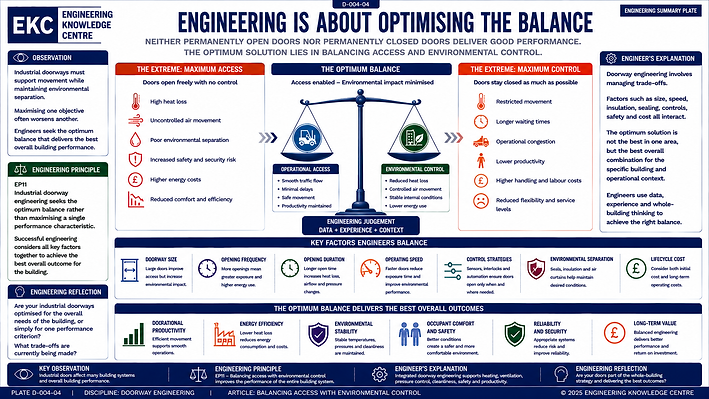
P-004 A detailed engineering infographic illustrating that successful industrial doorway engineering is achieved by optimising the balance between operational access and environmental control. A central balance scale compares the consequences of maximising unrestricted access with those of excessive environmental restriction, demonstrating that the optimum engineering solution lies between these extremes. Supporting engineering panels identify key design considerations including doorway size, opening frequency, operating speed, environmental separation, control strategies and lifecycle cost, showing how balanced engineering improves productivity, energy efficiency, environmental stability, safety and long-term building performance.
ENGINEERING REFLECTION
Are your industrial doorways optimised for the overall needs of the building, or simply for one performance criterion?
Whole-Building Performance Depends on Balanced Engineering
OBSERVATION
Industrial buildings perform most efficiently when doorway engineering supports both operational activity and environmental control simultaneously.
ENGINEERING PRINCIPLE
EP12 - Balancing access with environmental control improves the performance of the entire building system.
Industrial doorway engineering should contribute positively to operational productivity, environmental stability and long-term building efficiency.
When industrial doors are selected using a systems engineering approach, they support heating systems, ventilation strategies, pressure control, environmental separation and operational workflows. Rather than compromising one objective to improve another, engineering-led specification enables the building to perform efficiently across multiple operational and environmental requirements.

P-005 A professional engineering infographic illustrating how balanced industrial doorway engineering improves the performance of the entire building system. A detailed cutaway warehouse occupies the centre of the plate, showing industrial roller shutters, pallet racking, forklift operations, loading activities, office accommodation and heating equipment. Engineering callouts demonstrate how doorway performance influences thermal efficiency, airflow control, pressure management, cleanliness, safety, operational flow and energy systems. Observation, Engineering Principle, Engineer's Explanation and Engineering Reflection panels reinforce that industrial doors should be engineered as integrated components of the whole building rather than as isolated products. A lower engineering bar summarises the measurable benefits of a systems-based approach, including improved productivity, lower energy use, greater environmental stability, enhanced safety, reduced lifecycle costs and long-term building performance.
ENGINEERING REFLECTION
If industrial doors were engineered as part of the complete building system rather than as individual products, how much could overall building performance improve?
ENGINEERING BAR
At A Glance

Discipline
Industrial Doorway Engineering

Category
Engineering Fundamentals

Reading time
6
mins

Last reviewed
August
In This Article
Access and Environmental Control Must Coexist
Every Door Opening Has an Environmental Cost
Operational Efficiency and Environmental Efficiency Are Connected
Engineering Is About Optimising the Balance
Whole-Building Performance Depends on Balanced Engineering
Continue Reading
→
This is a title. Click here
→
This is a title. Click here .
→
This is a title. Click here
Key Takeway
Successful industrial doorway engineering balances unrestricted operational access with controlled environmental separation, ensuring buildings remain productive while minimising unnecessary heat loss, air movement and environmental disturbance.
Reading Tip
Click any engineering plate to view it full size.
Engineering Summary Plate

Shows how temperature, pressure, ventilation, heating and doorway operation influence airflow within industrial buildings, demonstrating how effective air distribution improves environmental consistency, occupant comfort, process performance and energy efficiency.
Engineering Summary
Industrial doorways perform two essential but competing functions. They must permit efficient movement of people, vehicles and goods while preserving the building's thermal performance, pressure stability and environmental conditions. Engineers achieve this balance by considering operational requirements alongside environmental objectives during the specification process. Factors including doorway size, opening frequency, opening duration, traffic density, operating speed and control methods all influence overall performance. Rather than eliminating doorway movement, good engineering reduces its environmental impact. Properly specified industrial doors improve energy efficiency, environmental stability, occupant comfort and operational productivity while supporting the wider performance objectives of the building.