

Air movement through a typical industrial doorway.
This figure illustrates the principal paths through which uncontrolled airflow can influence heat loss and environmental conditions.
D-003
DOORWAY ENGINEERING
Industrial doors perform far more than the simple task of allowing vehicles and people to enter or leave a building. Every opening influences heat transfer, airflow, pressure relationships, environmental separation, operational efficiency and the performance of other building systems. Yet industrial doors are frequently selected as individual products rather than as engineered components within the wider building envelope. This article explains why industrial doors should be viewed as integrated engineering systems whose specification, installation, operation and maintenance directly influence the overall performance of industrial buildings. Understanding their true engineering role provides the foundation for better design, improved efficiency and more effective environmental control.
Industrial buildings depend upon numerous engineering systems working together to achieve safe, efficient and reliable operation. Industrial doors form an important part of this integrated system, connecting operational requirements with environmental performance. Every opening influences heat movement, air exchange, pressure balance, security, traffic flow and the effectiveness of heating and ventilation systems. Consequently, the engineering characteristics of an industrial door extend well beyond its physical construction or opening mechanism. Engineers therefore evaluate industrial doors as complete engineered systems that contribute to overall building performance. Appreciating this broader engineering role allows better specification, improved operational efficiency and more informed investment decisions throughout the building lifecycle.
Industrial Doors Are Engineering Components
OBSERVATION
Industrial doors are often regarded simply as access points for vehicles and personnel. In reality, they are engineered components that directly influence the performance of the building envelope every time they operate.
ENGINEERING PRINCIPLE
EP03 — Industrial doors are engineered building systems whose performance extends far beyond providing physical access.
Industrial doors should be considered engineered building systems rather than standalone products. Their specification, operation and integration influence both building performance and operational efficiency
Every industrial door performs multiple engineering functions simultaneously. While providing access, it also controls the movement of heat, air, moisture, contaminants, noise and pressure between environments. The quality of these functions depends upon the engineering characteristics of the complete door system rather than simply its ability to open and close.

P-001 A professional engineering infographic illustrating that industrial doors are engineered building systems rather than simple access points. A detailed warehouse cutaway identifies the multiple engineering functions performed by an industrial door, including thermal control, air and pressure management, environmental separation, security, traffic management, operational performance and energy efficiency. Observation, Engineering Principle, Engineer's Explanation and Engineering Reflection panels explain how industrial doors influence overall building performance and should be specified as integral engineering components.
ENGINEERING REFLECTION
If an industrial door contributes to thermal performance, environmental separation and operational efficiency, should it be specified as an engineering system rather than simply an access product?
Every Door Performs Multiple Engineering Functions
OBSERVATION
A single industrial doorway may simultaneously provide security, environmental separation, traffic management, safety and operational access.
ENGINEERING PRINCIPLE
EP04 — Every industrial door performs multiple engineering functions simultaneously, requiring a balanced approach to design and specification.
Effective industrial door design requires balancing multiple engineering functions rather than optimising only one aspect of performance.
How many different engineering functions does each industrial doorway perform within your own facility?

P-002 A detailed engineering infographic demonstrating that every industrial door performs numerous engineering functions simultaneously. The warehouse illustration highlights security, thermal control, air and pressure control, environmental separation, noise reduction, safety, operational access, structural performance, traffic management and energy efficiency. The accompanying engineering panels explain that successful doorway design requires balancing multiple engineering requirements to achieve optimum overall building performance.
ENGINEERING REFLECTION
No industrial door performs only one task. Opening speed influences energy efficiency, insulation influences heat transfer, sealing affects air leakage, structural strength resists wind loading, while safety systems protect people and vehicles. Good engineering balances these competing requirements to achieve the overall performance demanded by the application.
Industrial Doors Influence Building Systems
OBSERVATION
The performance of heating, cooling, ventilation and environmental control systems is directly affected by industrial door operation.
ENGINEERING PRINCIPLE
EP05 — Industrial doorway performance directly influences the operation and efficiency of the wider building engineering systems.
Industrial doors should be engineered as part of the overall building system because their operation affects the performance of many other building services.
Each door opening changes internal conditions that heating, ventilation and cooling systems must respond to. Poor doorway performance increases system demand, while well-designed doors reduce unnecessary environmental disturbance and improve the effectiveness of the building's engineering services.
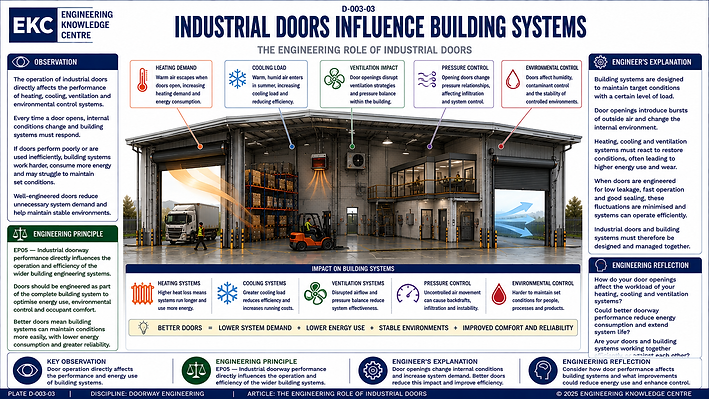
P-003 A technical engineering infographic explaining how industrial door operation influences the performance of wider building engineering systems. The warehouse cutaway identifies heating, cooling, ventilation, pressure control and environmental control systems, showing how every doorway opening changes internal building conditions. Engineering panels describe how well-designed industrial doors reduce unnecessary system demand, improve energy efficiency and help maintain stable environmental conditions.
ENGINEERING REFLECTION
Could improving doorway performance reduce the workload placed upon other building systems?
Engineering Performance Extends Beyond the Door Itself
OBSERVATION
The performance delivered by an industrial door depends not only upon the product itself but also upon its installation, controls, operation and maintenance.
ENGINEERING PRINCIPLE
EP06 — The performance of an industrial doorway depends upon the complete engineered system rather than the door leaf alone.
Overall doorway performance is determined by the complete engineered system rather than by the physical door alone.
Door leaves, guides, seals, drive systems, control equipment, sensors, activation methods and maintenance all contribute to engineering performance. Weakness in any part of the system can reduce overall effectiveness, regardless of the quality of the door itself.

P-004 A detailed engineering infographic illustrating that industrial doorway performance depends upon the complete engineered system rather than the door leaf alone. The warehouse cutaway identifies ten critical system components including the door leaf, guides, seals, drive system, controls, safety devices, activation equipment, structural opening, installation quality and maintenance. The engineering panels explain that every component contributes to overall reliability, thermal performance, safety and operational efficiency.
ENGINEERING REFLECTION
Are your industrial doors being evaluated as complete engineered systems or simply as individual products?
Engineering Solutions Deliver Better Building Performance
OBSERVATION
The greatest operational improvements are often achieved when industrial doors are selected as part of a wider engineering strategy rather than as isolated purchases.
ENGINEERING PRINCIPLE
EP07 — Industrial doors achieve their greatest value when selected as integrated engineering solutions that support the operational objectives of the entire building.
Industrial doors deliver maximum value when their engineering characteristics are matched to the operational requirements of the complete building system.
Selecting the correct industrial door involves understanding building usage, traffic flow, environmental conditions, energy objectives, pressure relationships and operational priorities. Engineering-led selection ensures that doorway performance supports the wider objectives of the building rather than compromising them.

P-005 A professional engineering infographic demonstrating how engineering-led doorway selection improves whole-building performance. The central warehouse illustration is supported by a systems-based engineering process that considers building use, operational requirements, environmental conditions, airflow, pressure, safety, sustainability and lifecycle costs before selecting the appropriate industrial door solution. The infographic concludes by showing how an integrated engineering approach delivers improved energy efficiency, reliability, environmental control and long-term operational performance.
ENGINEERING REFLECTION
Rather than asking "Which industrial door should we buy?", would a better engineering question be "What doorway performance does this building actually require?"
ENGINEERING BAR
At A Glance

Discipline
Industrial Doorway Engineering

Category
Engineering Fundamentals

Reading time
6
mins

Last reviewed
August
In This Article
Industrial Doors Are Engineering Components
Every Door Performs Multiple Engineering Functions
Industrial Doors Influence Building Systems
Engineering Performance Extends Beyond the Door Itself
Engineering Solutions Deliver Better Building Performance
Continue Reading
→
This is a title. Click here
→
This is a title. Click here .
→
This is a title. Click here
Key Takeway
Industrial doors are engineered building systems whose performance influences the entire building. Effective doorway design balances operational access with thermal performance, environmental control, safety and long-term operational efficiency.
Reading Tip
Click any engineering plate to view it full size.
Engineering Summary Plate

Illustrates how engineers balance unrestricted operational access with environmental separation by considering doorway size, opening frequency, operating speed and controls to reduce heat loss, airflow and unnecessary energy consumption.
Engineering Summary
Industrial doors should not be regarded as isolated access products. They are integral components of the building envelope that influence multiple engineering systems simultaneously. Their performance affects thermal efficiency, airflow, pressure relationships, environmental separation, traffic movement, safety, security and operational reliability. The effectiveness of an industrial doorway depends upon the complete engineered system, including controls, sealing, installation and maintenance, rather than the door leaf alone. Selecting industrial doors as part of a wider engineering strategy enables better environmental performance, lower operating costs and improved lifecycle value for the building as a whole.