

Air movement through a typical industrial doorway.
This figure illustrates the principal paths through which uncontrolled airflow can influence heat loss and environmental conditions.
B-014
COMPARING BUILDING IMPROVEMENT OPTIONS
Once a building assessment has identified opportunities for improvement, the next challenge is deciding where investment will deliver the greatest overall benefit. Industrial buildings rarely suffer from a single inefficiency, and no individual technology provides the answer to every problem. Professional engineers therefore compare alternative improvement options by considering technical performance, operational impact, installation practicality, lifecycle costs and expected return on investment. By evaluating each measure within the context of the whole building, they develop balanced recommendations that maximise long-term performance, improve environmental control and ensure capital investment is directed towards the improvements that deliver the greatest engineering value.
Most industrial buildings contain several opportunities to improve energy performance, environmental control and operational efficiency. Better insulation, improved airtightness, faster industrial doors, heating upgrades, ventilation improvements and control systems can all contribute to better building performance. The challenge is determining which improvements should be implemented first.
Professional engineers avoid assuming that one technology provides the answer to every problem. Instead, each potential improvement is evaluated within the context of the whole building, considering technical performance, operational requirements, installation practicality and expected return on investment. This systematic comparison enables investment decisions to be based upon engineering evidence rather than assumptions.
Every Building Has Different Priorities
OBSERVATION
Two industrial buildings can appear to require exactly the same improvement, yet deliver very different results following identical investments. One facility may benefit most from improving insulation, while another achieves greater savings by reducing air leakage or improving door performance. Engineers therefore avoid assuming that a single technology provides the best solution without first understanding how the building performs as an integrated system.
ENGINEERING PRINCIPLE
EP03 – Industrial buildings function as integrated systems.
Industrial buildings lose energy through many different mechanisms, including conduction, air leakage, ventilation, operational practices and process activity. These losses rarely occur independently and often influence one another. Improving one aspect of building performance may significantly alter the effectiveness of another.
Professional engineers therefore compare improvement options by considering the complete building rather than focusing on isolated components. The objective is to identify the combination of measures that delivers the greatest overall improvement in performance.
Professional engineering begins with diagnosis before prescription. Every recommendation should be supported by evidence gathered during assessment, ensuring that investment addresses the causes of poor performance rather than merely treating its symptoms.

P-001 This plate illustrates that industrial buildings with similar external appearances may require entirely different improvement strategies. Using a warehouse cutaway, it demonstrates how objective assessment identifies the building's most significant performance limitations before engineering solutions are selected, reinforcing the principle that buildings should be evaluated as integrated systems rather than collections of individual components.
ENGINEERING REFLECTION
Engineering decisions become more effective when solutions are selected to address the building's greatest sources of inefficiency rather than simply adopting the latest technology.
Balancing Performance Against Investment
OBSERVATION
Many building improvements provide measurable benefits, but not all produce the same level of return on investment. Some require relatively modest expenditure while delivering rapid energy savings, whereas others involve larger capital costs that produce benefits over many years. Understanding this balance enables engineers to prioritise investment effectively.
ENGINEERING PRINCIPLE
EP09 – Effective engineering prioritises improvements that deliver the greatest overall benefit.
An improvement that delivers the greatest energy saving is not always the most appropriate first investment. Engineers compare installation costs, expected operational savings, maintenance requirements, equipment lifespan and operational disruption before determining priorities.
Lifecycle thinking enables improvements to be evaluated over many years rather than considering only their initial purchase cost.
Professional engineers evaluate improvements by considering total ownership costs together with operational benefits. This broader perspective helps organisations invest in solutions that continue delivering value throughout the life of the building.
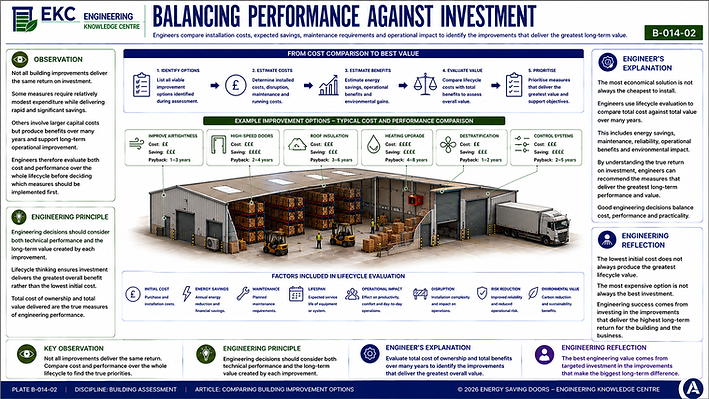
P-002 This plate explains how engineers compare the performance and lifecycle value of alternative building improvements rather than considering installation cost alone. The warehouse illustration is supported by examples of typical engineering measures, showing how investment decisions are prioritised by balancing operational benefits, maintenance requirements, expected savings and long-term value.
ENGINEERING REFLECTION
The lowest-cost solution is not necessarily the most economical, just as the highest-performing technology may not always represent the greatest engineering value.
Understanding How Improvements Work Together
OBSERVATION
Building improvements rarely operate independently. Improving airtightness may reduce heating demand, while installing faster industrial doors can enhance the effectiveness of heating, ventilation and environmental control systems. Engineers therefore examine how improvements interact rather than assessing each measure in isolation.
ENGINEERING PRINCIPLE
EP11 – Engineering solutions should optimise overall system performance rather than individual components.
Buildings behave as integrated systems in which changes to one element frequently influence the performance of another. Reducing air leakage may improve heating efficiency, while better insulation may reduce equipment operating hours. Similarly, improved door performance can support environmental control throughout the building.
Considering these interactions enables engineers to produce coordinated improvement programmes that achieve greater overall performance.
Engineering optimisation involves understanding relationships between building systems. By coordinating improvements rather than implementing isolated projects, engineers maximise overall building performance.

P-003 This plate demonstrates that building improvements rarely operate independently. Through an annotated warehouse illustration, it shows how measures such as insulation, airtightness, heating systems, controls and industrial doors interact to improve overall building performance, emphasising that coordinated engineering strategies often deliver greater benefits than isolated improvements.
ENGINEERING REFLECTION
The combined benefit of several complementary improvements often exceeds the sum of their individual contributions.
Matching Improvements To Operational Requirements
OBSERVATION
Operational priorities differ between organisations. A refrigerated warehouse, pharmaceutical facility, manufacturing plant and logistics depot may all occupy similar buildings, yet each requires different environmental conditions and operational performance. Successful engineering recommendations therefore reflect how the building is actually used.
ENGINEERING PRINCIPLE
EP04 – Industrial buildings continually respond to operational activity.
Every improvement should be evaluated against operational requirements including production processes, occupancy patterns, traffic movements, environmental conditions, maintenance resources and future business plans.
By aligning engineering recommendations with operational priorities, engineers ensure that improvements deliver measurable business value alongside technical performance.
Professional engineers balance technical performance with operational practicality, ensuring that recommended improvements enhance productivity, reliability and environmental control without compromising day-to-day operations.

P-004 This plate illustrates how engineering improvements should be matched to the operational requirements of each facility. Using a warehouse cutaway and operational overlays, it demonstrates how occupancy, production processes, traffic movements, environmental conditions and future business requirements influence engineering decision-making and investment priorities.
ENGINEERING REFLECTION
Buildings exist to support the activities taking place within them. Successful engineering improves both the building and the business it serves.
Creating A Prioritised Improvement Programme
OBSERVATION
Professional engineers rarely recommend a single improvement in isolation. Instead, they develop phased programmes that allow organisations to implement improvements progressively, balancing available budgets with long-term objectives while continually reviewing building performance.
ENGINEERING PRINCIPLE
EP09 – Effective engineering prioritises improvements that deliver the greatest overall benefit.
Following a comprehensive assessment, engineers compare the technical, operational and financial merits of each potential improvement before establishing priorities. Early actions often focus on measures that deliver rapid returns, while larger capital projects can be planned as part of longer-term investment strategies.
This phased approach enables organisations to improve building performance in a structured and evidence-based manner.
Prioritisation transforms technical assessment into practical action. By implementing improvements in a logical order, organisations maximise available resources while continuously improving the performance, efficiency and resilience of their industrial buildings.

P-005 This plate explains how engineers transform assessment findings into a structured programme of phased improvements. The warehouse illustration supports a prioritised improvement roadmap, demonstrating how organisations can implement quick wins, medium-term projects and long-term investments while continually reviewing performance and refining future engineering decisions.
ENGINEERING REFLECTION
Successful engineering strategies are built through a sequence of informed decisions rather than a single investment.
ENGINEERING BAR
At A Glance

Discipline
Building Assessment

Category
Engineering Decision Making

Reading time
8
mins

Last reviewed
July
In This Article
Every Building Has Different Priorities
Balancing Performance Against Investment
Understanding How Improvements Work Together
Matching Improvements To Operational Requirements
Creating A Prioritised Improvement Programme
Continue Reading
→
This is a title. Click here
→
This is a title. Click here .
→
This is a title. Click here
Key Takeway
The best engineering solution is rarely a single product. It is the combination of improvements that delivers the greatest overall performance for the building.
Reading Tip
Click any engineering plate to view it full size.
Engineering Summary Plate

Shows how engineers transform assessment evidence into prioritised improvement strategies, balancing performance, cost, risk and practicality to create phased programmes that improve energy efficiency, comfort, reliability and long-term building performance.
Engineering Summary
Professional building assessment continues beyond identifying problems. Engineers compare alternative solutions, evaluate interactions between improvements and prioritise investment according to measurable performance, operational benefit and long-term engineering value.